Is 2026 going to be the year that you finally get to the #1 position in Google for your law firm’s main keywords?
SEO for lawyers helps you do that. And, with over one-third of potential clients searching online first for an attorney, cracking SEO is vital for growing your firm.
These days, however, law firm SEO is about much more than keywords. More than ever, firms need to display credibility, expertise, trustworthiness, and authority so that both humans and machines can understand their content.
In this guide to SEO for lawyers, you’ll discover the strategies to propel you to #1 and attract new clients.
Remember, only 0.63% of users click on Google page two, so a #25 ranking simply won’t do.
You don’t need to be a digital marketing expert but investing a little time into understanding how SEO for law firms works can pay handsome dividends.
So, let’s get straight into it.
SEO (Search Engine Optimization) for lawyers is the process of improving the visibility of your law firm’s website in the search engines.
Google captures approximately 89-92% of all search queries worldwide, so when we’re talking about optimizing for the search engines, we mean optimizing for Google.
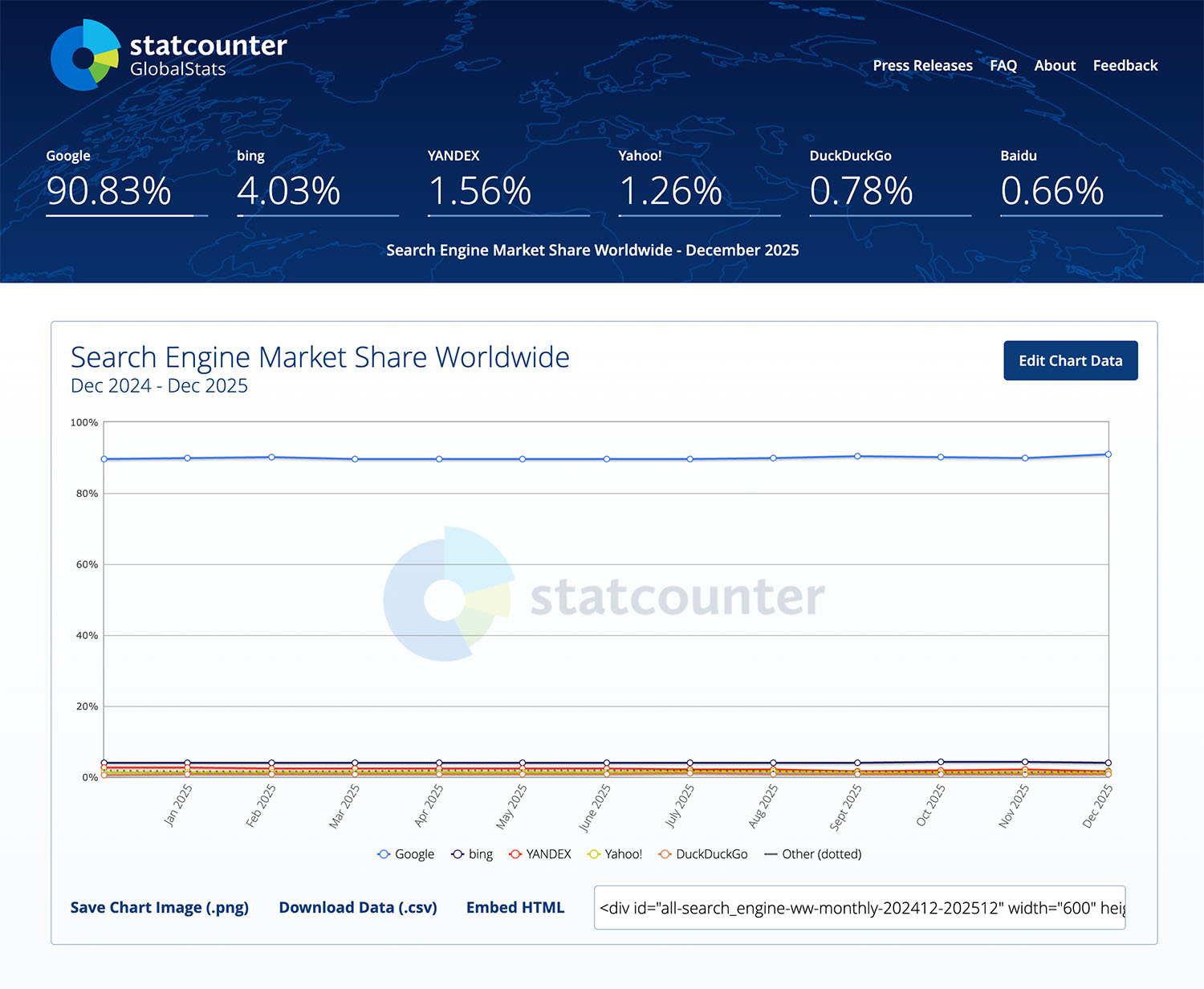
Ultimately, if you implement the strategies that improve your law firm website’s visibility on Google, you’ll increase the quantity and improve the quality of traffic to your website. This will grow the number of leads you get. That’s the name of the game, in a nutshell.
How does SEO work?
Law firm SEO works by combining actions taken on your website with off-site strategies that make it easier for Google to associate your website with the search terms you target. Google will then promote your website’s relevance and authority in your practice area.
A comprehensive approach to SEO for lawyers combines the following strategies, which we go into deeply in this article:
- Content marketing.
- On-site optimization of webpages.
- Link building and citation building.
- Local SEO strategies, including Google Business Profile optimization.
- Measurement and reporting.
If you “do” SEO correctly, it will rapidly grow your law firm’s lead numbers, especially if you’ve mainly been relying on referrals in the past.
Why is law firm SEO important?
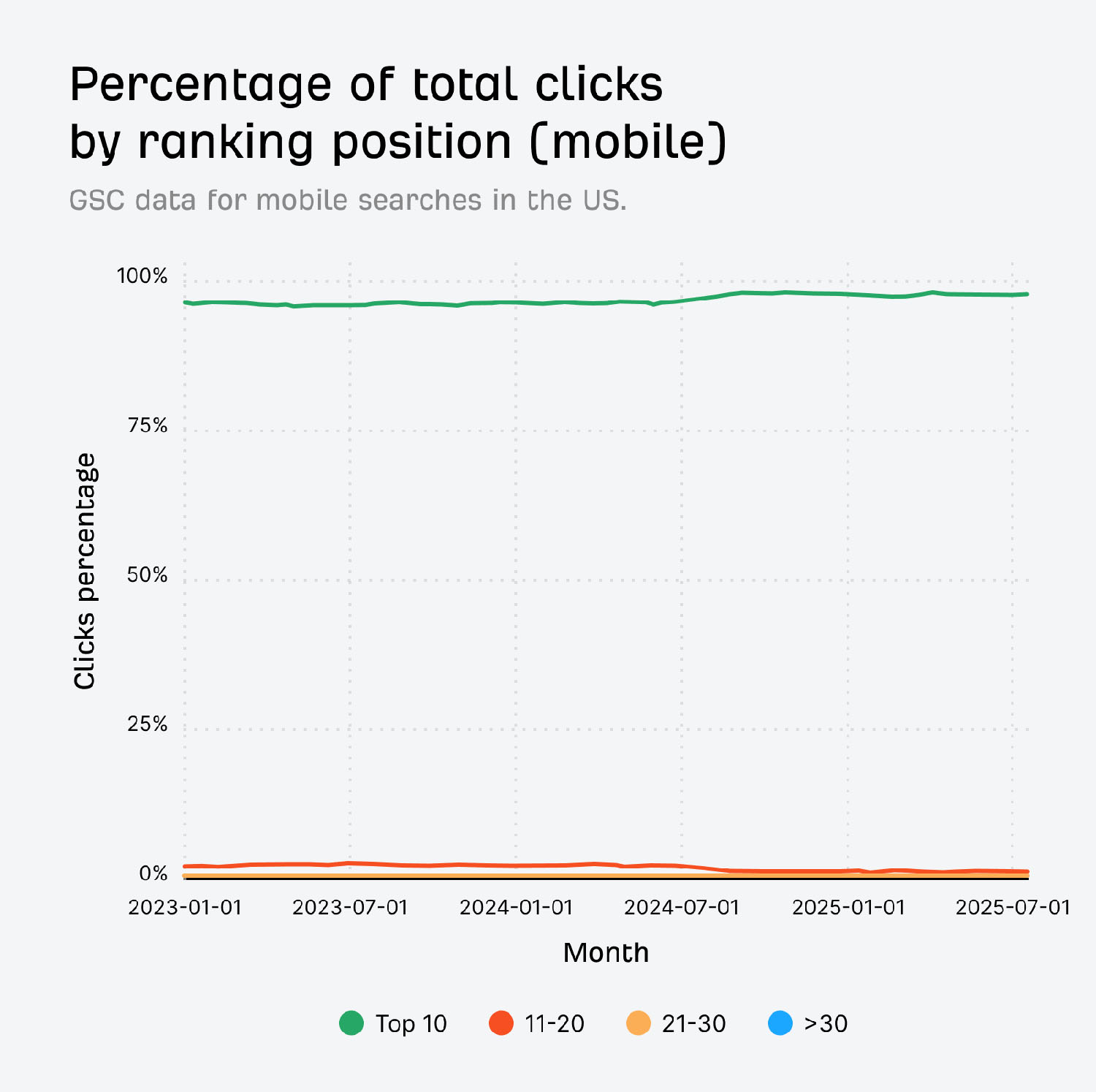
SEO authority site, Ahrefs, reports that 96.98% of mobile clicks occur in Google’s top 10 organic results (only slightly lower for desktop). Positions 11-20 capture less than 2%.
So, law firms can forget about receiving significant traffic to their website unless they rank on page one of Google.
This graph for mobile search explains it in stark terms:
This personal injury law firm in Los Angeles (a highly competitive market) increased its monthly website visitors from a thousand sessions per month, up to 14,000 per month all be increasing its visibility on the first page of Google’s search results.
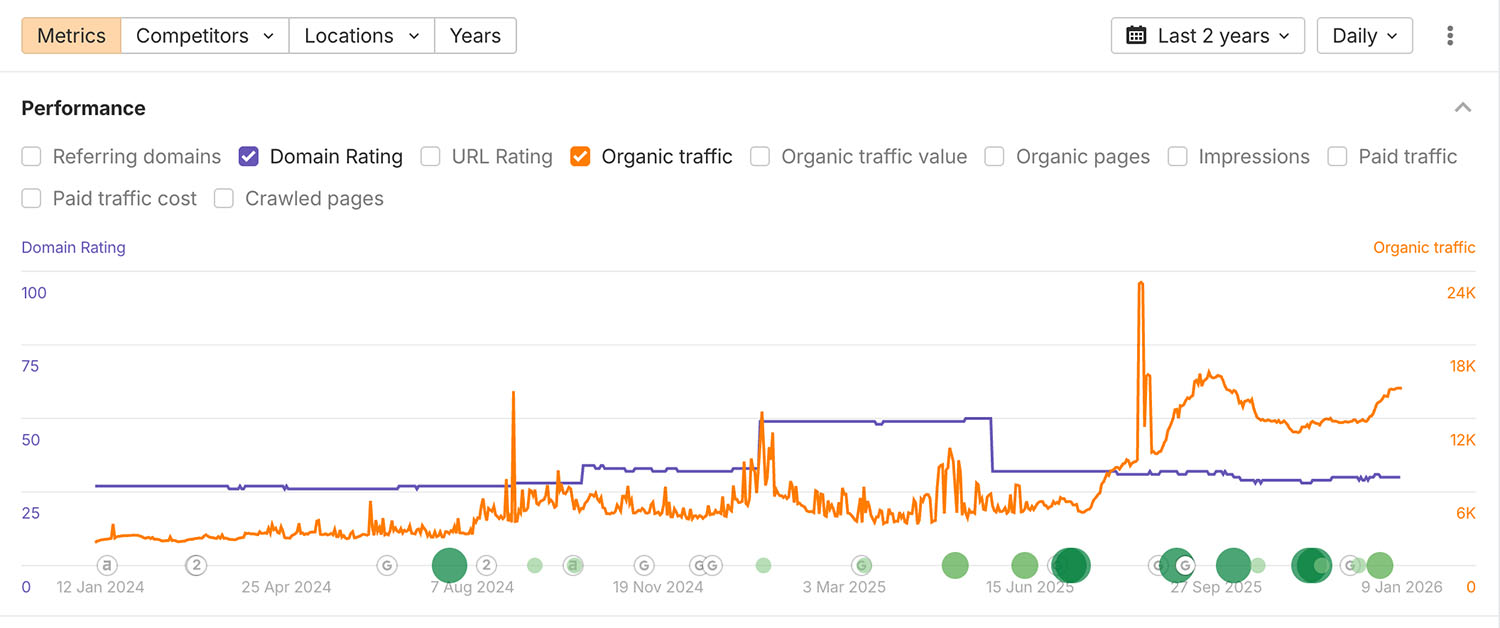
You can achieve similar results regardless of your location or practice area.
This criminal defence law firm dominates search results for competitive terms like “criminal defence lawyer in Calgary.”
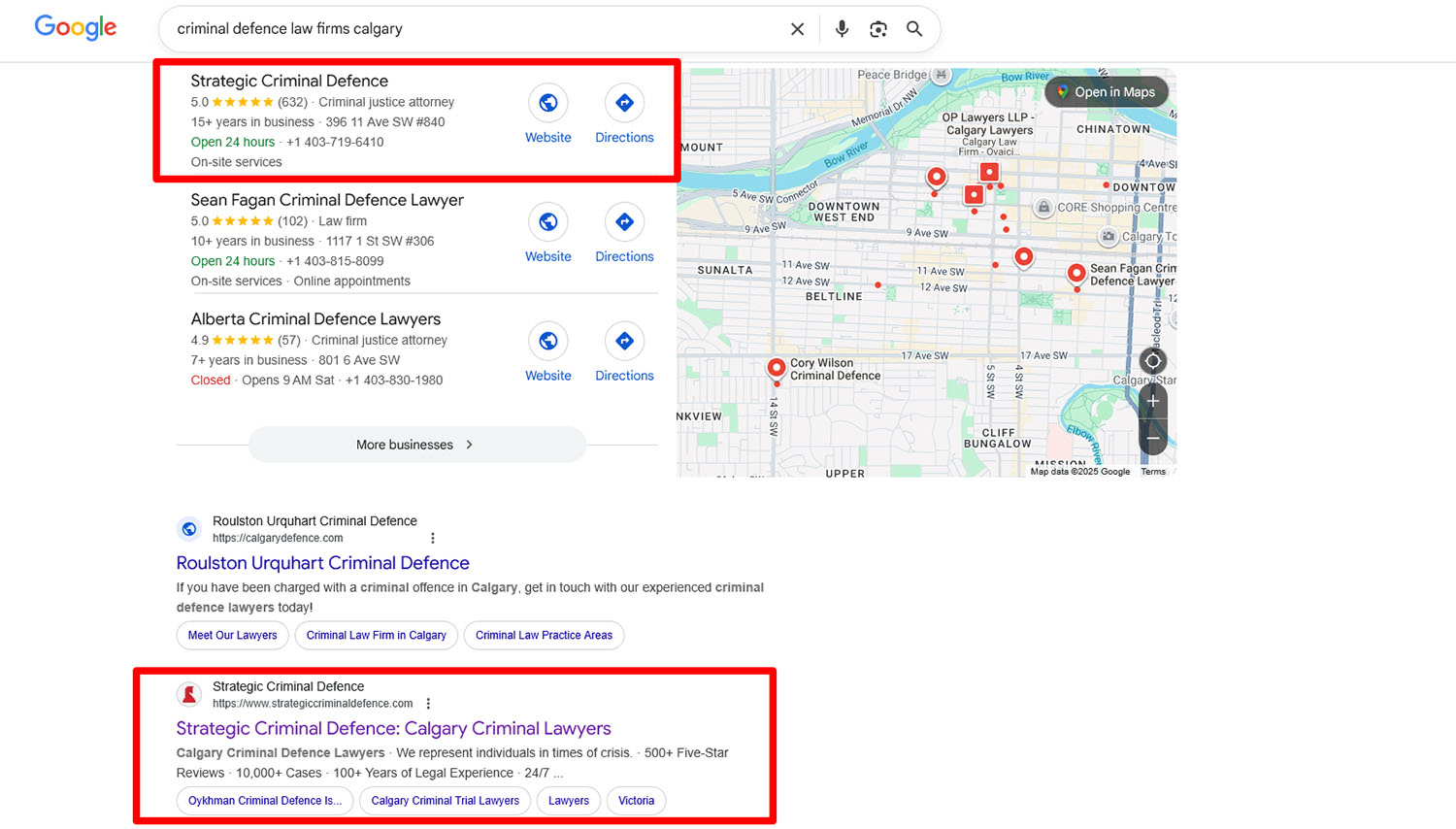
With up to 80% of all traffic to law firm websites originating from organic searches, the importance of SEO for lawyers should be clear if you’re looking to grow your practice.
What’s happening in the world of law firm SEO?
If you get it right, law firm SEO remains one of the most cost-effective forms of law firm marketing out there, with an impressive return on investment.
The world of SEO is being disrupted somewhat by AI (see next section), but we still see tried and trusted SEO methods working every day with our clients.
In 2026, we particularly need to focus on four areas:
- Adapting to AI-driven search changes.
- Optimizing locally.
- Developing more user-centric content.
- Demonstrating EEAT (Experience, Expertise, Authoritativeness & Trustworthiness).
We cover these areas in detail below.
You would have to be offline permanently not to have noticed this:
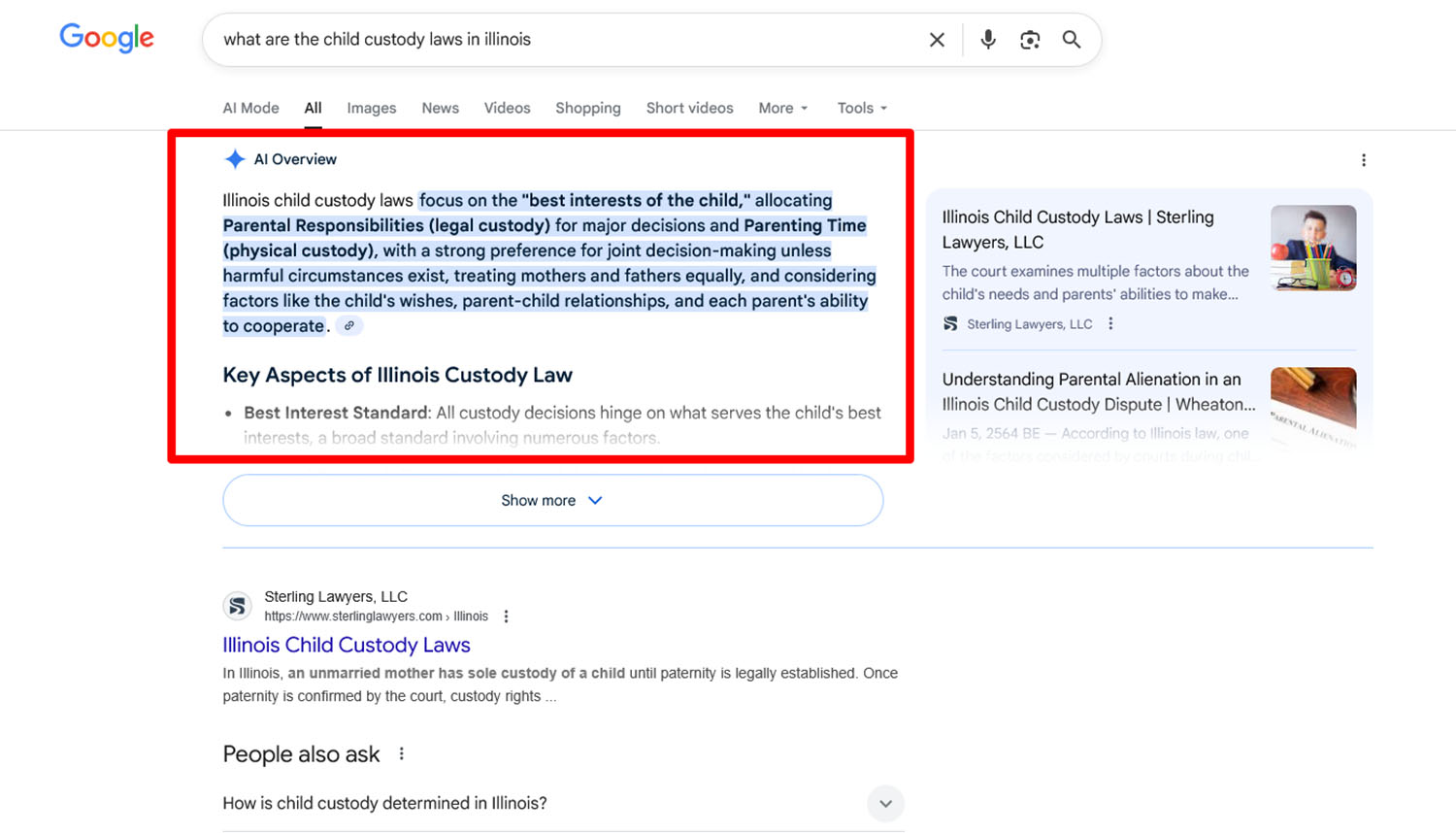
Anyone searching Google with the question “What are the child custody laws in Illinois?” (or any similar legal question) will receive an AI overview of the answer at the top of the Google Search Engine Results Page (SERP).
Previously, “Featured snippets” dominated the top of Googles results, with information taken directly from the most optimized law firm website.
Now, Google uses Gemini, it AI engine, to provide an AI Overview in “Position Zero” at the very top of the page resulting in Zero-click results.
AI Overviews include a short explanation or answer and follow-up questions. This important change has caused huge ripples in the world of SEO.
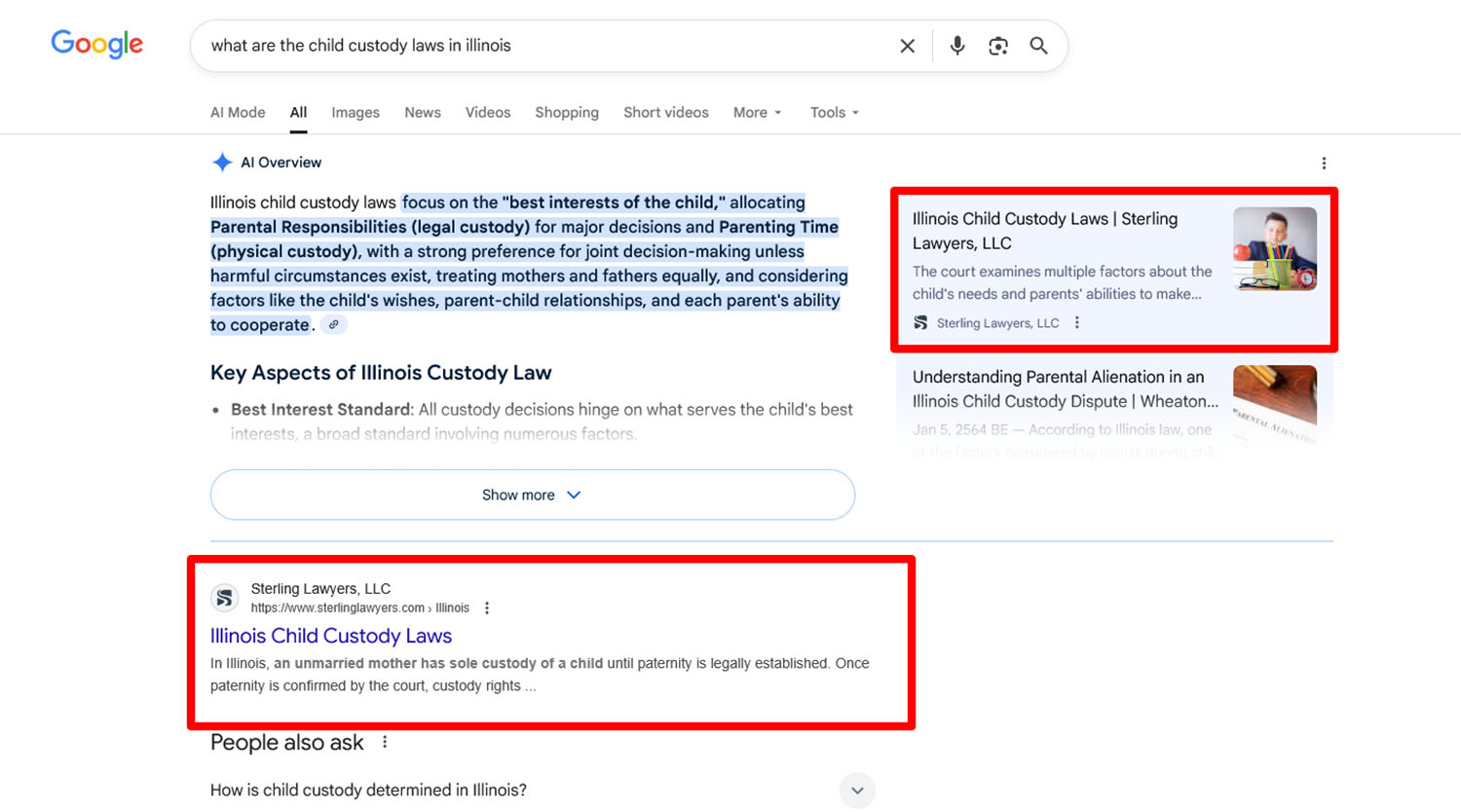
Optimization implications for law firms
When we look to the right of the AI overview on Google’s results page, we see links to the same law firm websites that were previously used for the snippets. Sterling Lawyers, LLC still dominates the page for organic search links for that term.
So, law firms still need to create the same authoritative content to get rankings, with 76% of AI Overview citations pulled from the pages ranking in Google’s top 10 organic results.
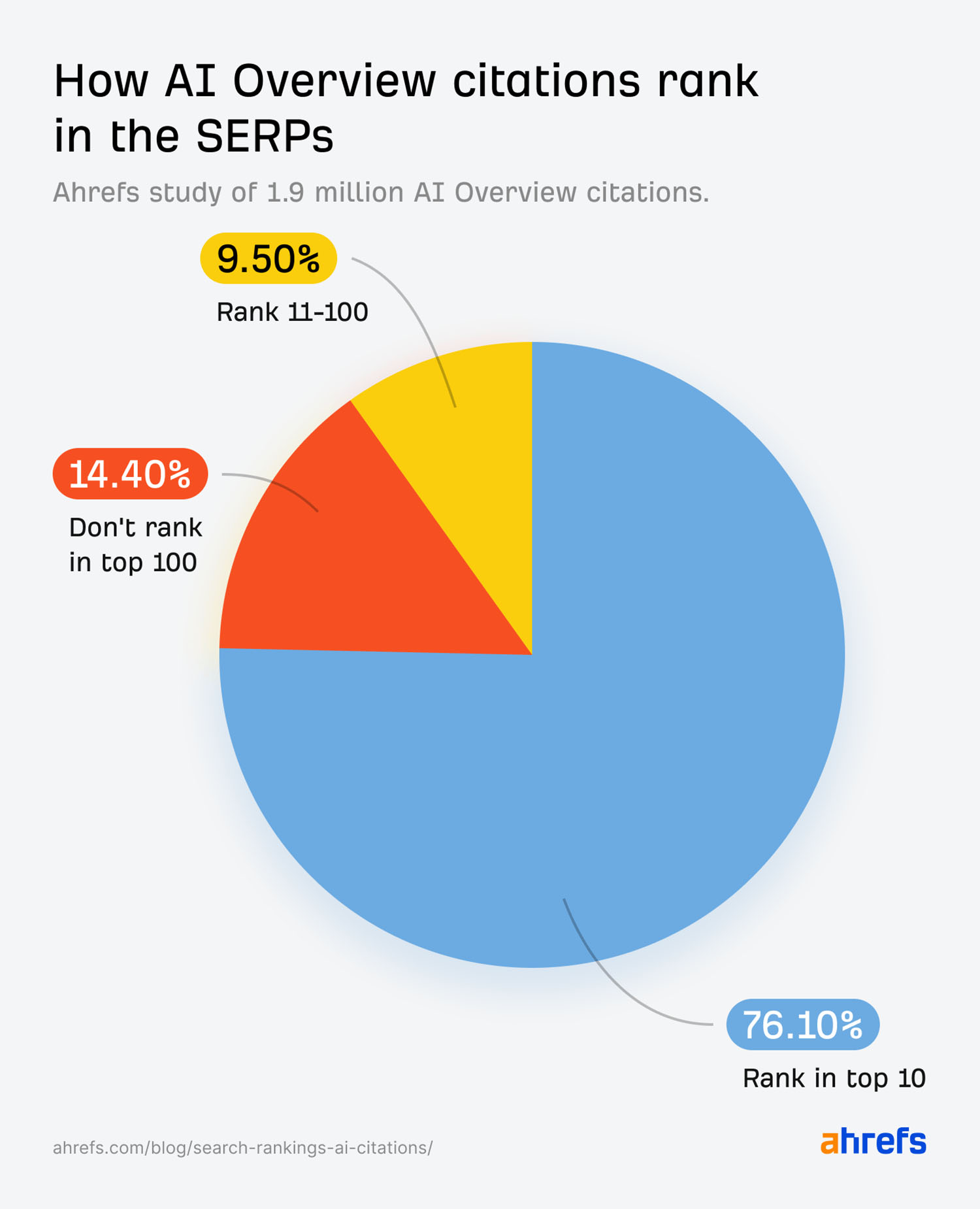
AI will generally cite authoritative content in its overview. If your content is cited, you still receive a prominent, free organic link at the top of the SERP.
So, the main implication for law firm SEO is that firms need to position themselves as trusted AI sources. There’s more about how to do that below.
How to adapt an SEO strategy for AI
AI platforms like Gemini (Google), ChatGPT, and Claude, and the use of AI Overviews providing quick answers to queries, do impact search and click-throughs to websites.
Some estimates suggest that 60% of Google searches now end without a click to a website, both desktop and mobile. Clearly, the search game is changing, and the laws of evolution suggest we must adapt or die.
A recent iLawyer Marketing study on AI-based research found the following interesting results:
In 2025, 28% of people say they would use ChatGPT to help find an attorney, up from just 9% in 2023, representing more than a threefold increase in adoption.
Not all search types are affected equally by AI. High-volume how-to and FAQ legal queries are heavily affected as people seek quick, informed answers from AI. However, branded queries, local intent, and niche legal topics will still drive traffic to websites from the search engines.
Google still sends 345 times more traffic to websites than ChatGPT, Gemini, and Perplexity combined. However, unless your content also targets citations in AI search, it will get left behind.
From now on, the risk for law firms is being excluded entirely from answers to queries, rather than simply dropping in rankings and being banished to the second page of Google.
The Maine Criminal Defense Group is doing a great job with adapting to AI queries, creating pages like this:
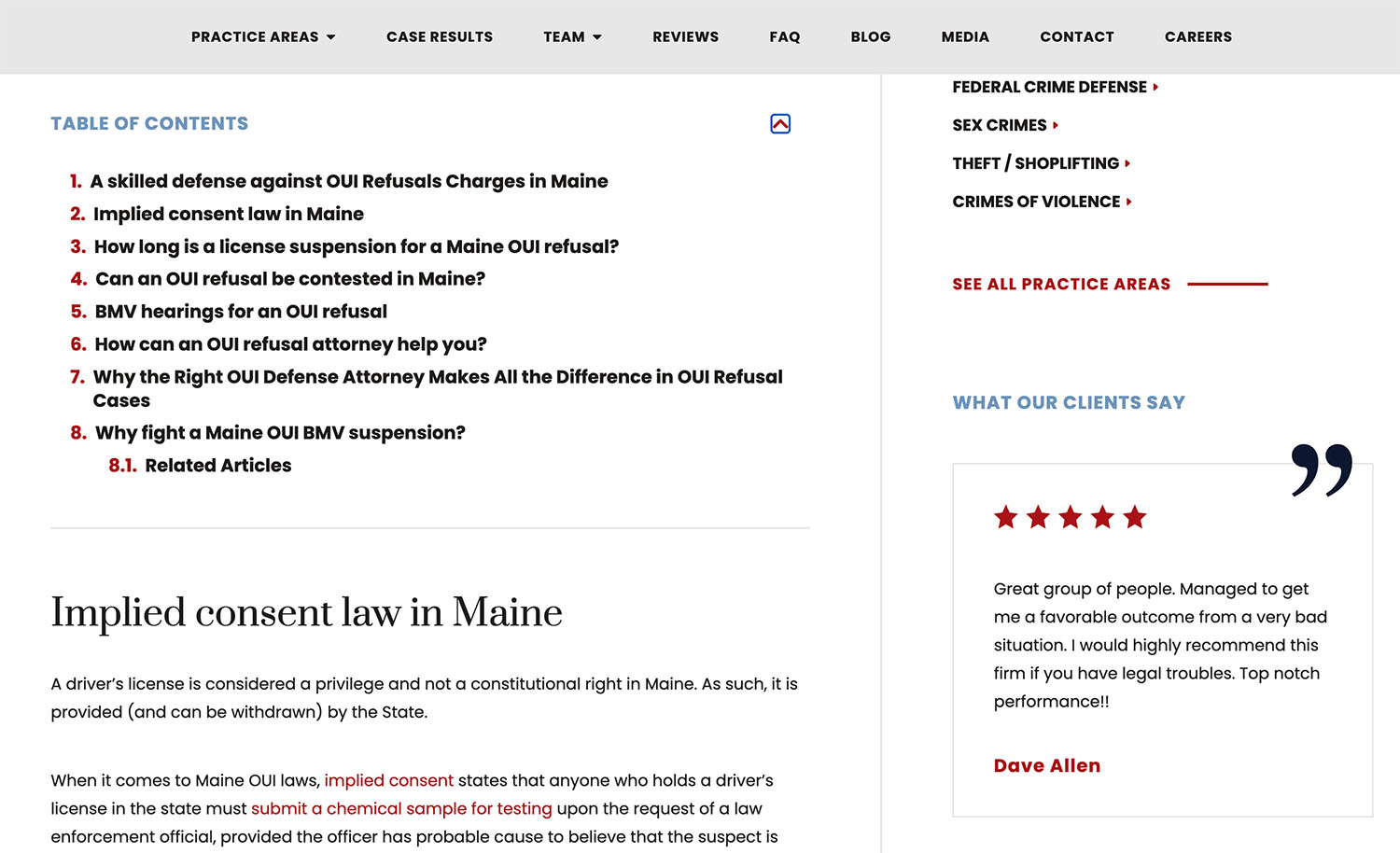
Look what happens when you do a Google search for “How do I fight an OUI refusal in Maine?”
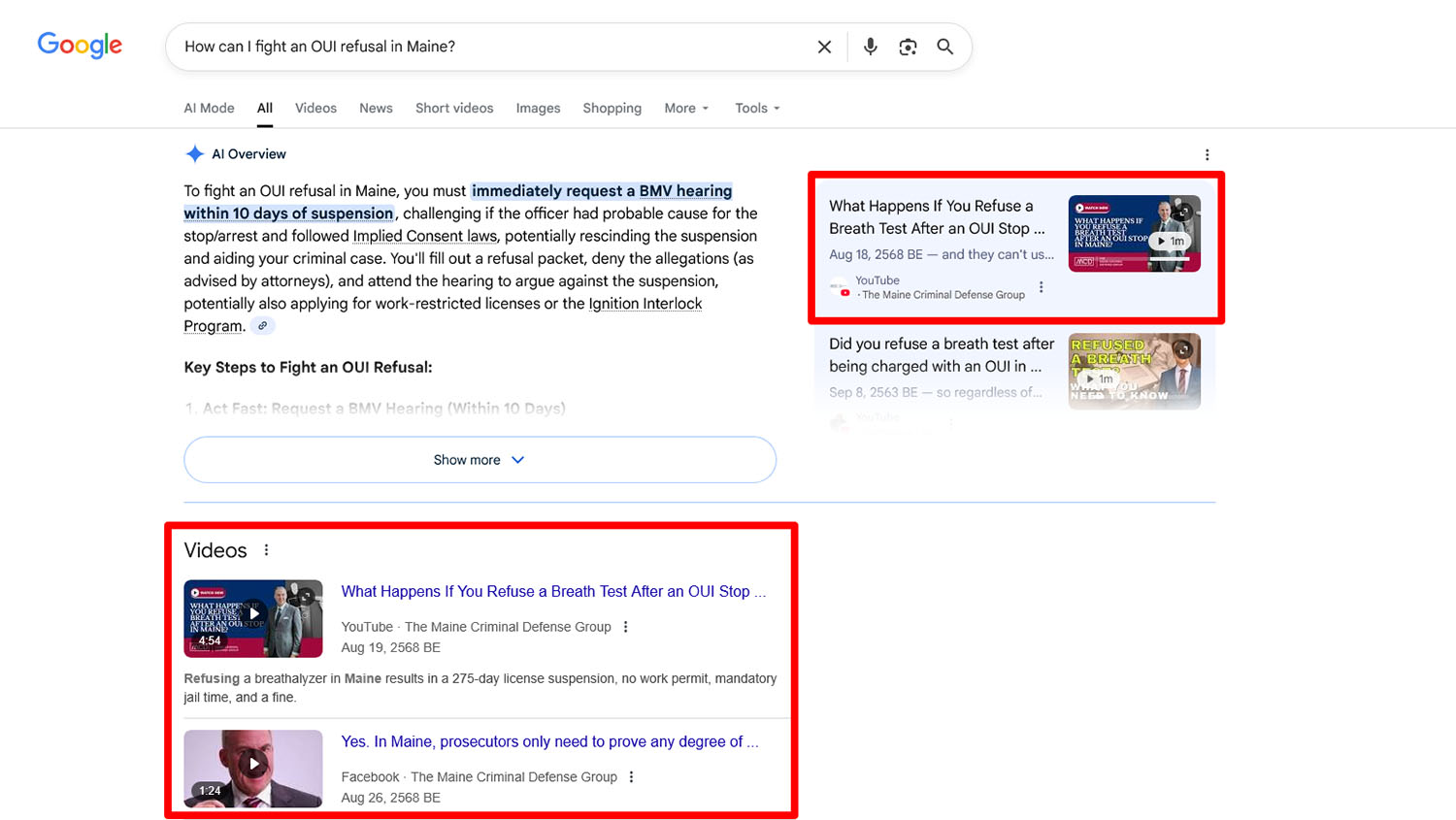
The Maine Criminal Defense Group’s content is highly prominent, in this case, its videos. What about when you type the same search into ChatGPT?
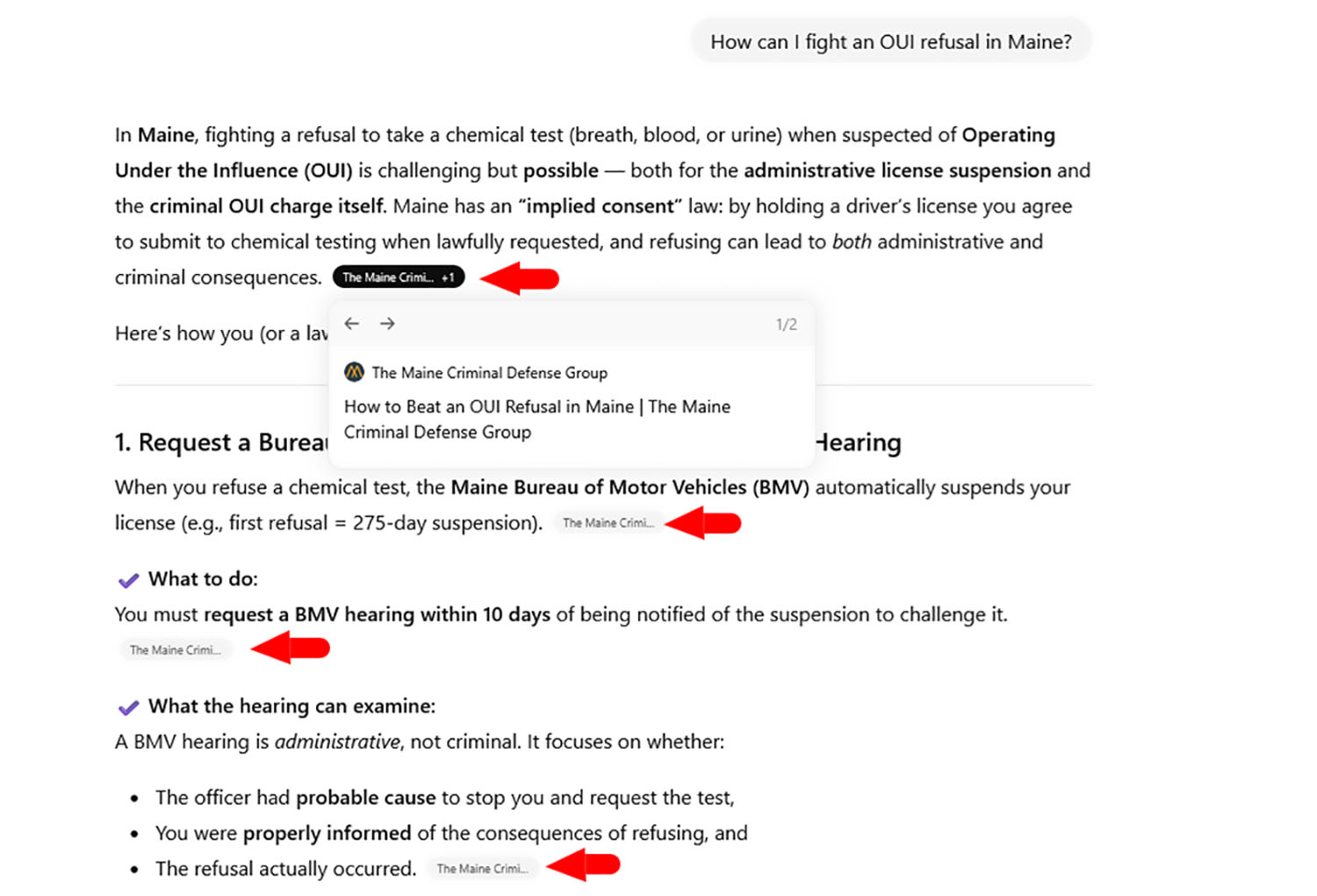
As you can see, the same firm dominates the AI response with four citations to the content they’ve created before even scrolling.
How can law firms adapt to AI search on Google?
Smart, AI-ready, law firm SEO should target the following in 2026:
- Demonstrate deep expertise through high-quality content.
- Create helpful videos or FAQ pages/guides with a clear, logical structure.
- Showcase strong EEAT signals (Experience, Expertise, Authoritativeness & Trustworthiness).
- Target AI citations.
- Focus on quality over quantity of leads.
- Focus on optimizing for the local area.
- Track your inclusion in AI search with platforms like ahrefs.com.
For example, Ahrefs Brand Radar allows you to track AI citations directly in it’s platform.
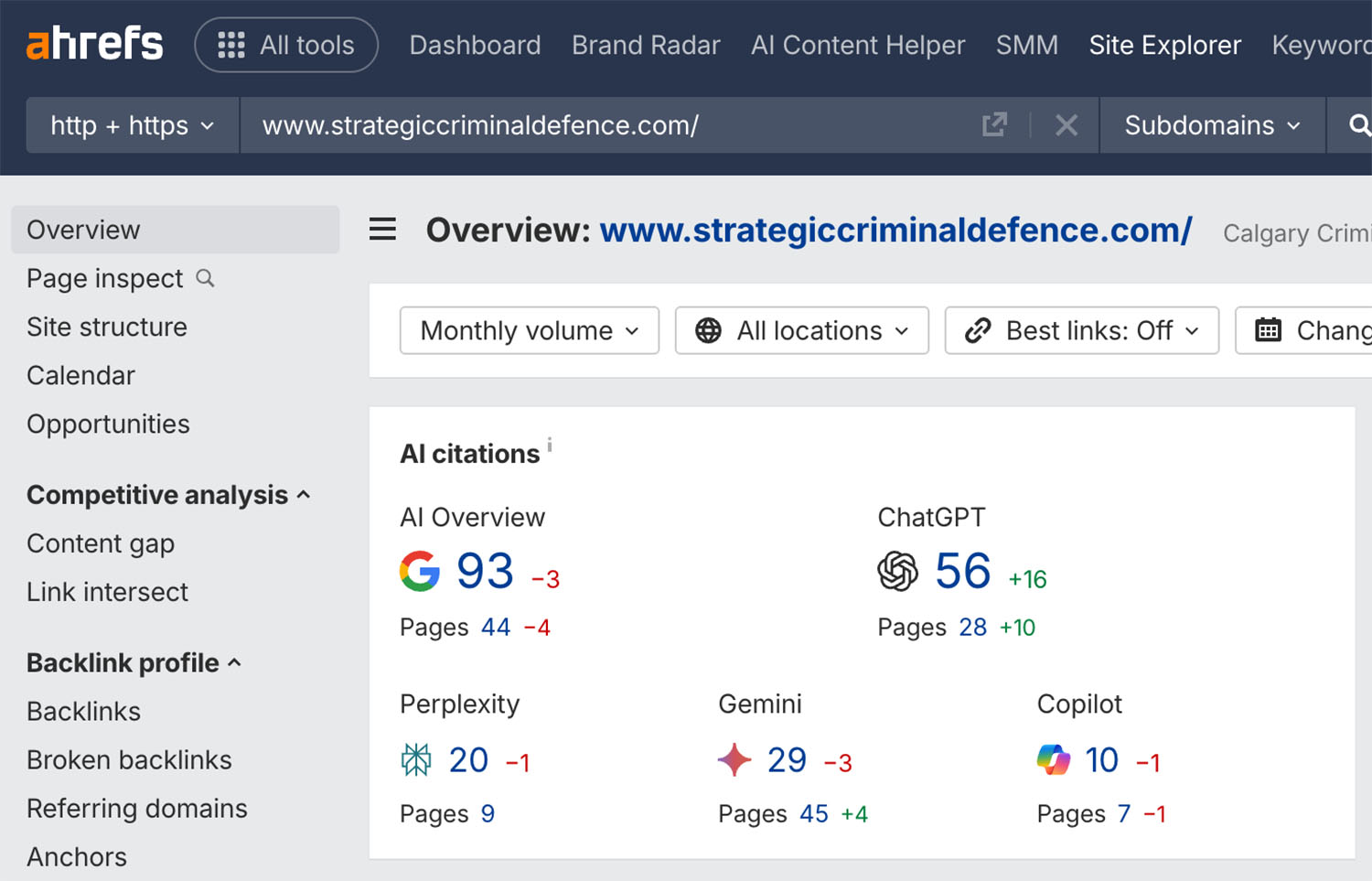
REALITY CHECK: Many of the strategies to make law firms “AI-ready” are simply SEO best practices, which we take you through in the following sections.
Before going deeper into the main strategies that lawyers must focus on with SEO in 2026, we need to understand the main Google ranking factors.
What are Google Ranking Factors?
If Google didn’t return the most accurate, credible, and authoritative information to its users, people would stop using it, advertising revenue would plummet, and we’d experience the death of a behemoth.
AI hasn’t changed that.
To protect itself, Google has traditionally returned search results according to over 200 ranking factors used to assess the worthiness of websites when returning results to queries.
The following four are the most important for law firms to focus on:
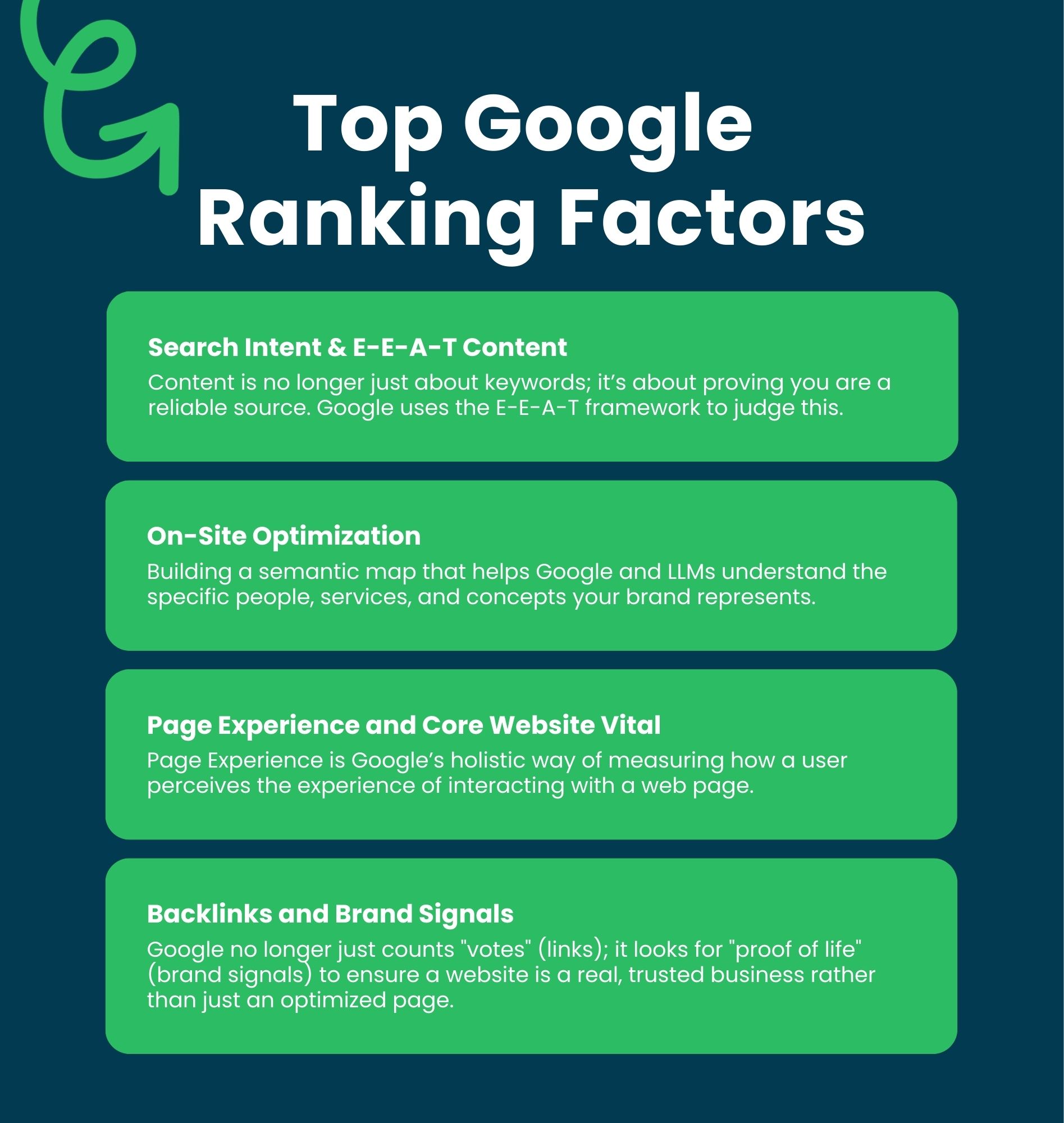
Search Intent & E-E-A-T Content
Creating content is no longer enough. To rank today, your content must satisfy search intent and demonstrate deep topical authority.
This is where E-E-A-T comes in.
EEAT stands for Experience, Expertise, Authoritativeness, and Trustworthiness: four qualities you can’t get enough of if you want to rank at #1 in the search engines.
Google considers legal topics as an area in which users need protection from misinformation.
The Your Money or Your Life (YMYL) policy aims to provide reliable information on critical topics (like legal queries), where misinformation could have serious, real-world, negative consequences.
A query like this, for example, could result in a negative, life-changing decision if the recommendations provided are wide of the mark:
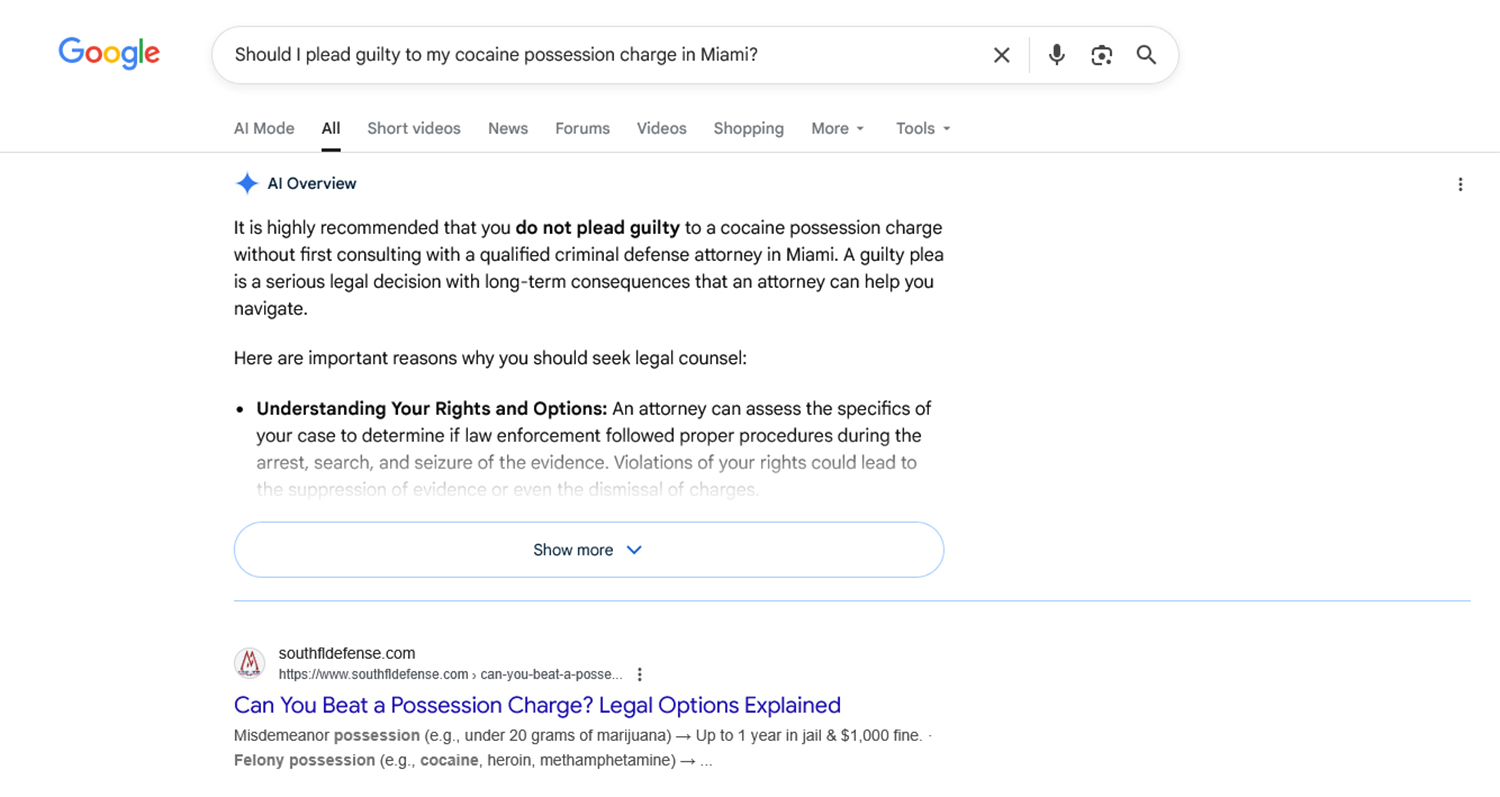
Google, therefore, places great emphasis on the EEAT qualities mentioned.
These are the types of questions you need to ask about your law firm’s website when self-assessing EEAT:
- Experience: Does your firm have a long track record of first-hand experience in your practice area and the credentials to provide insightful and relevant content for users?
- Expertise: Can you provide the necessary relevance, depth, and accuracy to recommend to users via its rankings?
- Authoritativeness: How many reputable websites link back to your page or share your content on social media? Are you a respected, go-to source for reliable information?
- Trustworthiness: What do your clients say in reviews? How accurate and honest is your website? Is your website secure and mobile-friendly?
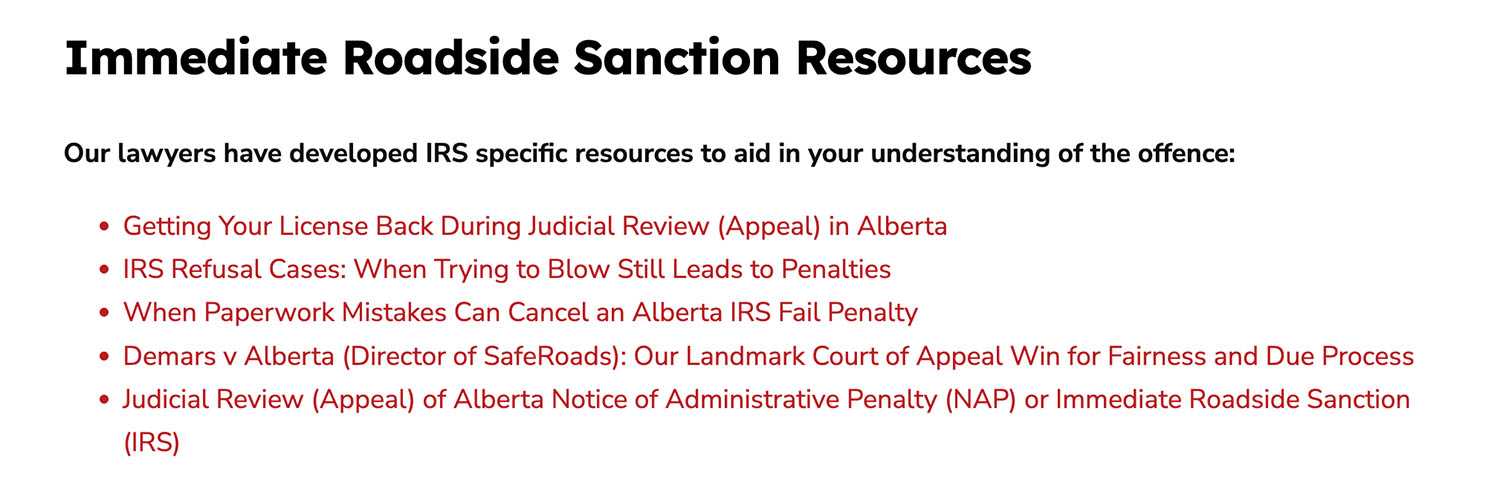
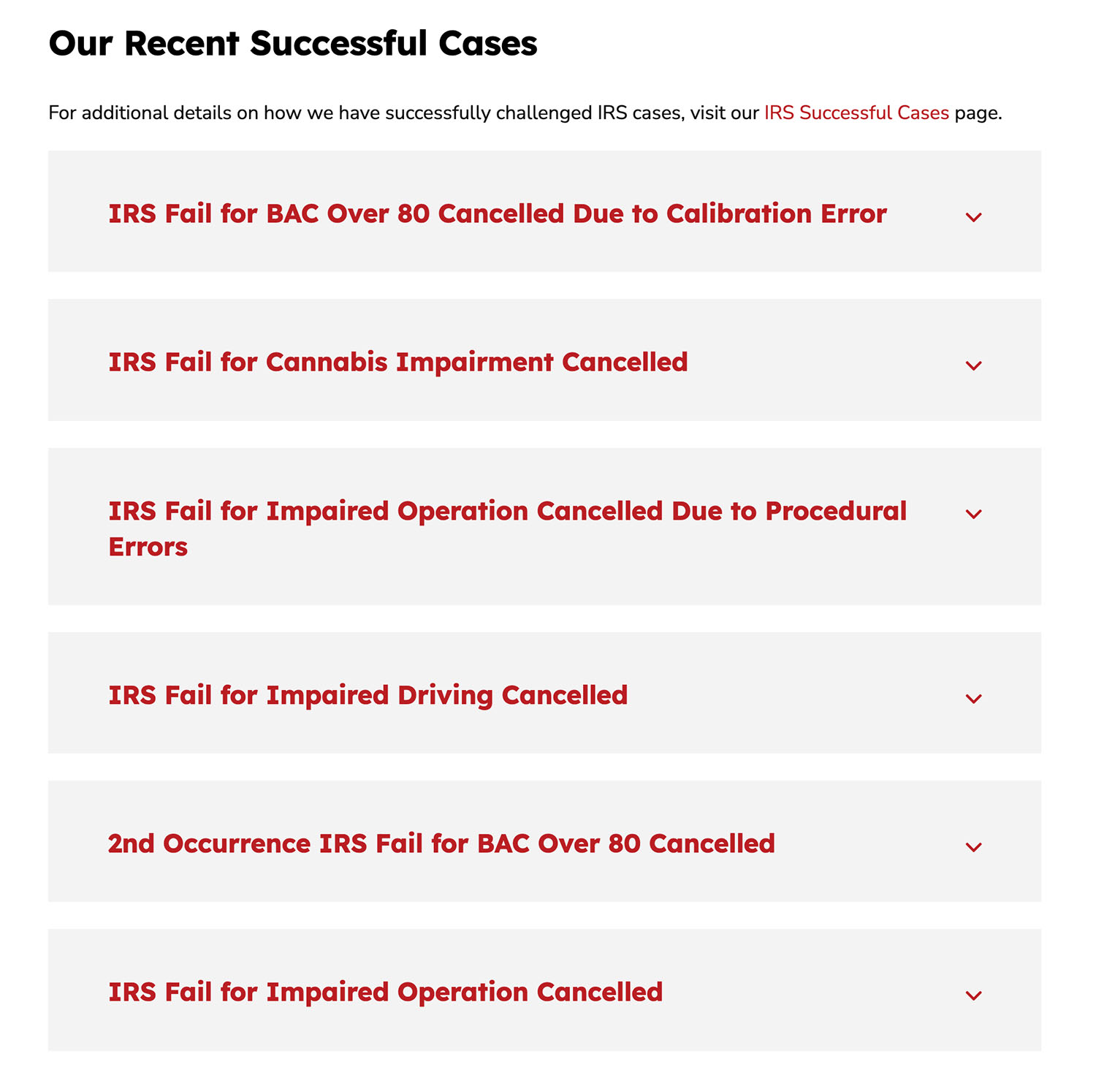
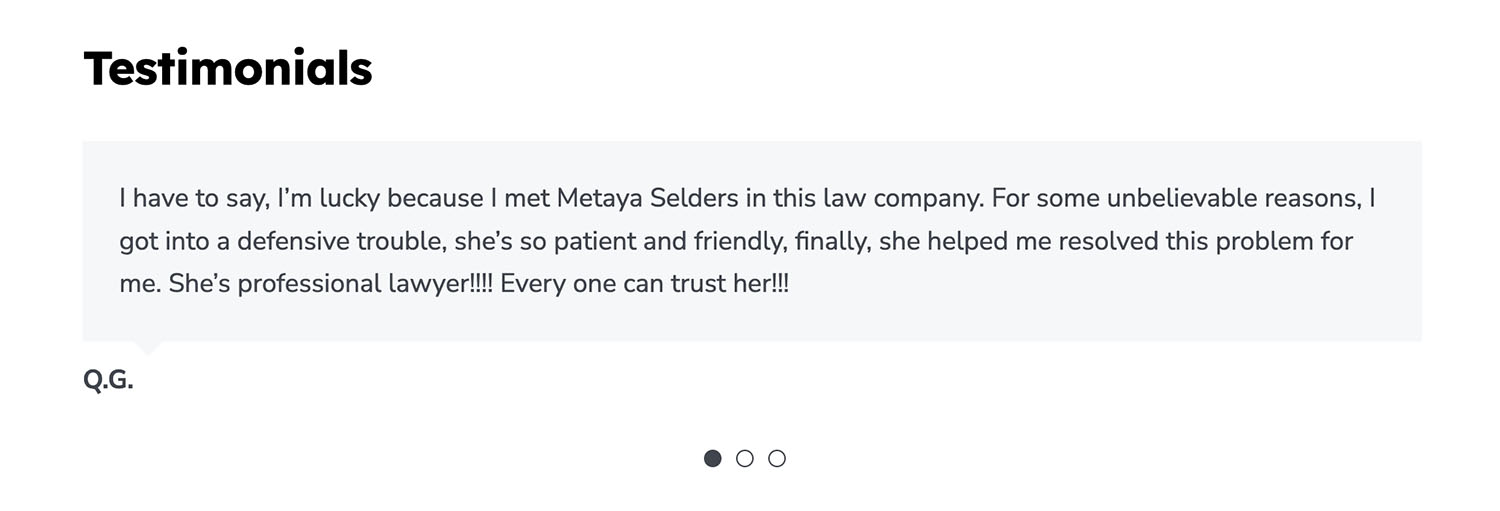
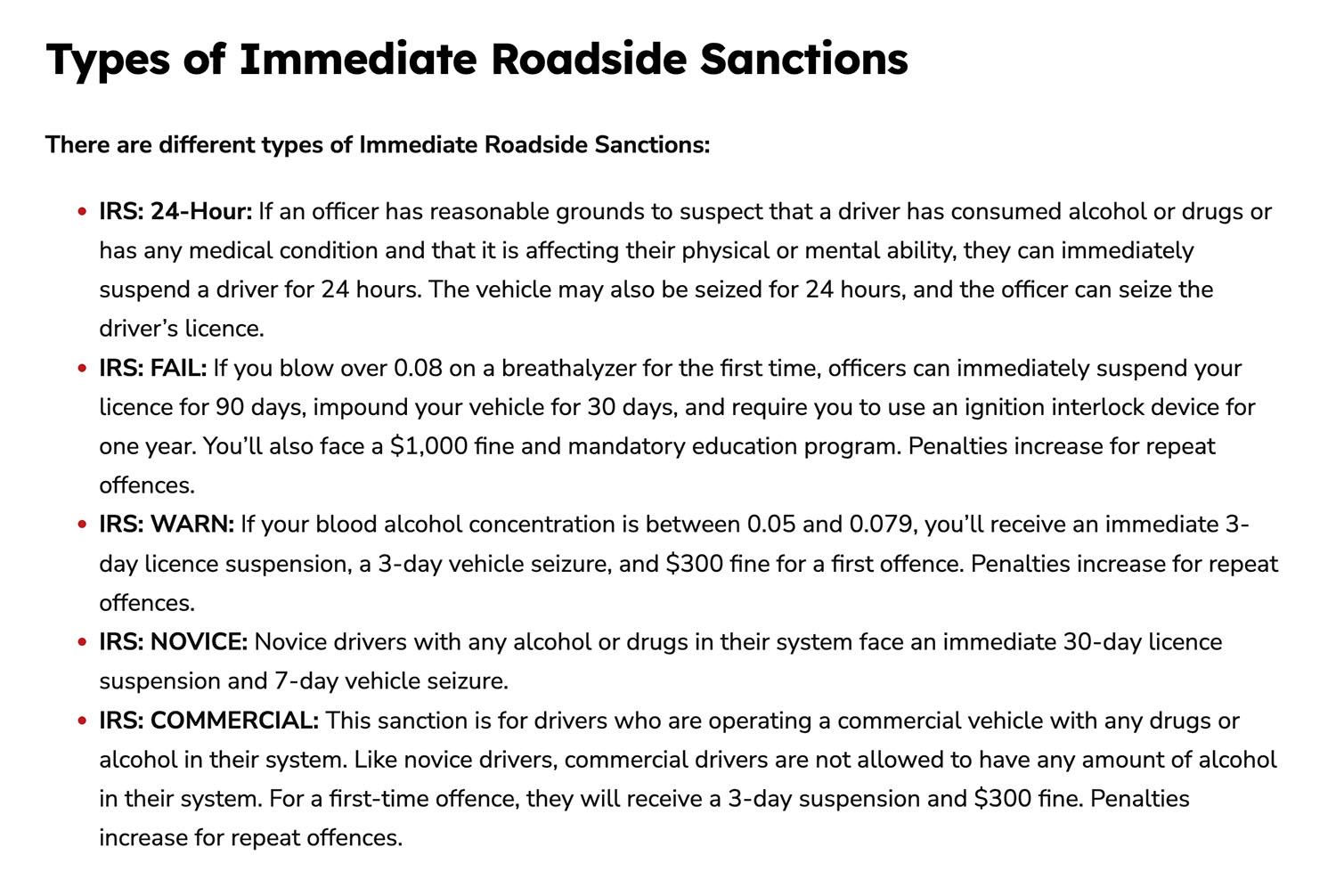
Here is an example of an EEAT article published by Strategic Criminal Defence.
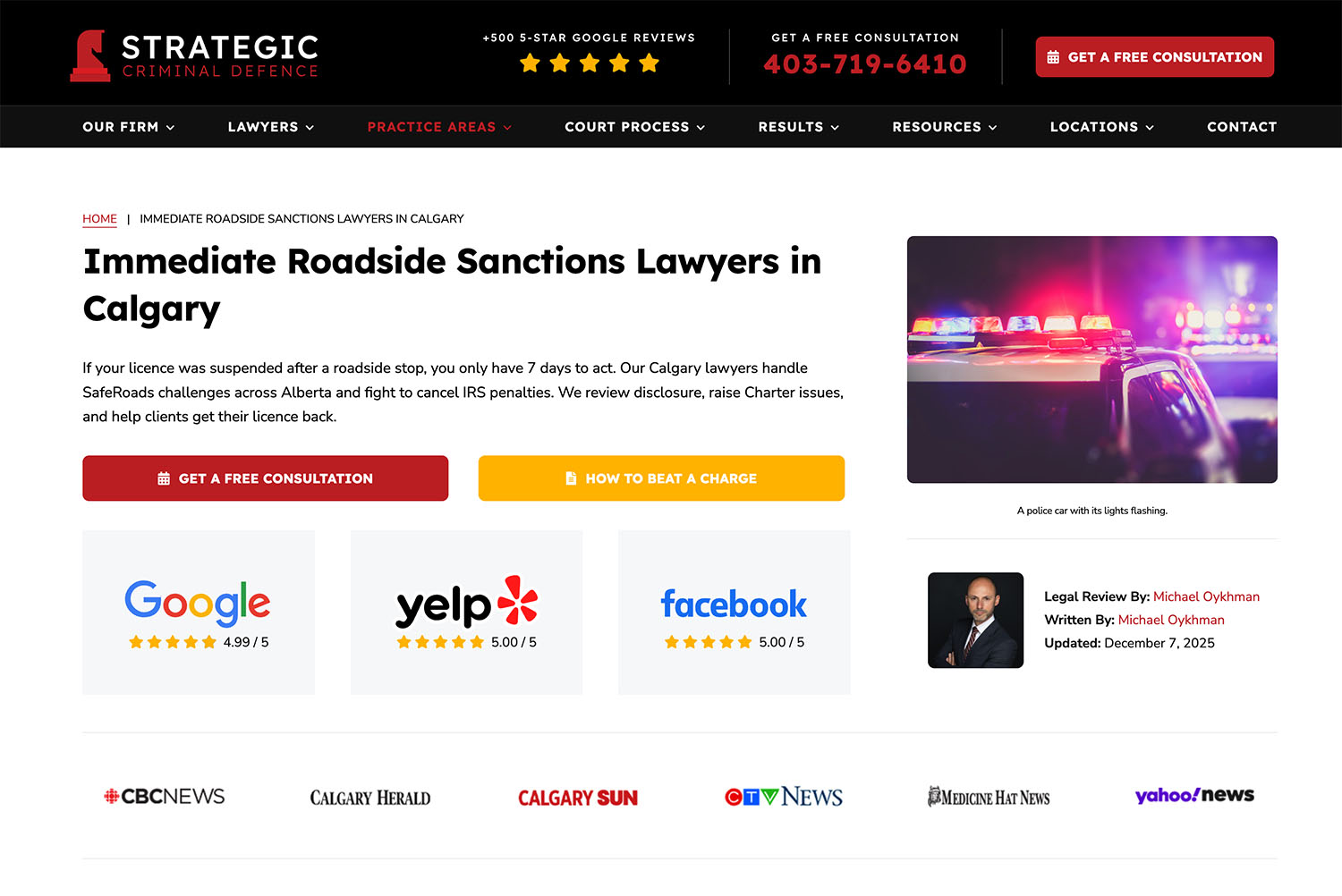
The page includes a detailed resources section.
A section for successful cases.
A list of client testimonials.
And, extensive client-focused information.
Optimizing your website content with search intent and EEAT in mind will give your firm’s rankings a notable boost.
It must be topically relevant, answer the searchers questions as soon as possible, and be informative for the target audience, as well as easy to digest and share.
Here are a few pages to prioritize:
- Website Home Page
- Practice Area Pages
- Lawyer Biographies
- Articles, FAQs, guides, eBooks, etc.
- Frequently Asked Questions
- Testimonials and Successful Cases
Backlinks and Brand Signals
Hyperlinks are clickable text (or images) that direct users to another webpage or section within the same website, like this:
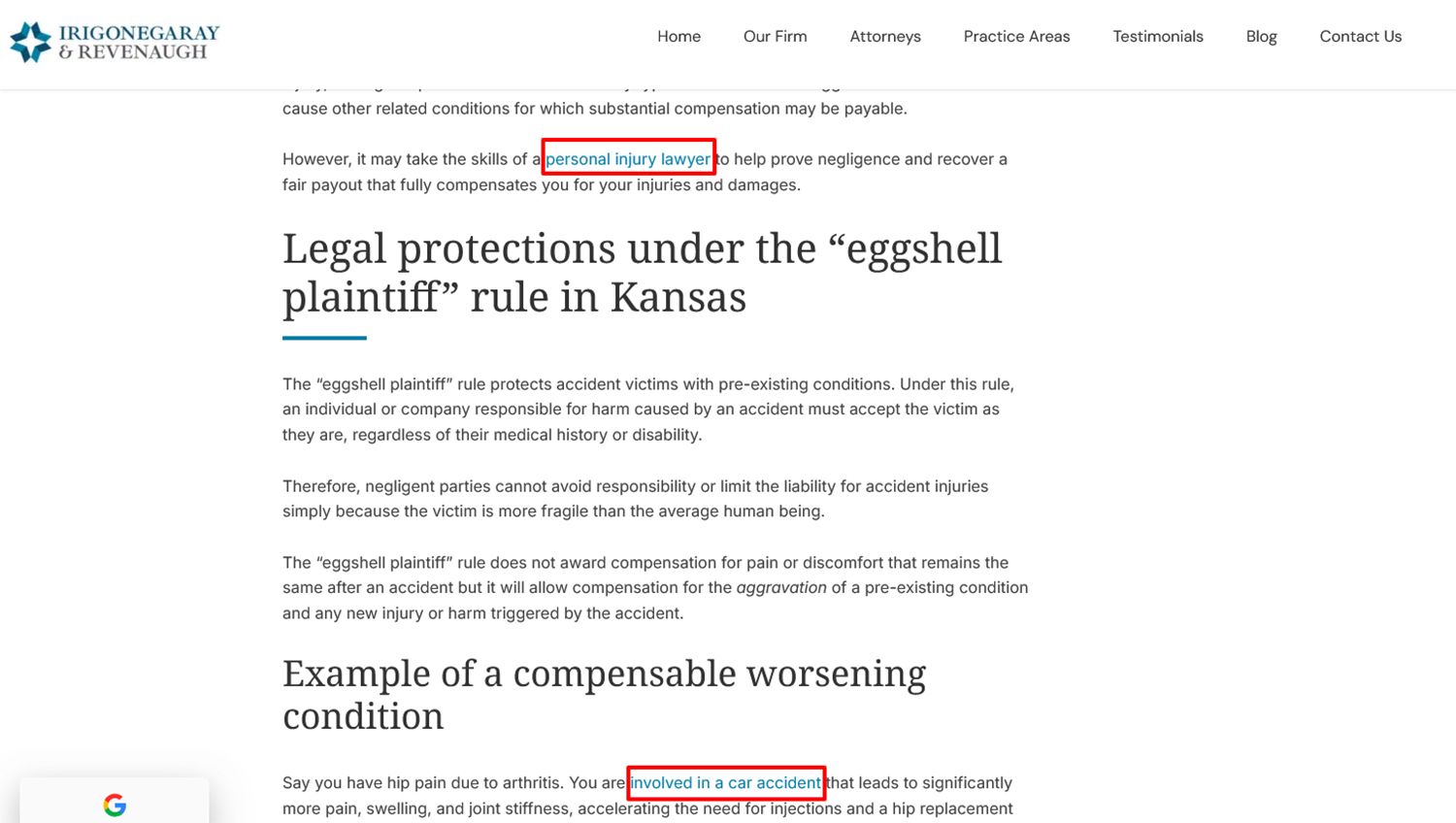
Hyperlinks remain the foundation for navigating the Internet, and backlinks remain one of the core foundations of a successful law firm SEO strategy.
Backlinks are those that point to your website.
If other authoritative sites point to yours, Google considers it a digital vote. High-quality backlinks increase your perceived level of trustworthiness and authoritativeness, which Google values so highly for law firms.
Not all backlinks are equal. Each link to your website is assessed by Google for quality and relevance.
A website with a few high-quality, relevant backlinks can easily outperform a website with many lower-quality backlinks.
Here are a few questions to ask if you want to self-assess your law firm’s website backlinks:
Page Experience and Core Website Vital
Core Web Vitals help measure the user experience, which is a key ranking factor.
Improving the user experience is about making your website:
- Fast
- Secure
- Navigable (easy to find the info you need)
- Digestible (easy to read or view)
- Mobile-friendly
- Clutter-free
- Pop-up-ad-free
The better the user experience, the longer visitors stay on your website (improving dwell time and lowering bounce rate) and the more likely they’ll contact you.
Two pages with essentially the same information on the same topic can differ in rankings depending on their Core Web Vitals and the other metrics outlined above.
Here’s an example of a fast-loading, secure, responsive page that presents its information in a very user-friendly way:
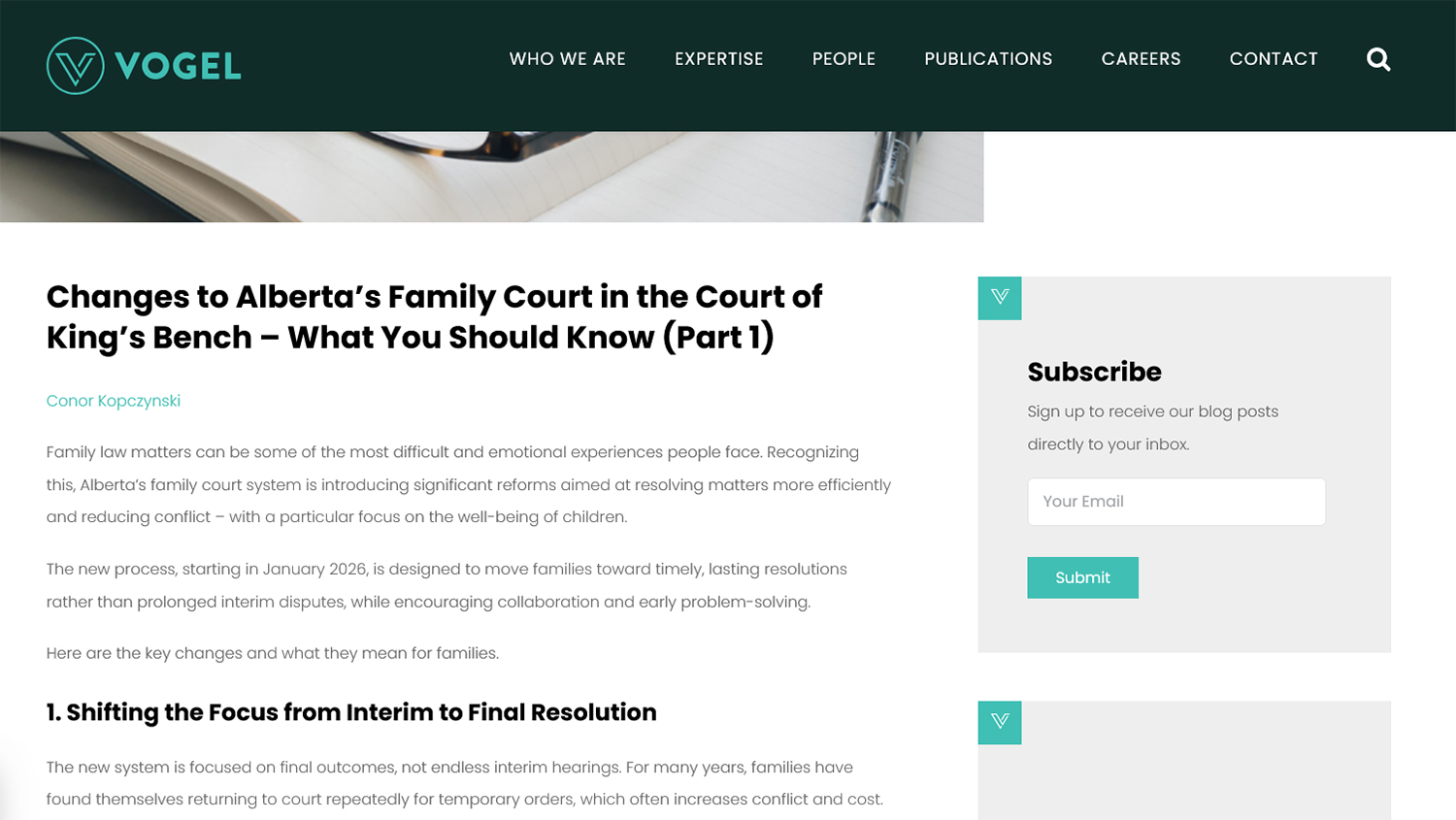
A quick word about mobile-friendliness
Over 60 percent of organic search traffic comes from mobile devices, prompting Google to consider the mobile version of your website first when ranking content. It is no longer simply an option to have a mobile-friendly website. Everything you do from a marketing perspective should be mobile-first.
Onsite Optimization
The level of “onsite” optimization of your website is another key Google ranking factor. The main question you need to ask here is:
How well are the text and media optimized for search on our website’s pages?
This is covered in detail below, where we explore content, keywords, multimedia, etc., but the main onsite optimization focus is best explained in the following graphic:
Consistently publishing valuable content positions your law firm as a subject matter expert or “topical authority” in your practice area.
This has numerous benefits:
- Increases your website traffic.
- Increases backlinks.
- Improves EEAT and boosts rankings.
- Increase the chances of being cited in Google’s AI overview.
- Increases the chance of featuring in the People Also Ask section of the SERP.
- Increases social media traffic.
- Increases quality leads and client sign-ups.
Here’s an example of the visibility boost you can expect in Google’s search results.
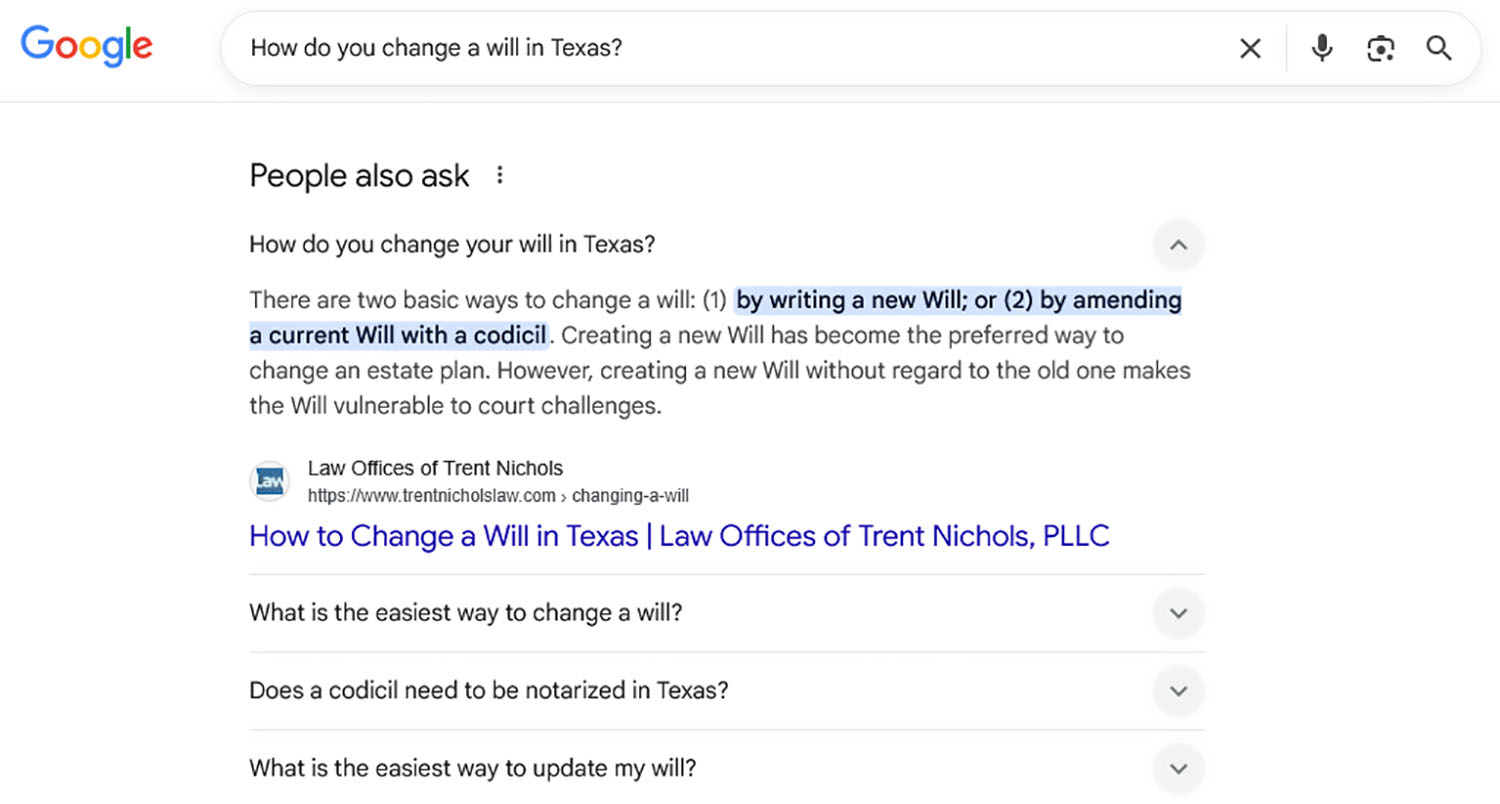
Remember, by focusing on EEAT, you will achieve many of the key SEO objectives. Keep that in mind as you develop your content strategy.
Search Intent: The Secret To Higher Rankings
Search intent is a key concept when shaping the types of content you create.
If you know what the user is really looking for from a search term, you can carefully craft your content to specifically address their query.
There are four main types:
- Transactional searches: e.g., divorce lawyer in seattle.
- Commercial searches: e.g., best criminal defense firm seattle reviews.
- Navigational searches: e.g., mckinley irvin law firm seattle.
- Informational searches: e.g., spousal support laws in washington (see example below).
Here’s an example of an information search and how a Washington firm appears in the search results.
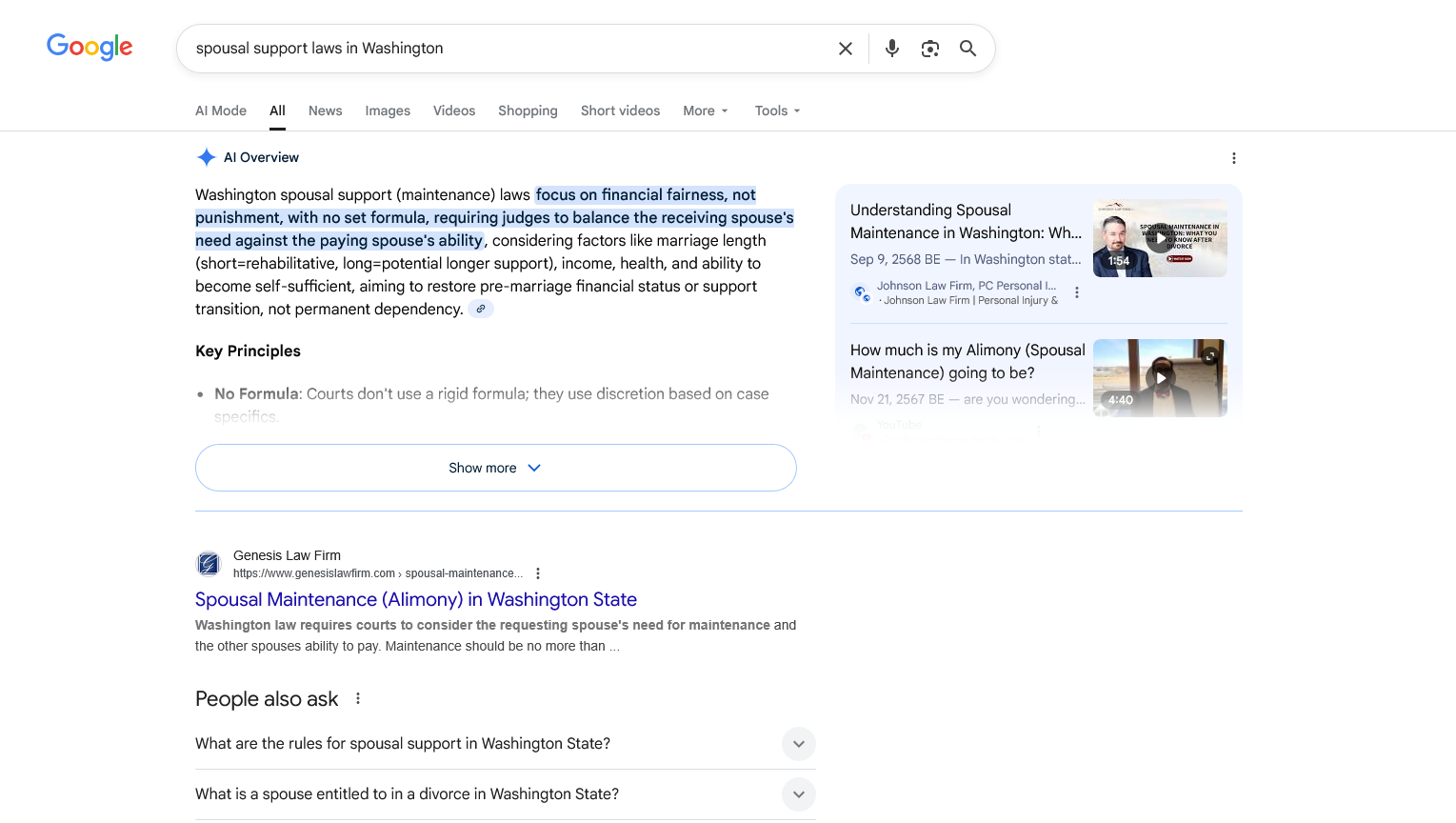
Your content will largely target informational searches, with some pages targeting transactional searches. Local SEO optimization (see later) will take care of the brand searches.
Now, let’s look at some examples of the main types of content to focus on…
Practice Area Pages: Your Website’s Money Pages
Your practice area pages are a supreme opportunity to demonstrate topical authority.
It’s a shame to see so many law firm practice area pages missing this and essentially saying: “We’re great, so call us”.
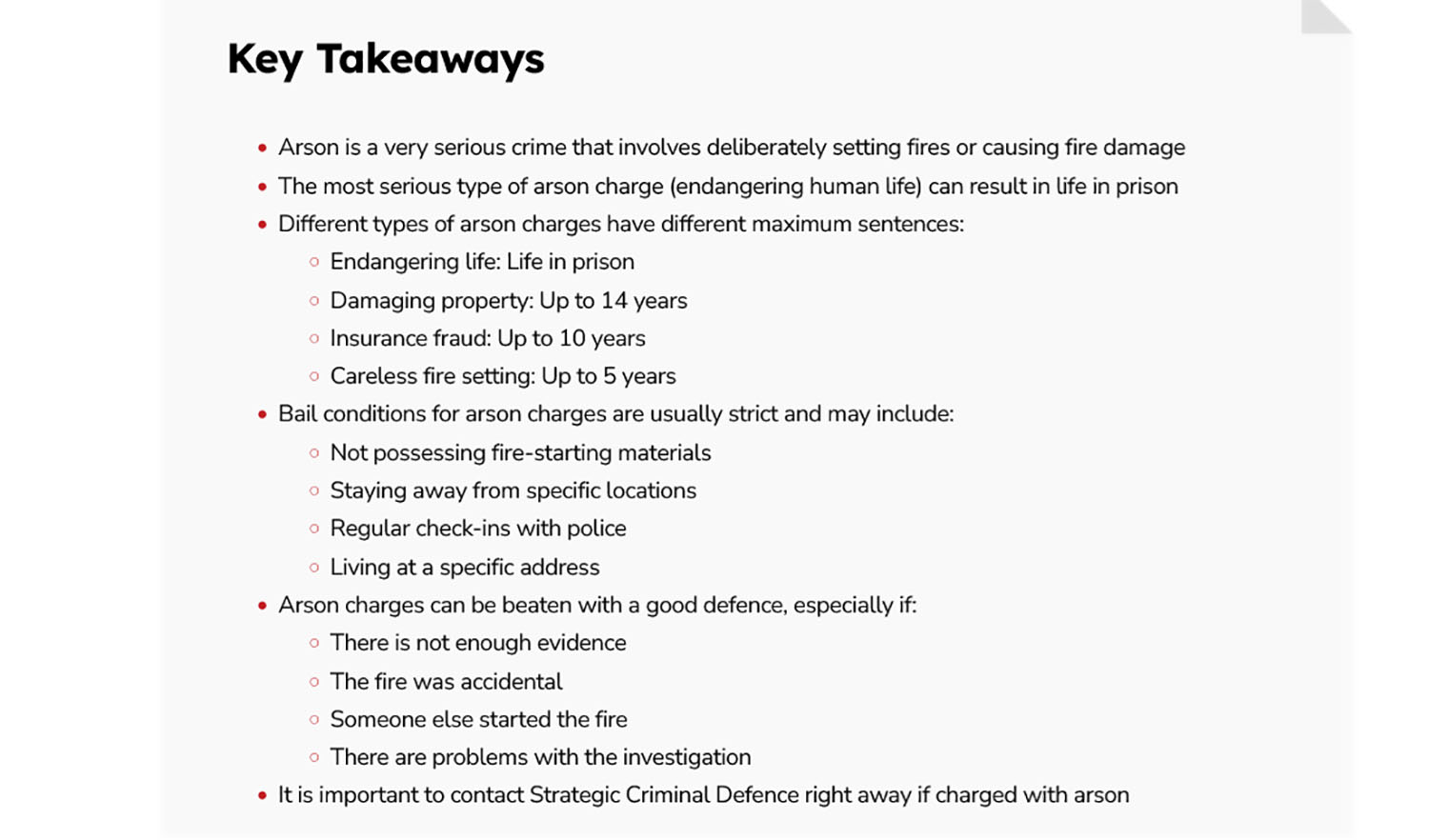
Here’s how a criminal defence law firm based in Alberta demonstrates topical authority on its page for the crime of arson, including the various types of arson charges, the potential penalties, the bail conditions, and possible defences available:
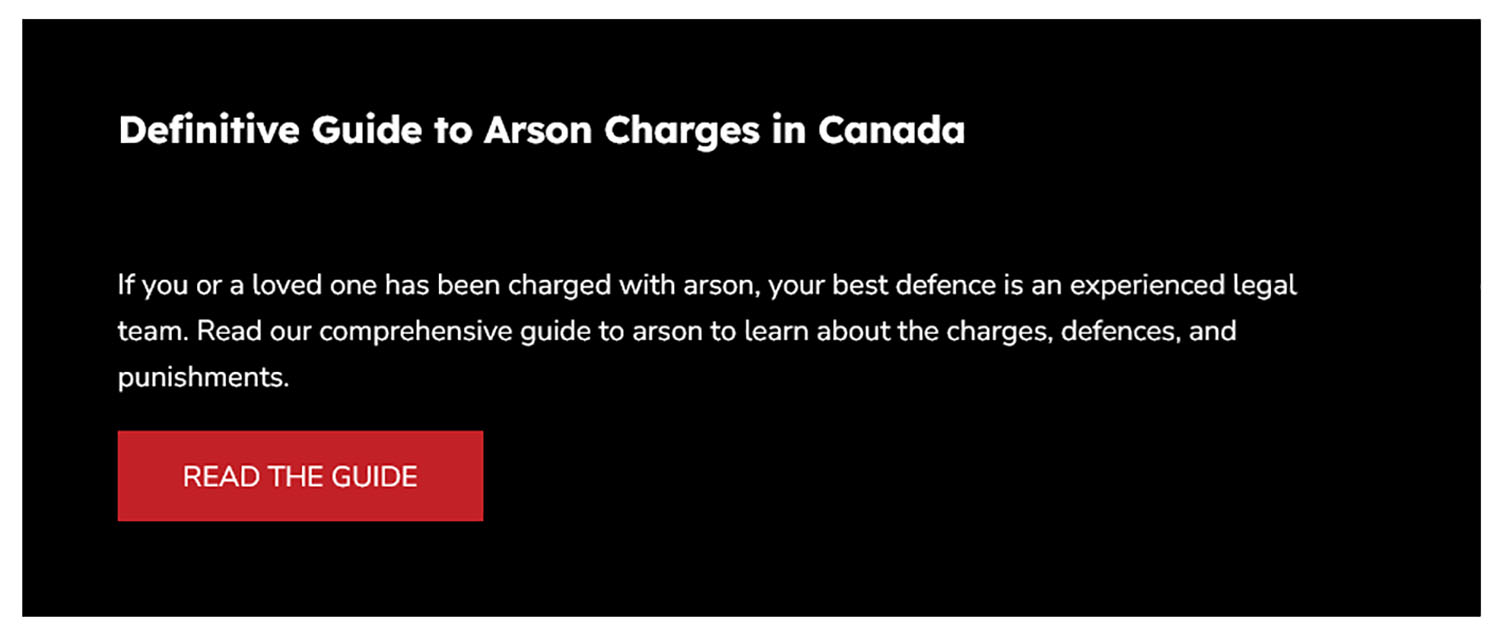
Further down the page, a guide on arson offenses can be downloaded:
Practice area pages still need a strong call to action and messaging, so this is highly prominent on the page:
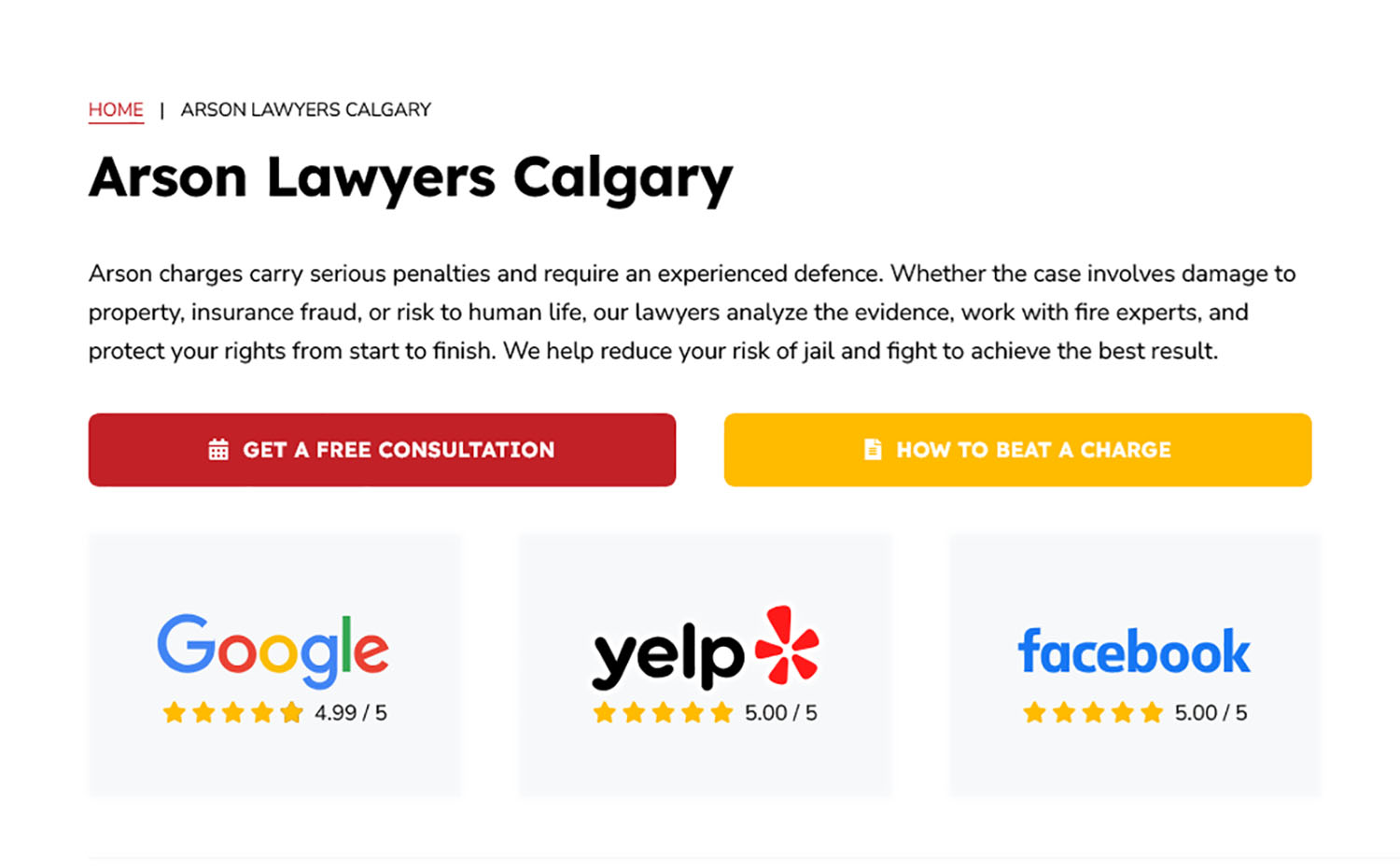
So, practice area pages are bottom-of-the-funnel and should convert interest into real leads. But there should be a strong informational element to your pages, too.
Each practice area page should specifically focus on one area only.
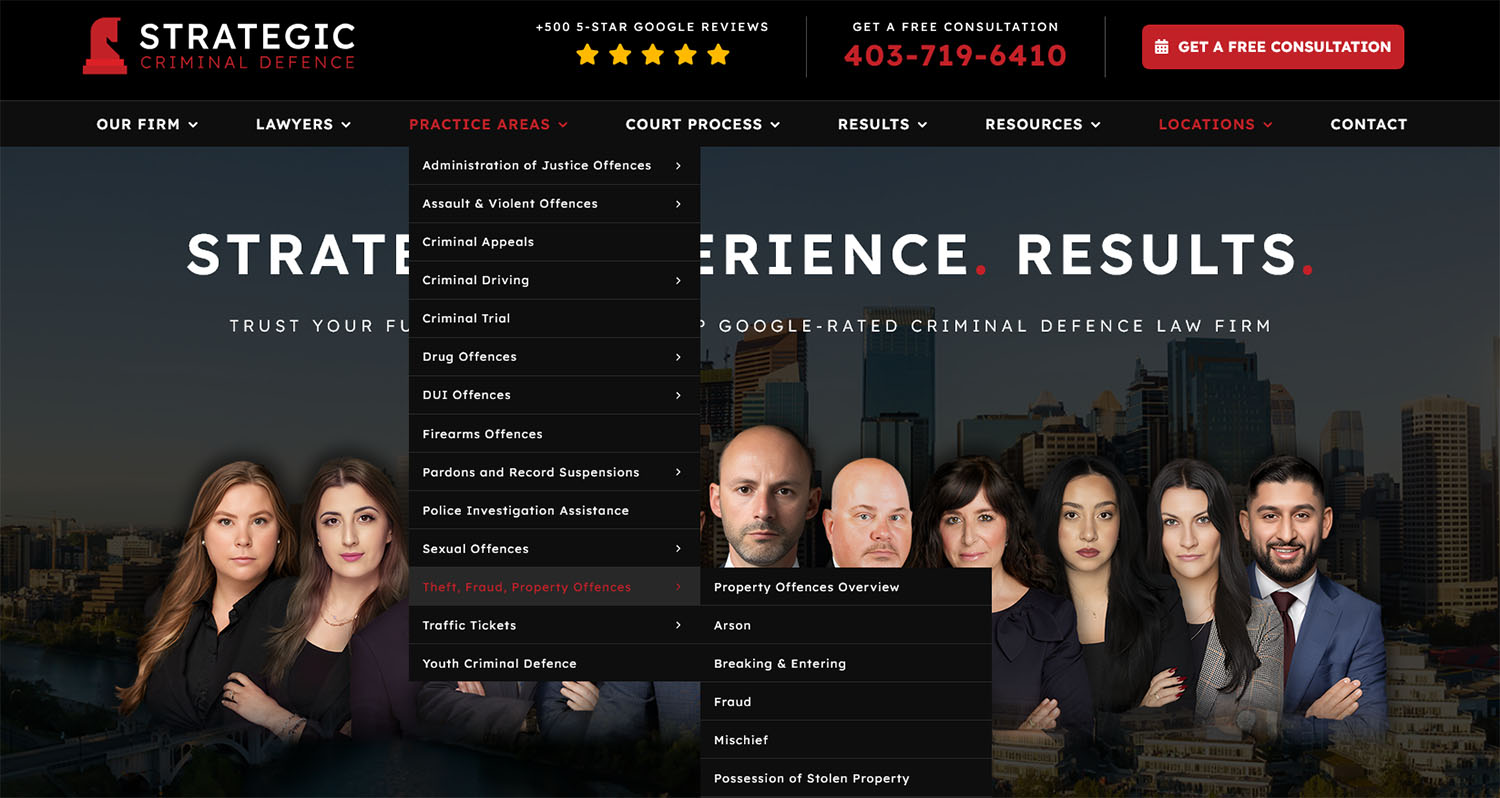
Strategic Criminal Defence has created a huge library of practice pages, each covered in great detail:
Best practice with practice area pages:
- Target relevant keywords like “arson lawyers calgary”.
- Provide searchers with in-depth information on the topic (1500 words, not 300 words).
- Address specific laws and rules that pertain to the targeted area.
- Demonstrate EEAT.
- Include a strong call to action to convince searchers to reach out to you.
Blog Article Pages: Capture Informational Queries
If you’re not currently publishing at least monthly blog posts on the legal topics that are uppermost in your target clients’ minds, it’s time to get started.
Law firms that blog:
- Receive 97% more inbound links than businesses that don’t.
- Have 434% more indexed pages with the search engines than those that don’t.
- Receive 55% more website traffic than businesses that don’t.
Yet despite the clear correlation with better SEO, greater visibility, and lead generation, only around one-third of law firms have blogs.
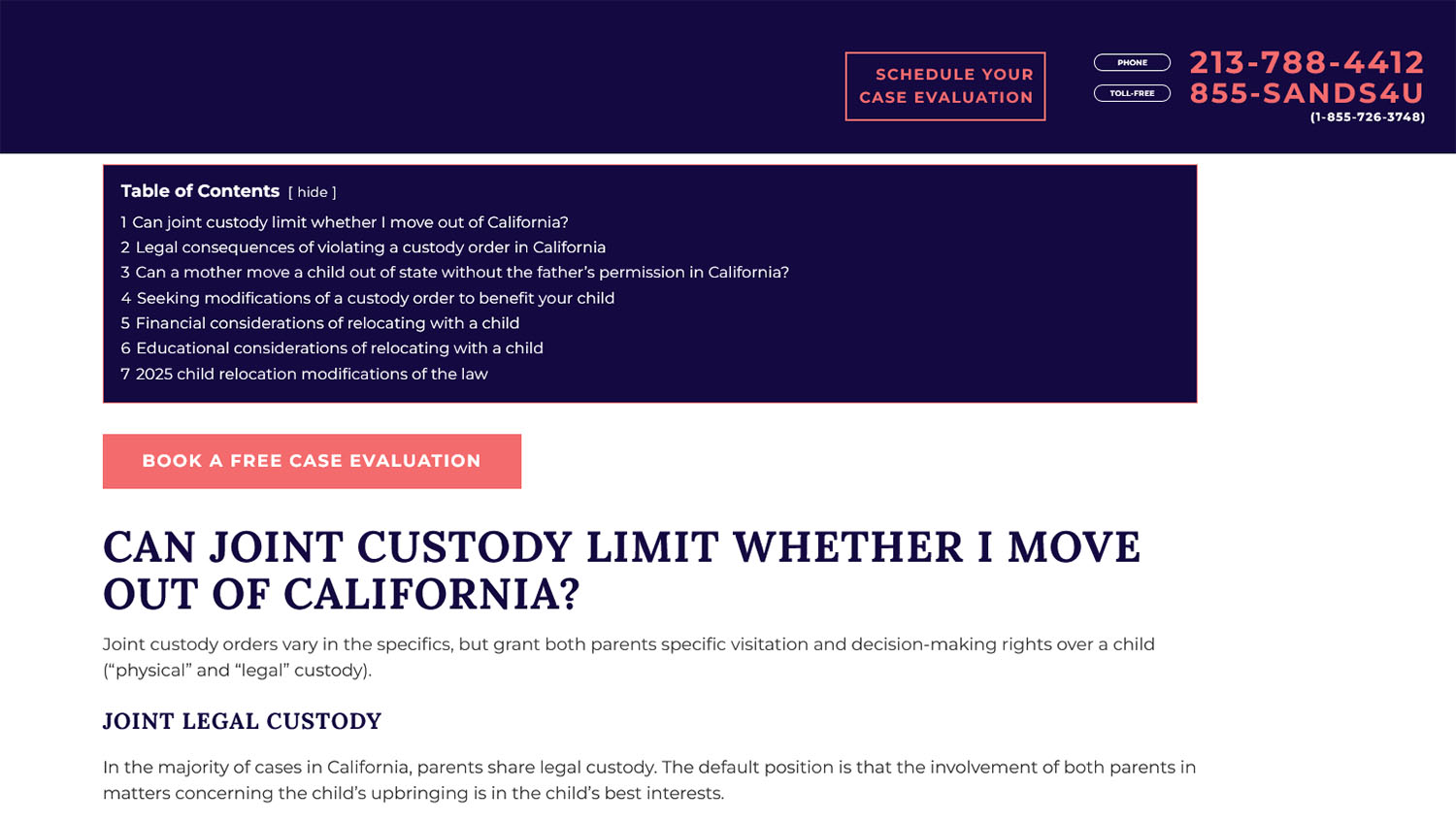
Importably, blogging doesn’t need to be complicated.
This example from a family law firm in California highlights what you could be doing on your blog:
And here’s another great example from a personal injury law firm in Colorado on page answering frequently asked questions about personal injury.
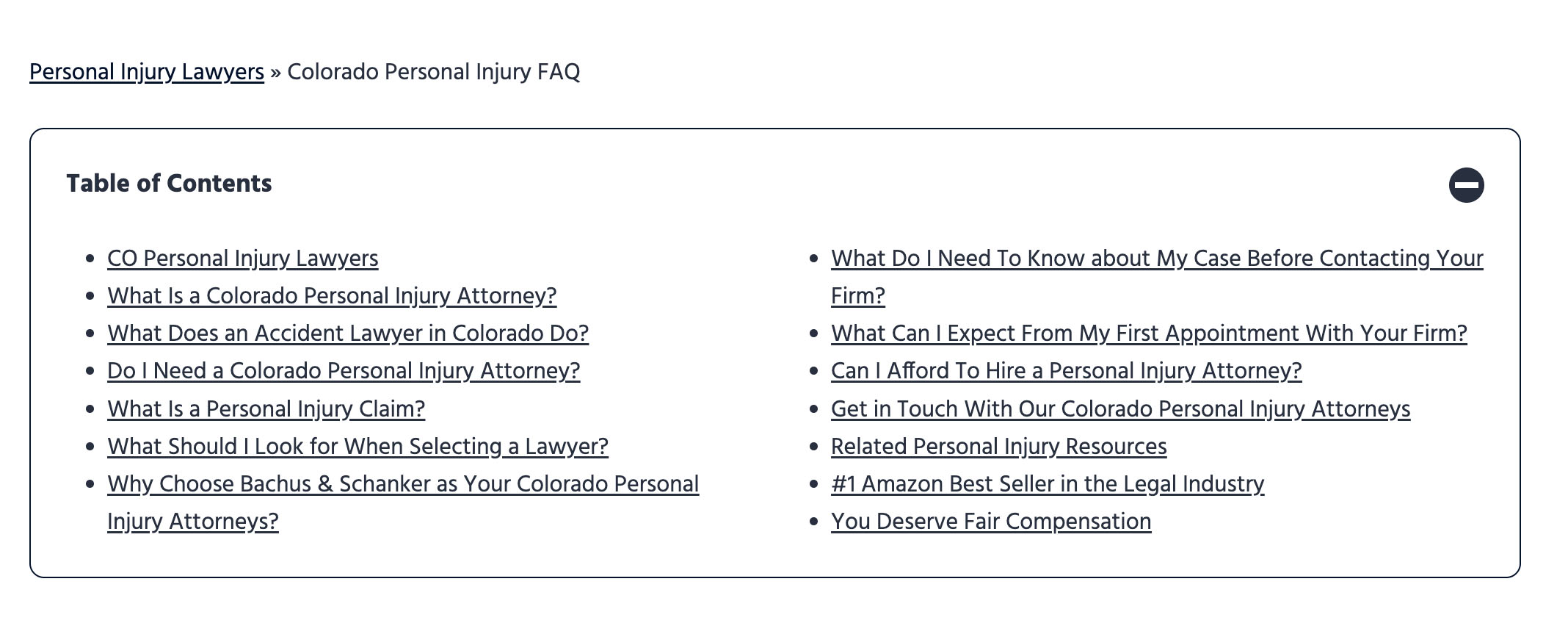
Best practice with blog article pages:
- Include a Table of Contents (TOC) at the top of blog articles.
- Don’t be overly promotional in your articles.
- Show attorney bylines, bios, credentials, and real-world experience.
- Cite trusted sources/references (especially important now that AI is prevalent in search).
- Create valuable, accurate information to “promote” your firm without trying (clicks, shares, and links).
- Answer the key questions from your target audience.
- Use images, video, or other media to break up text.
Attorney Bio Pages: Your Digital Business Card
Attorney bio pages are essential content for establishing EEAT.
Here’s a great example from an employment law firm with extensive information in the bio including: Areas of Expertise, Public Engagement, Strong Media Presence, Articles & Insights, Legal Publications, and Education
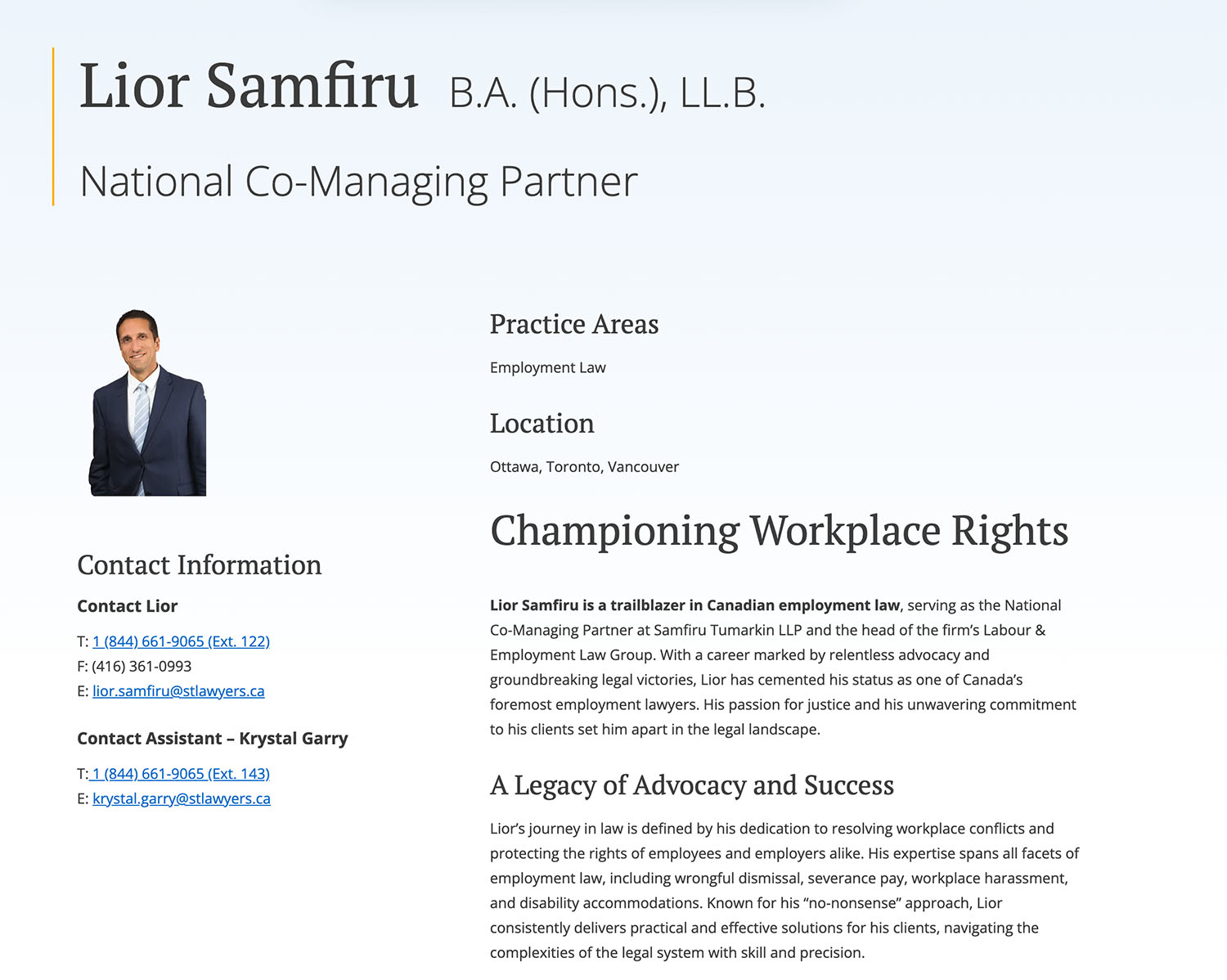
Here’s another style from an employment law firm in Florida.
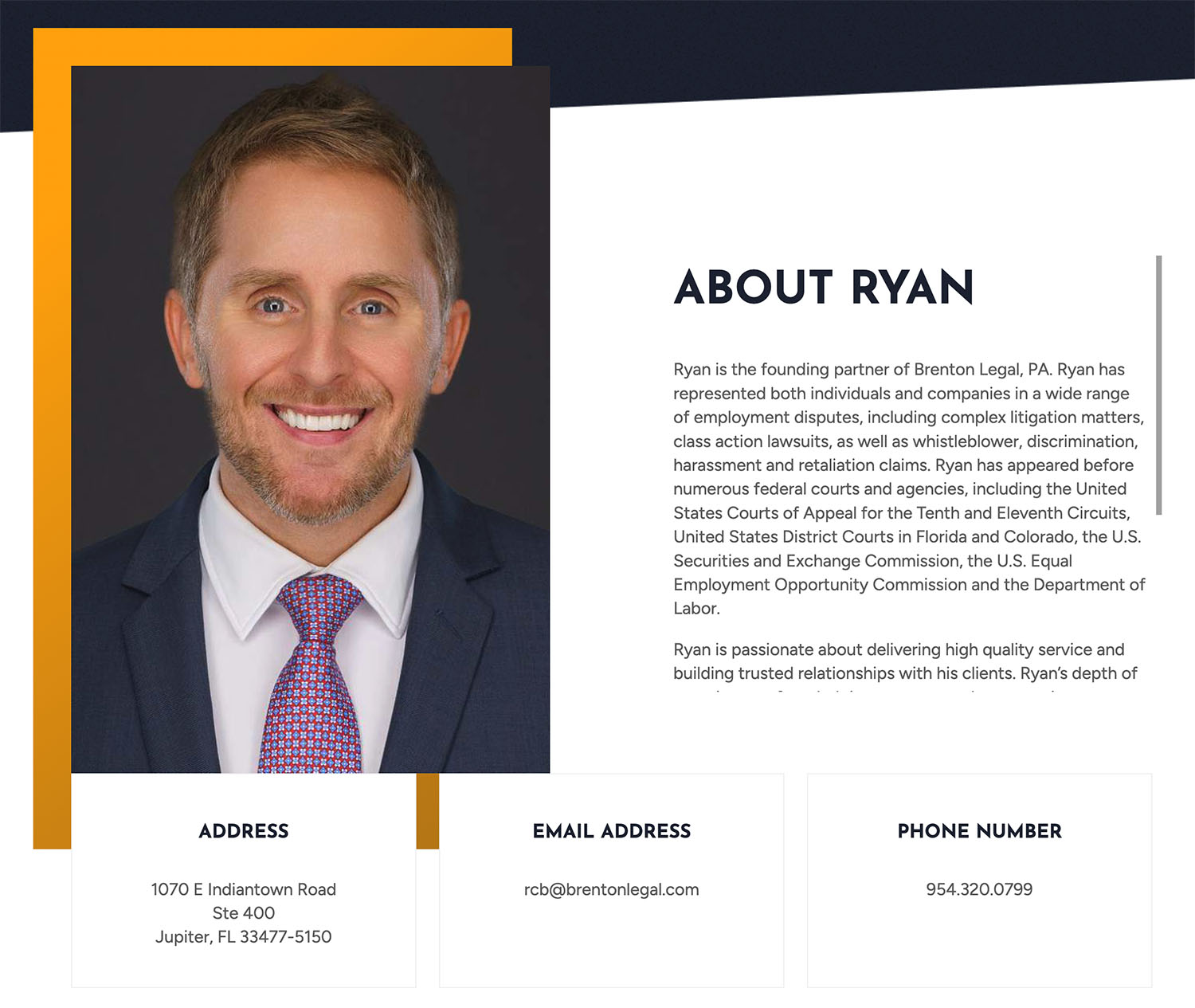
The bio information is much easier to process with the block designated for each area of his contact information, and following admissions, education, and areas of practice.
Best practice with bio pages:
- Don’t treat your bio simply as a CV.
- It’s OK to show personality, as well as education, legal qualifications, and achievements.
- Highlight any awards you have won.
- Keep it clutter-free and easy to read.
- Include a professional photo.
FAQ Pages: Get Rewarded For Answering Questions
FAQ pages help law firm websites rank in search AND move visitors through the sales “funnel” by answering their questions.
The main question you need to ask yourself is simply: What types of questions do your clients ask you every day?
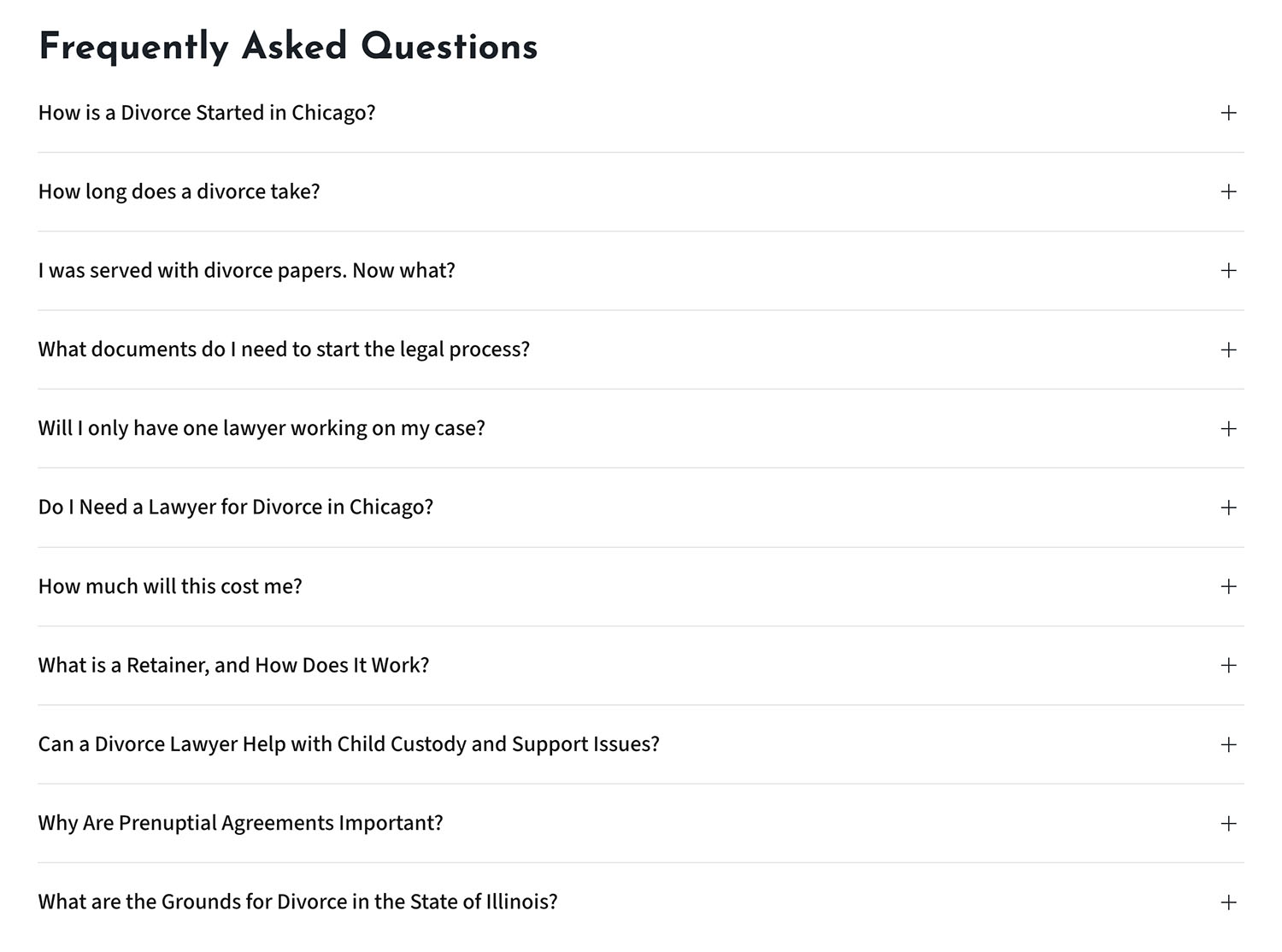
Here’s a great example from a family law firm in Chicago:
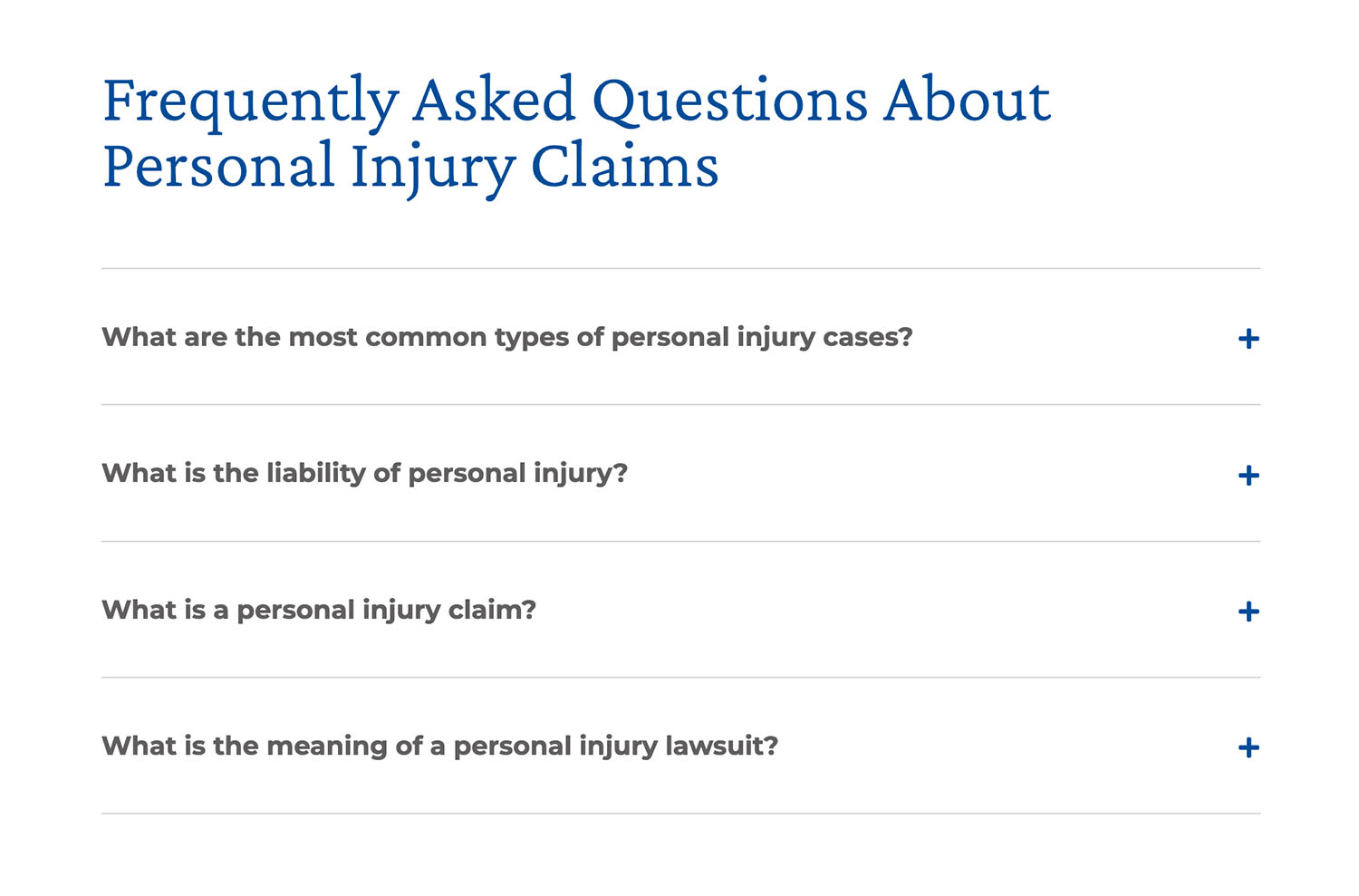
This is another dedicated FAQ page from a personal injury law firm in Tennessee:
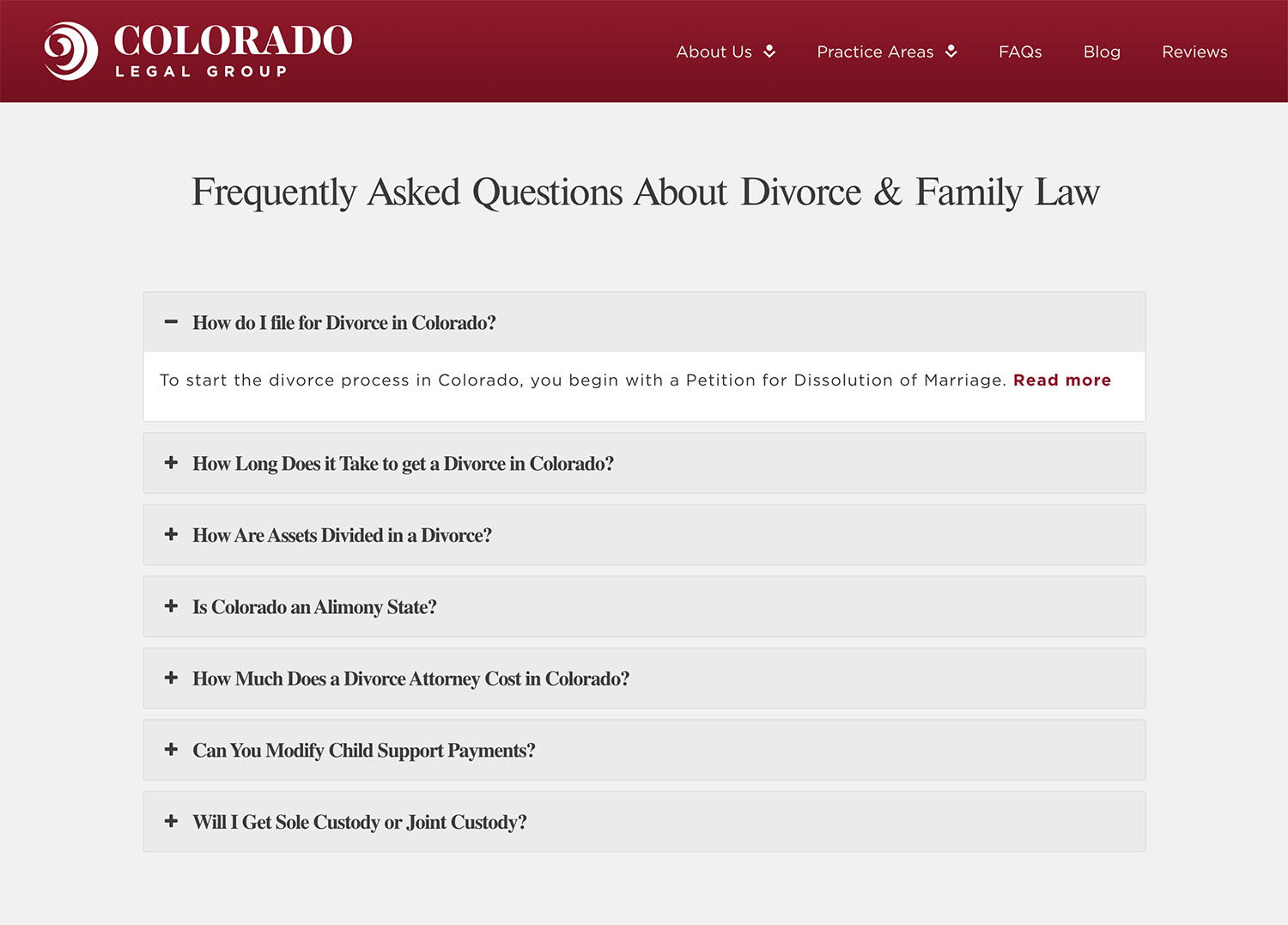
FAQs can also be scattered throughout the homepage or practice area pages. This example from a family law firm in Colorado features FAQs prominently on its homepage:
Best practice with FAQ pages
- Answer questions in as much depth as possible.
- Create entire articles on the most important topics.
- Shorter FAQs can be featured on dedicated FAQ pages or scattered throughout the website.
- Avoid legal jargon: use clear, plain language.
Successful Cases Pages: Your Conversion Catalyst
Showcasing successful results in your practice area informs visitors and Google about your expertise, professionalism, and legal skills (great for EEAT).
This “Successful Cases” page from Strategic Criminal Defence features hundreds, if not thousands, of successful case results:
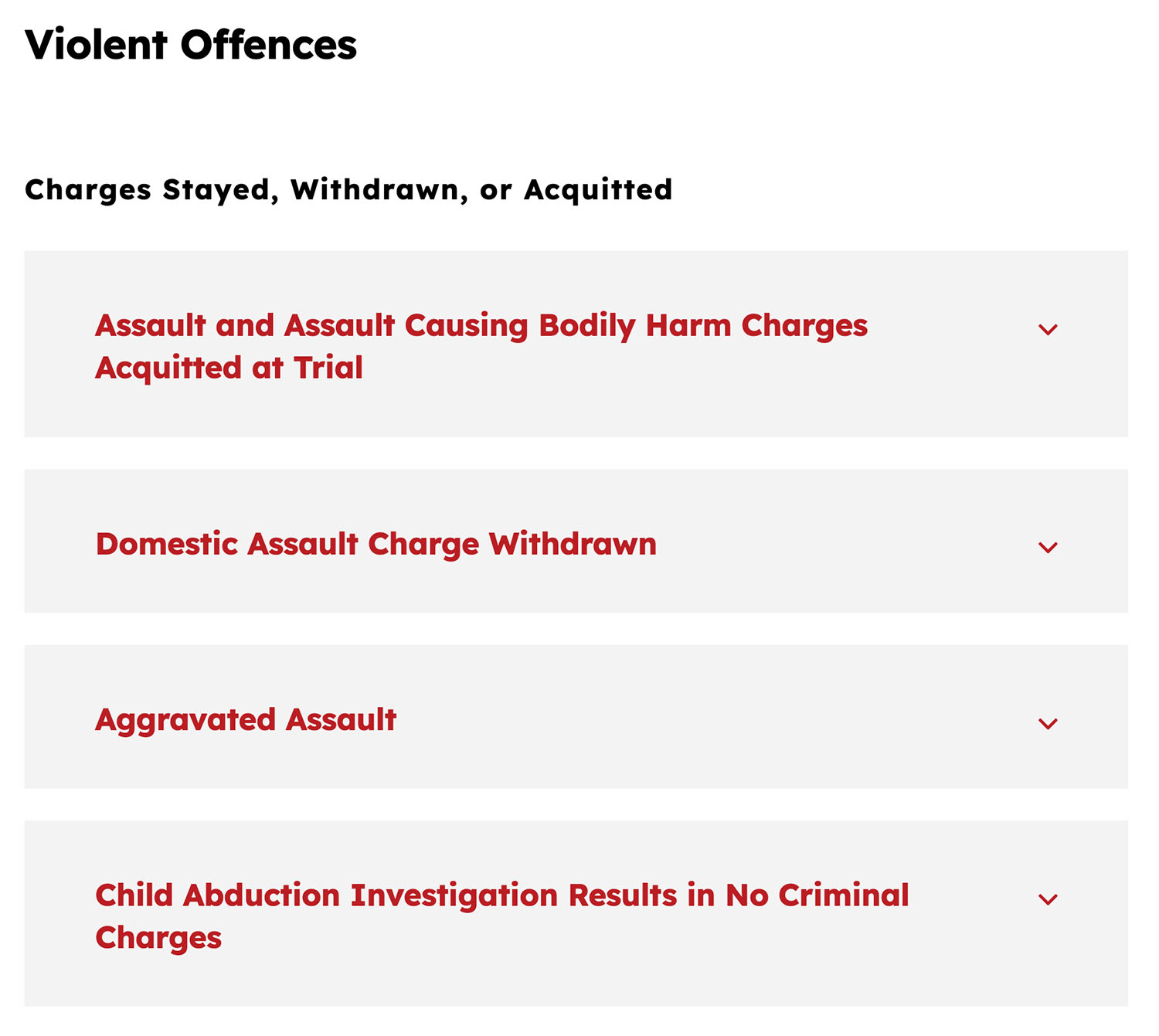
Click on the accordion-style dropdowns and you get the details of how the firm successfully defended the charges:
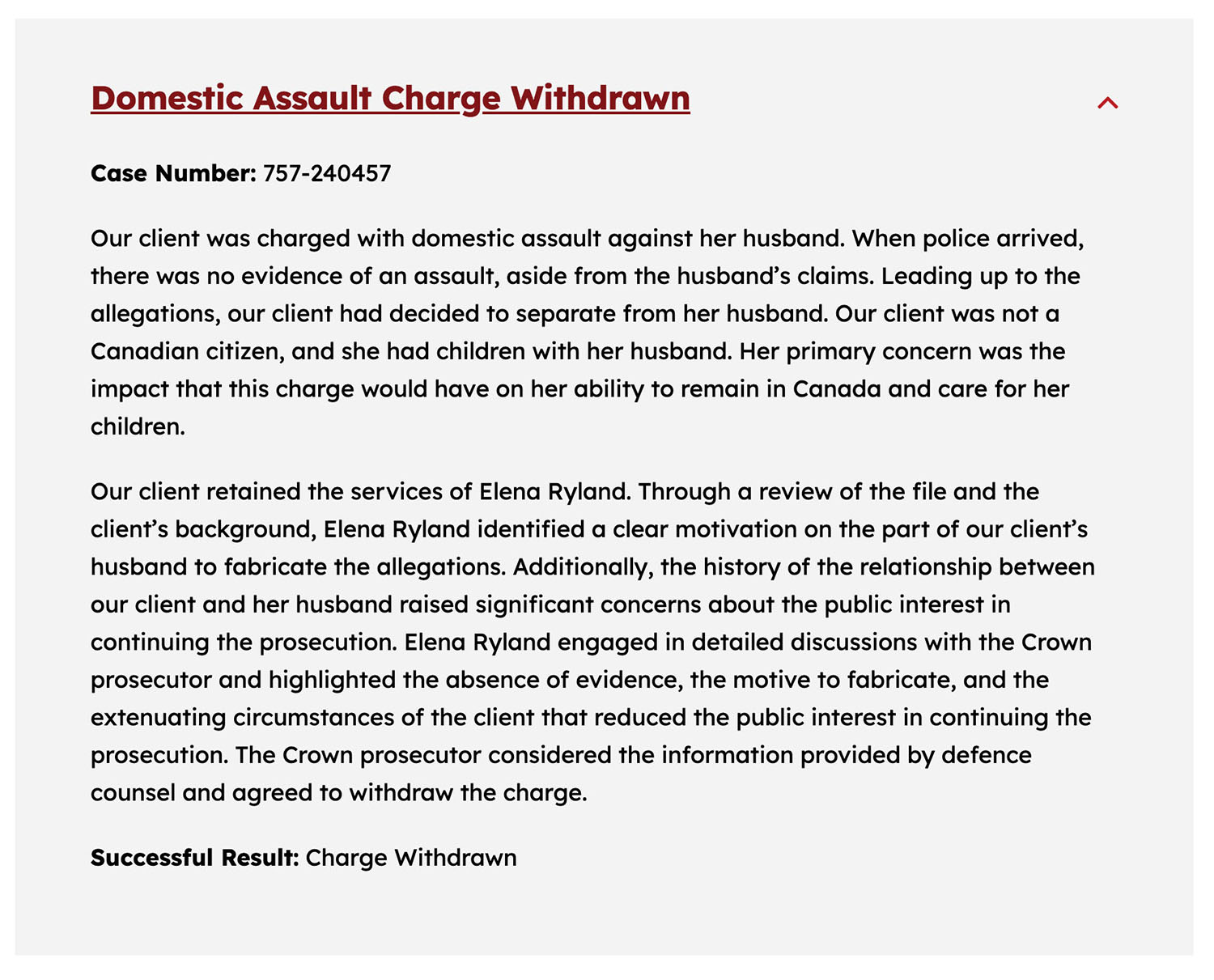
Best practice with case study pages
- Create a dedicated page.
- Highlight your firm’s best results.
- Detail verifiable outcomes.
- Ensure client consent and privacy compliance.
Best SEO practices for all content
Finally, here are some best SEO practice guidelines for all the content you produce:
On-site optimization involves refining a website’s structure, written content, and underlying code so that search engines can easily crawl and understand it.
Page-specific elements (“onsite SEO”) play a major role in how Google determines rankings.
If that sounds technical, don’t worry. Most of the improvements in this area will require collaboration with a web developer or SEO consultant.
Below are some key topics to guide those conversations.
Metadata Optimization
Every page on your website should have a meta title and description tags.
These appear as “snippets” alongside the URL in the Google SERPs after you type in a search term.
They inform users about the topic on the page:
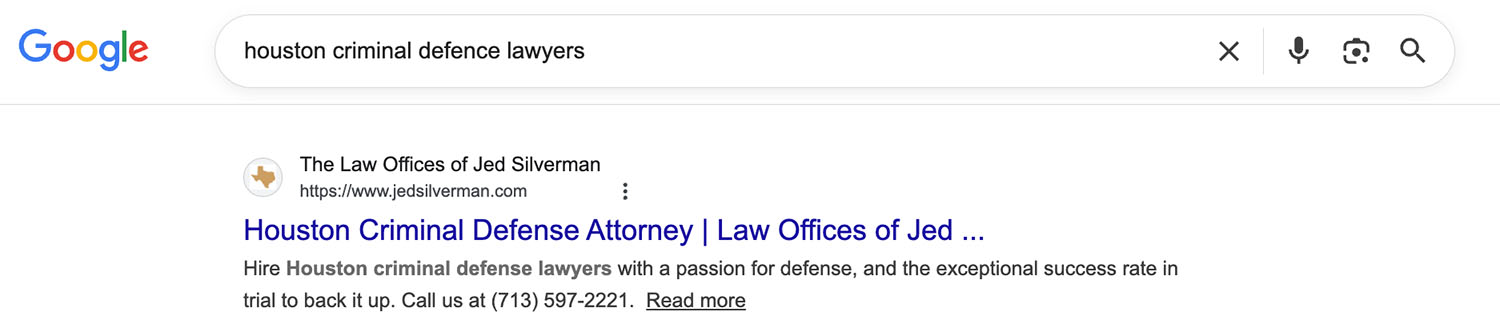
Getting this right is essential for onsite optimization, as it tells Google what’s on the page.
Here are a few tips to get it right:
Keyword Optimization
There are plenty of other places, besides in the meta titles and descriptions, to optimize for keywords on your website.
Most importantly, use keywords liberally in headers and sub-headers of pages: Google uses H1 and H2 tags as a relevancy signal.
This page is optimized for Calgary Criminal Trial Lawyers:
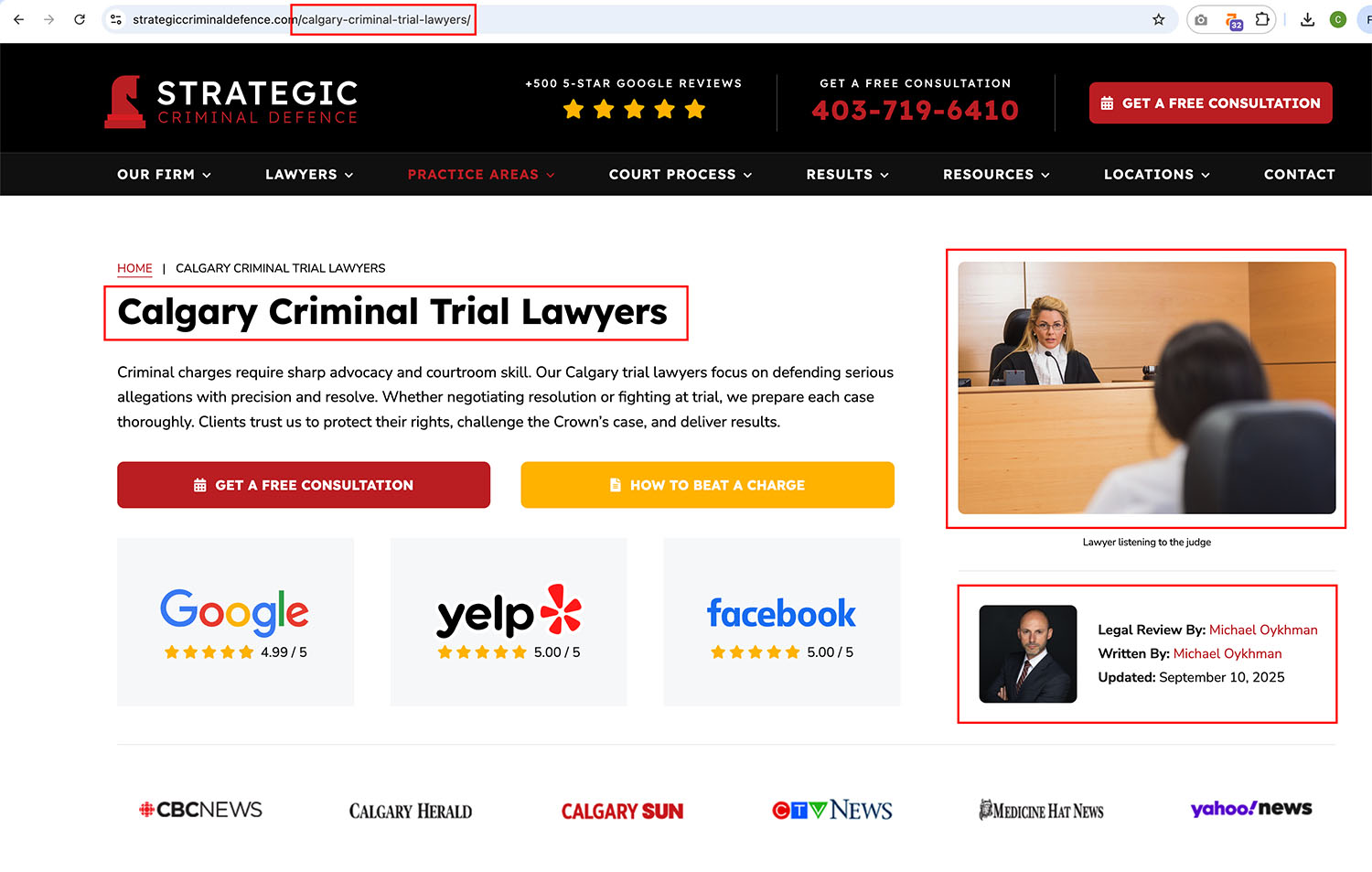
Don’t try to stuff keywords, it’s simply not needed anymore.
Google uses advanced Natural Language Processing (NLP) and models like BERT or MUM. These understand context, synonyms, and the relationships between entities rather than just looking for statistically related words.
Key takeaway: Add keywords naturally to content, especially early in the piece (the first 100 words is a good guideline).
Internal linking
There’s a whole section on backlinks later but don’t ignore internal linking as a strategy for onsite optimization.
Internal links are links to another relevant page on the same website, intended to aid navigation.
Google expects to see internal links, so you should use them across your site from the home page through to your blog articles:
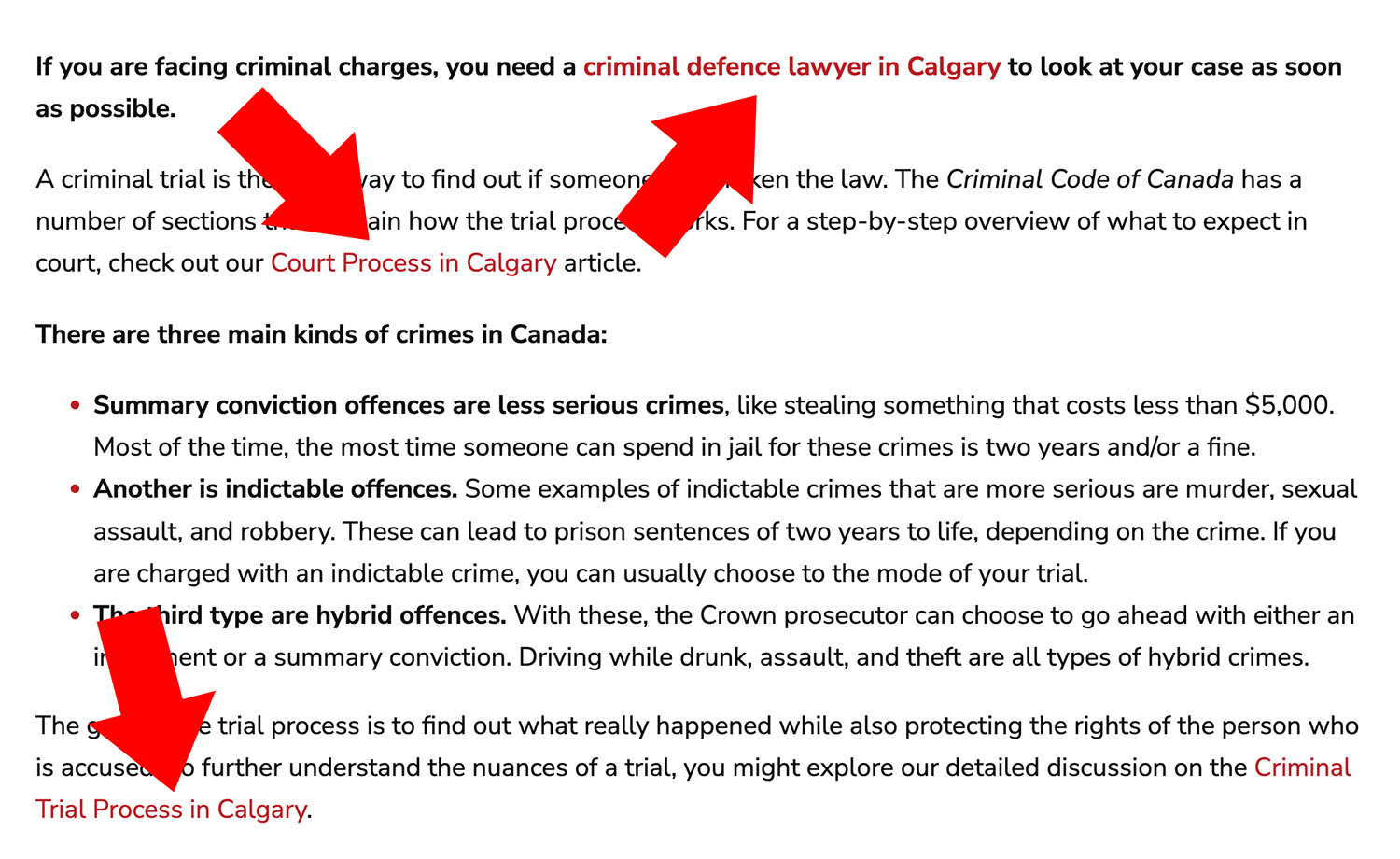
Internal links help the user experience and Core Web Vitals, a key ranking factor. Users can navigate more easily through your website AND it’s easier for Google to crawl it.
By directing users to other relevant information, you also encourage them to remain on your site longer, lowering bounce rates and improving dwell time.
This can help boost rankings.
Page Speed Optimization
Another Core Web Vital, if you recall, is page-load speed.
Page-load speed directly correlates with bounce rates, with slower sites causing users to leave immediately. Google statistics show dramatic increases in bounces as load times extend beyond just 1-2 seconds.
You can check page-load speeds on your site using Google’s free PageSpeed Insights tool.
This website is fast, passes the Core Web Vitals test, and enjoys excellent rankings:
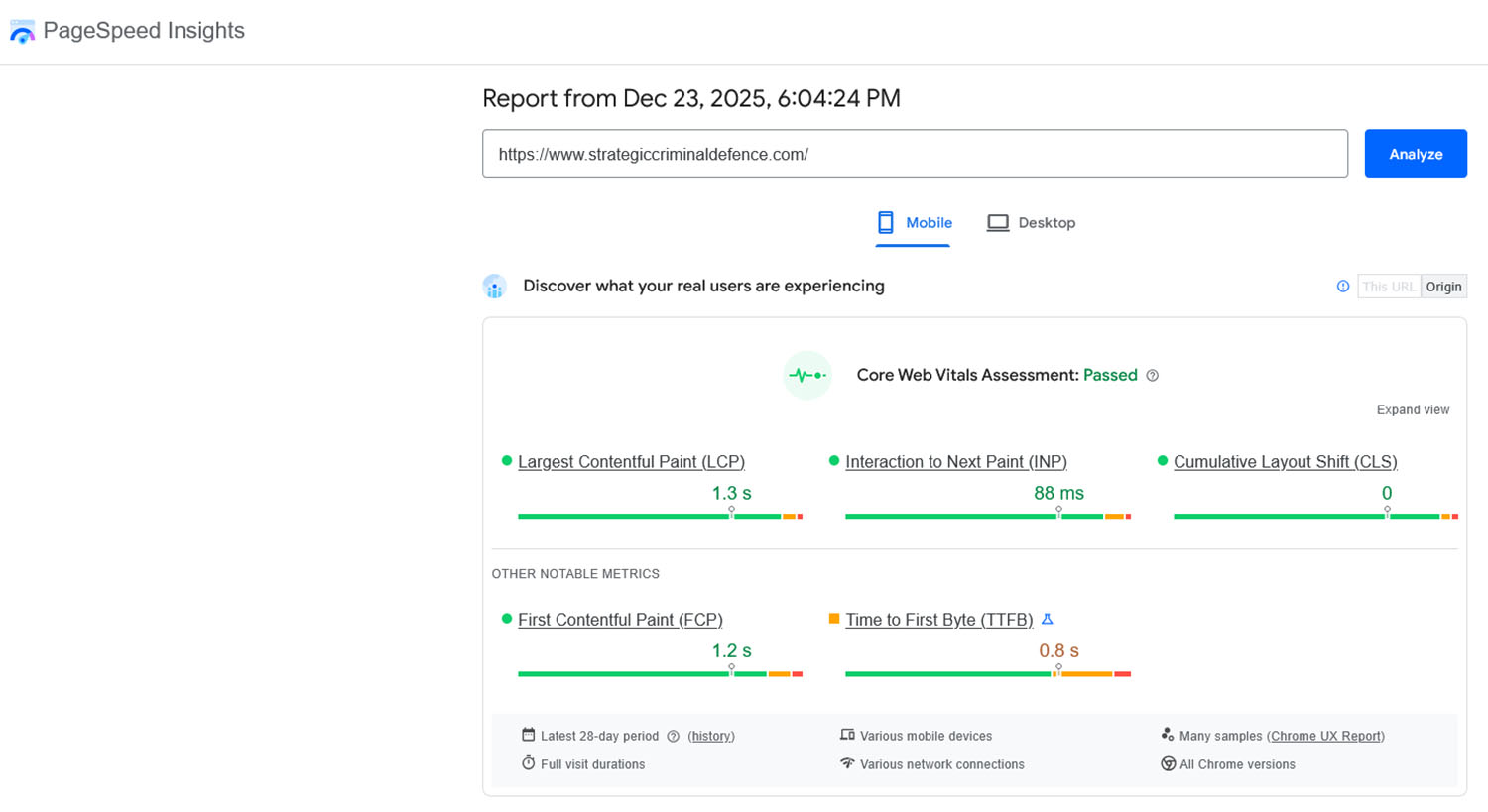
Ultimately, to increase the speed of your website:
Facebook Open Graph (OG)
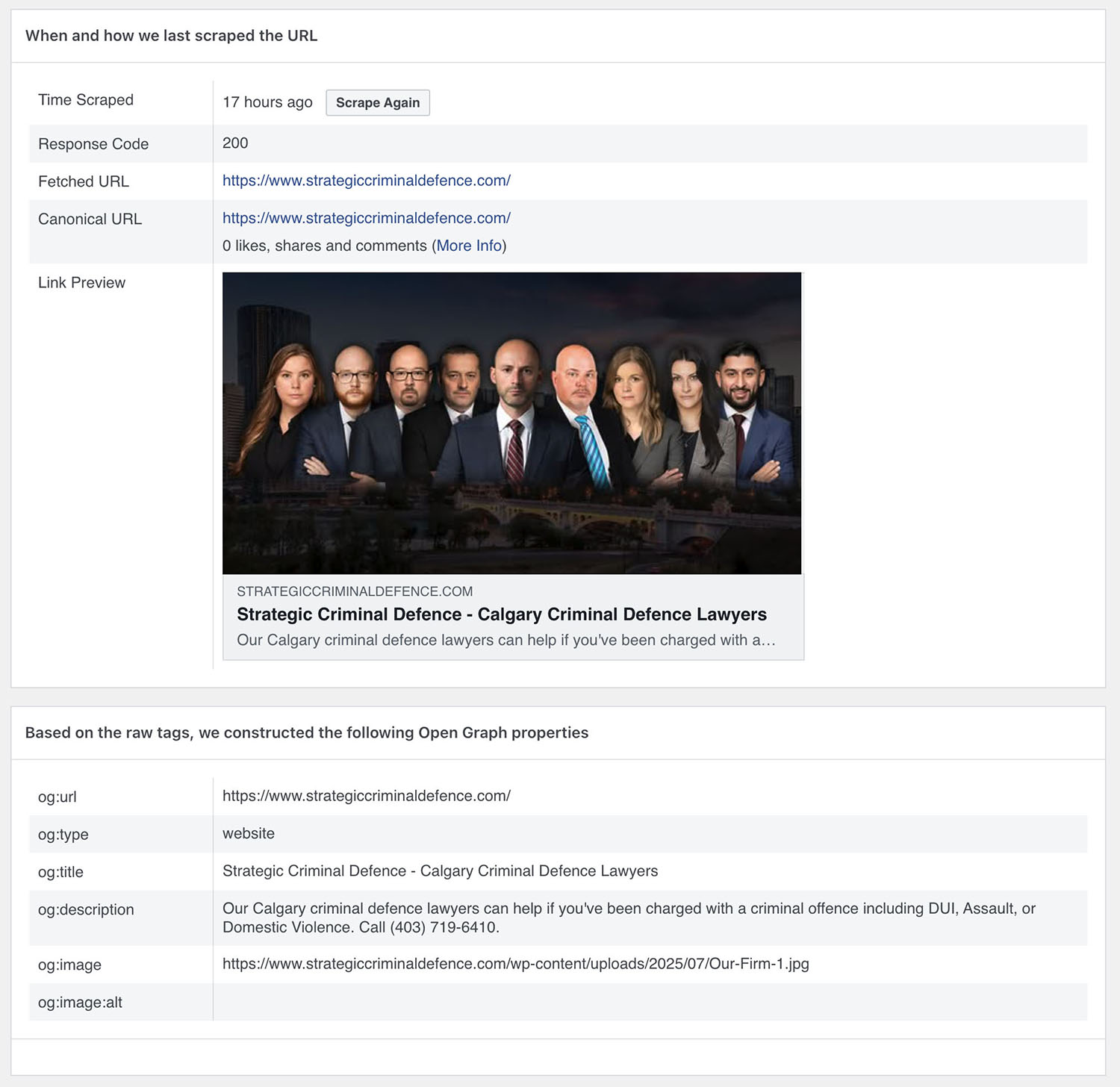
Facebook Open Graph (OG) tags are meta tags added to a webpage’s HTML that control how content appears when shared on Facebook and compatible platforms like LinkedIn or Messenger.
When someone shares a link, OG tags specify: the image, title, and description for rich previews instead of generic links.
Law firms should implement OG tags on case studies, blog posts, and service pages to boost social shares and clicks.
You can test and preview how they appear with Facebook’s Sharing Debugger.
Schema Markup
Legal service schema is a type of webpage markup that guides search engines to understand the structured data on a web page.
That sounds technical but implementing it basically improves the structure of your law firm’s website, reduces ambiguity, and helps SEO.
For a non-developer, schema.org markup can look like an alien language. I’ve tried to simplify and breakdown what this structured data represents.
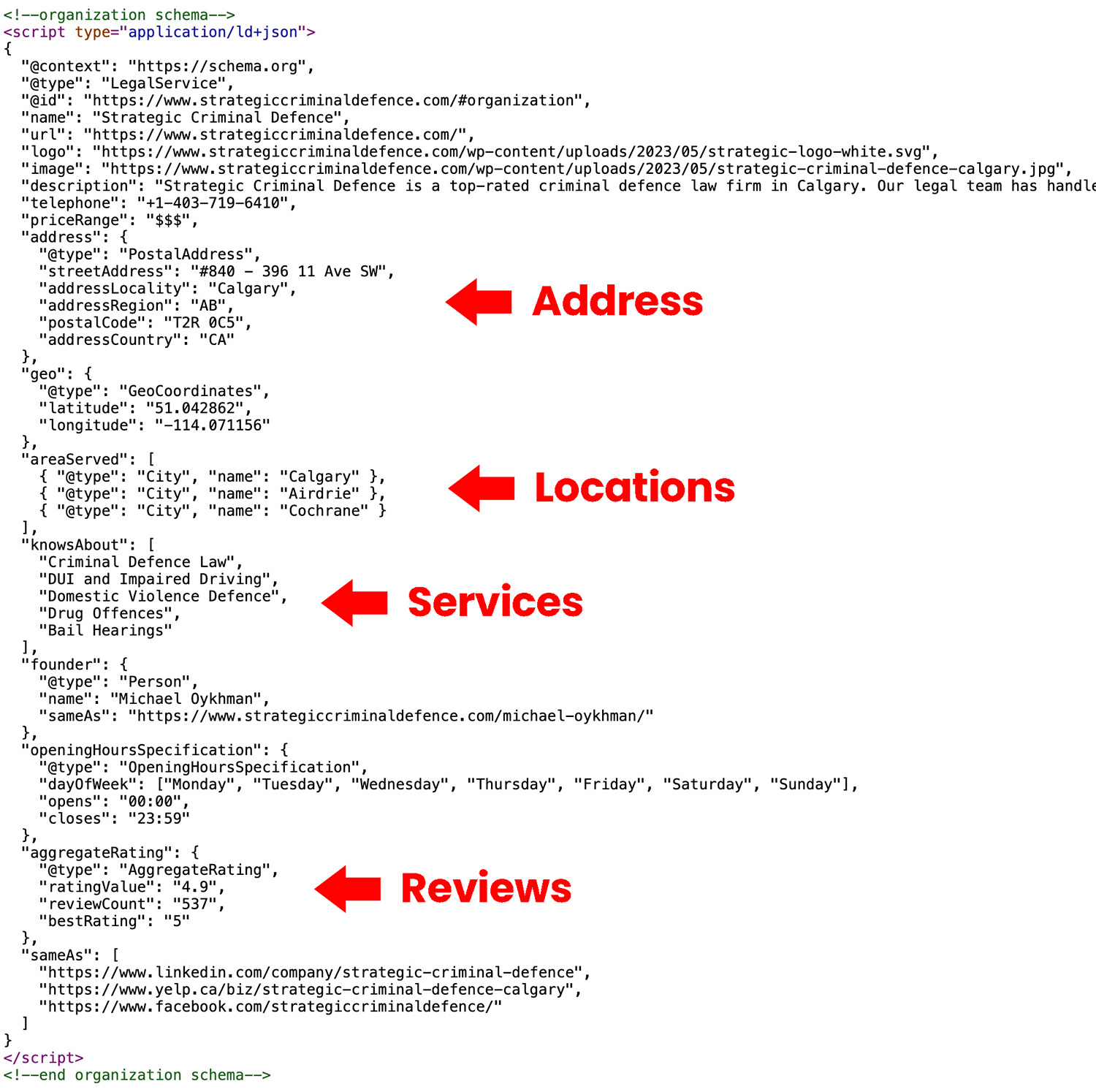
In my opinion, tagging a firm with LegalService schema is the most important.
However, here are a few other types of schema markup for your law firm:
- Location schema: viewed and interpreted by search engines without appearing in search results.
- Attorney schema: identifies an entity and a law firm, viewed and interpreted by search engines without appearing in search results.
- FAQ schema: identifies a question and its answer, displayed in Google’s search results before a website’s meta description tag.
- Review schema: identifies information in a review, including the reviewer, the review, and a rating, displaying in Google’s organic search results (see example below)
Local search optimization should be a strong focus of SEO for lawyers, as most firms compete for local business.
Local SEO targets geographically relevant searches.
Cracking this type of SEO helps law firms connect with local clients in their practice area, many of whom are actively looking to hire a local lawyer.
People are out there right now searching for “car accident injury lawyer in Michigan”, “family lawyer in Connecticut” or “drug offense attorney in Fresno”.
The cornerstone of local SEO is the Google Business Profile and appearing in the Google Map Pack (aka Local Map Pack):
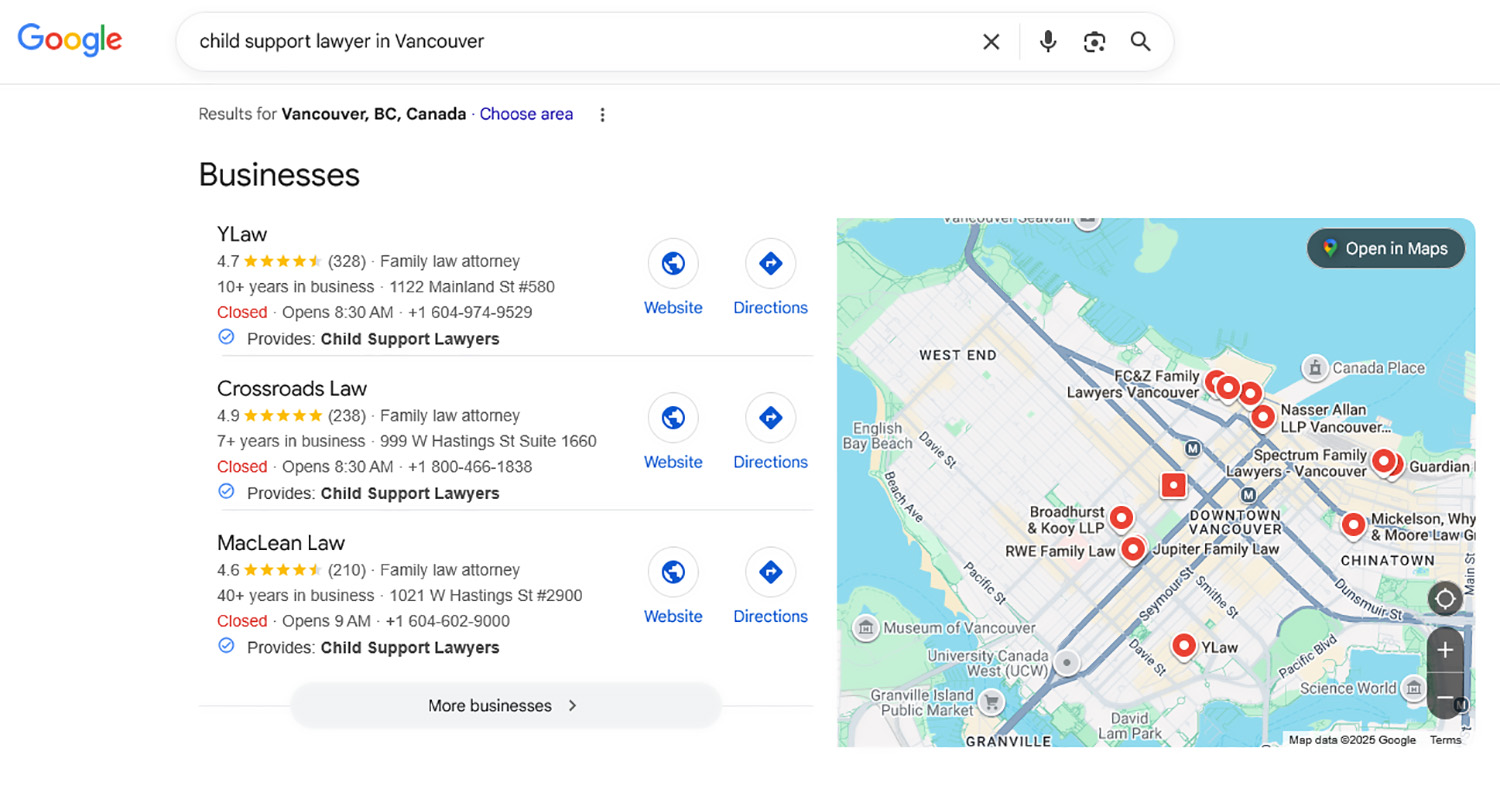
Why do you need to master local search and appear in the Google Map Pack? 75% of users only engage with the top three local pack results in Google Maps.
To start, you need to understand what the main ranking factors are with local search. They are different from those already discussed for general SEO.
Local search ranking factors
From Google’s own guide on how to improve your local ranking on Google, we can interpret the following as the key local search ranking factors:
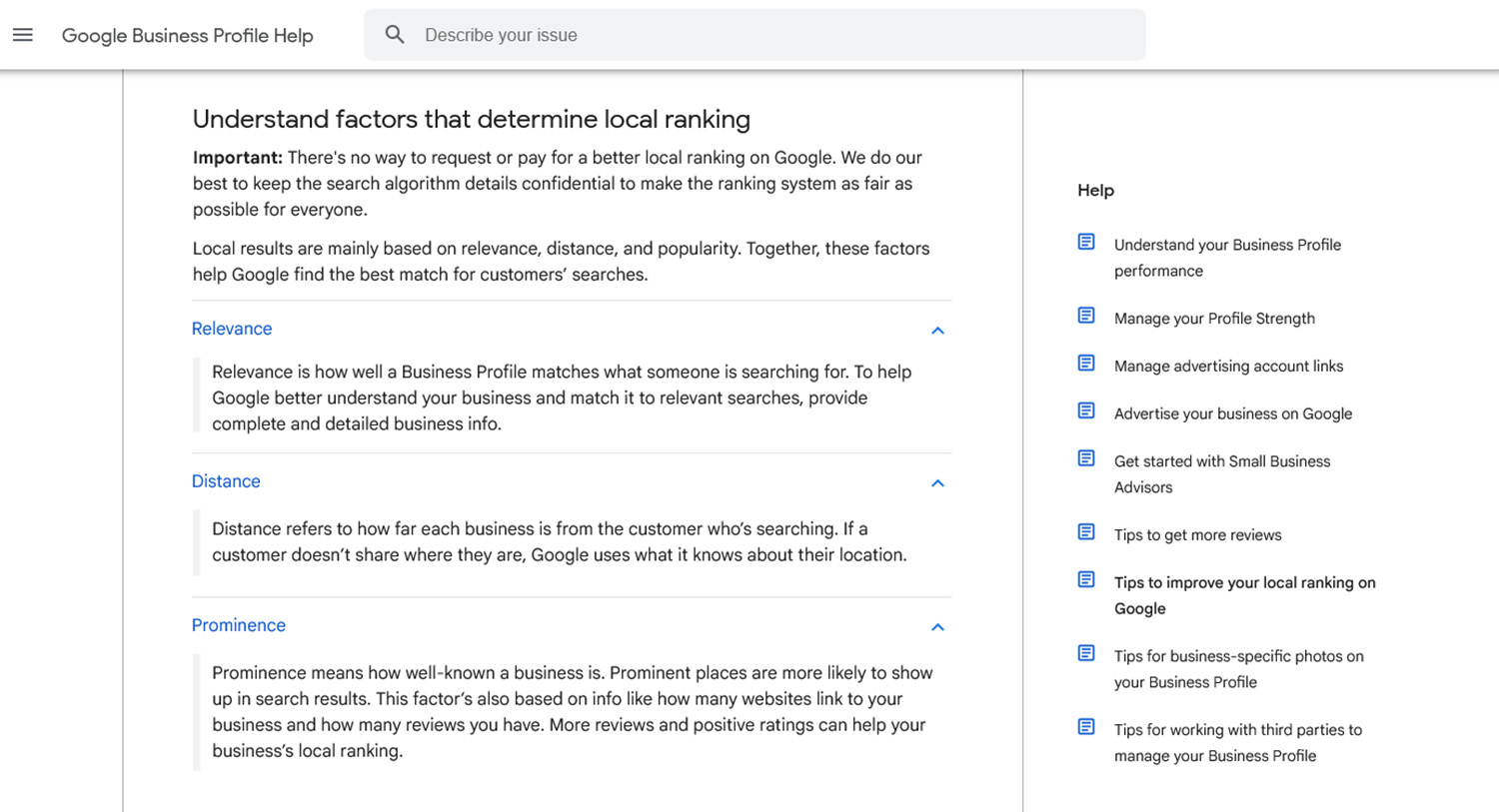
Further, each year a study called the Local Search Ranking Factors is conducted by Whitespark showing the top rankings factors in the local map pack results.
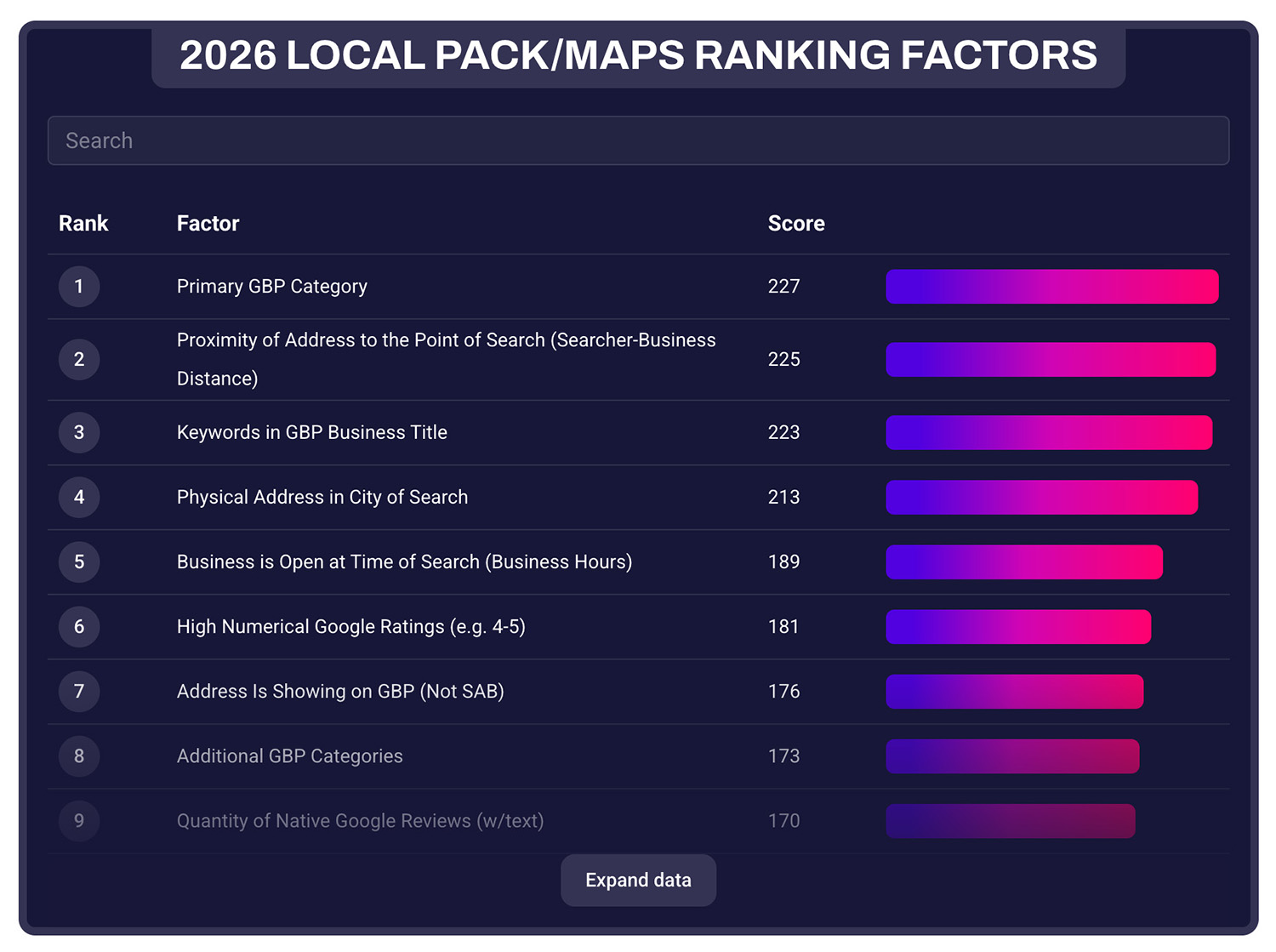
Both resources illustrate the importance of three things: relevance, distance, and popularity.
Relevance
Google’s main local search job is to determine which Google Business Profile listing best matches a search query.
So, if someone is searching for “drug trafficking lawyer near me”, Google wants to send that person to the most credible resource.
To boost the chances of your criminal defense firm occupying one of the three Local Pack positions for such a query, you’ll need to optimize your Google Business Profile.
There’s more about this below, but pay special attention to:
- Choosing the right law firm category (Criminal justice attorney).
- Providing a comprehensive description of your firm and practice area.
- Maintaining consistent business information.
- Including images and video in your profile.
- Including business updates.
- Adding products (which for law firms are its services).
- Answering client questions, or drafting your own.
It’s important to note that the most important factors, the critical to your GBP ranking success, is your firm’s primary category and inclusion of keywords in your business name.
You will find greater success if you name your law firm Brand Name + Practice Areas, such as McKenzie Family Law, than you would be to name it McKenzie & Associates.
Distance
One of Google’s top ranking factors is distance or explained more accurately, the searchers proximity to your law firm.
That’s why your precise location, and the areas you serve, is so important in your Google Profile.
Other location-based factors that impact your local SEO rankings include:
- Proximity of Address to the Point of Search (explained previously)
- Physical Address in City of Search
- Proximity of Address to Centroid
If you’re curious where the Centroid of your city is, simply open Google Maps, and search for your city. Then get directions to that location.
Here’s how it appears for Calgary:
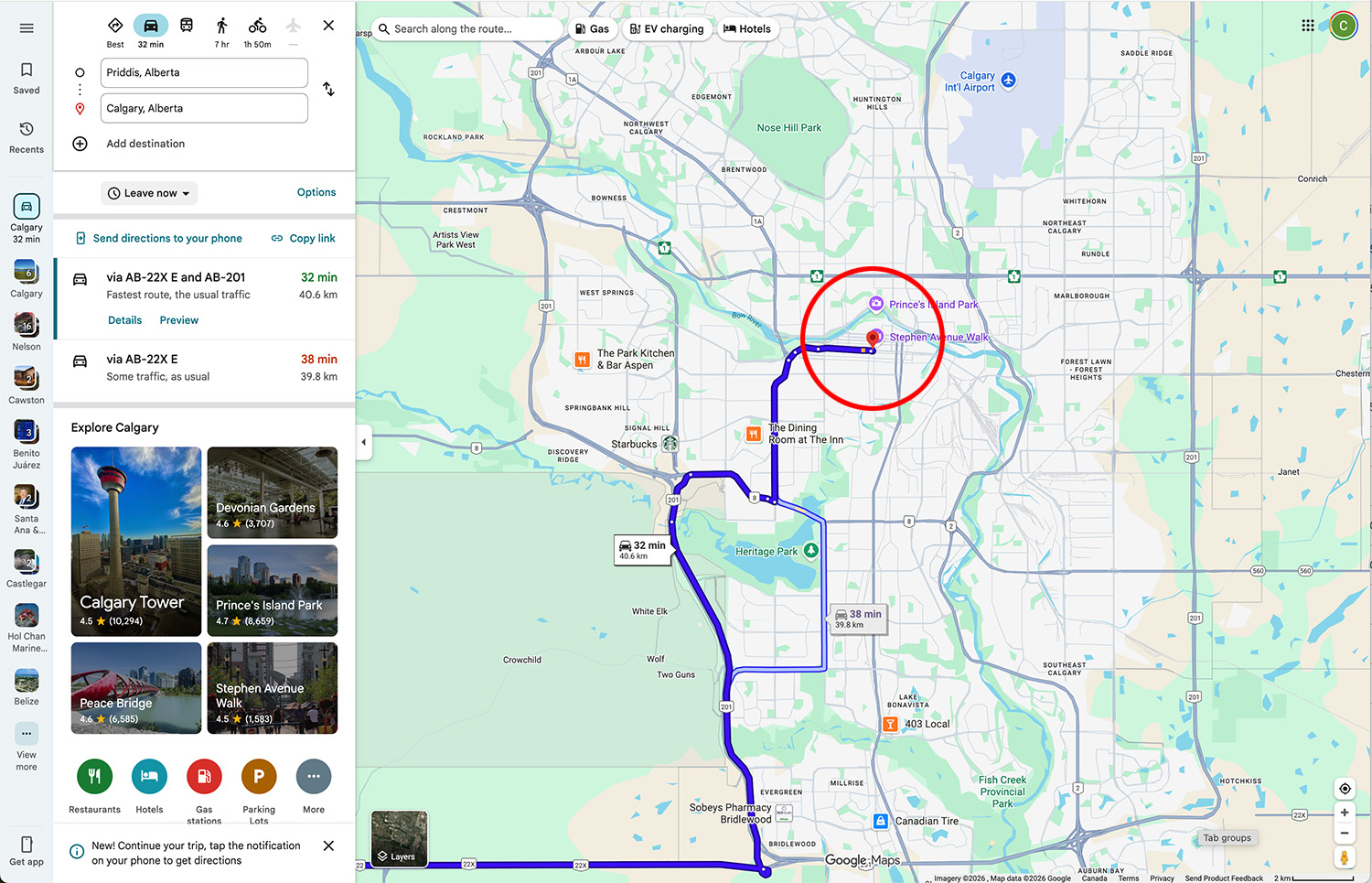
Clients may be prepared to drive a little further to find the right lawyer than the right burger joint but roughly the same metric applies.
Prominence
Prominence or popularity is the third key local search ranking factor.
This one requires the most work. Local law firm SEO is competitive, so making your firm popular and prominent can be a challenge.
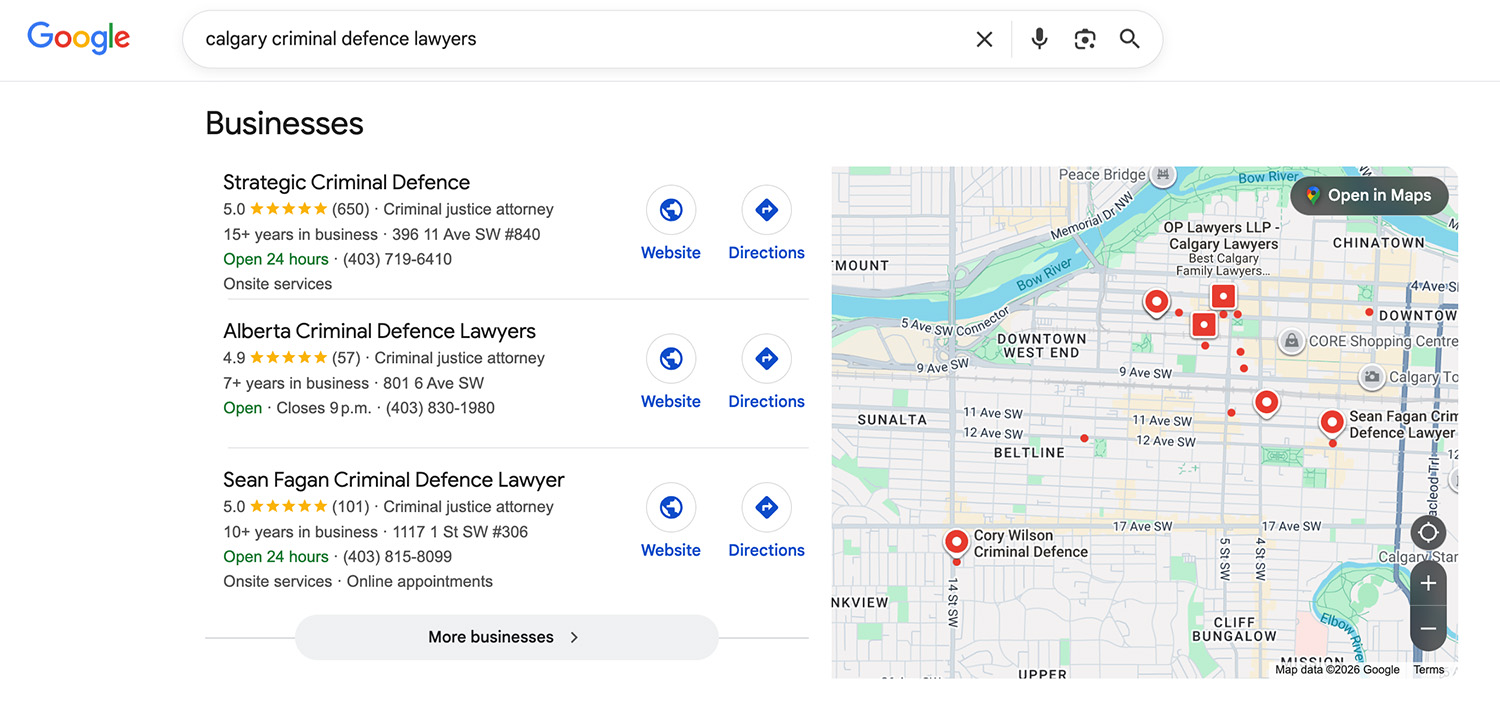
You need to focus on:
- Backlinks, which are like “votes of confidence”.
- High Numerical Google Ratings (e.g. 4-5)
- Citations in directories.
- Consistent NAP (business name, address, phone number) across all web properties.
- Images in your Google Business Profile.
These are all covered in more detail below.
Complete your Google Business Profile details
Did you know that Google frequently takes information directly from your Google Business Profile rather than your website for local search queries?
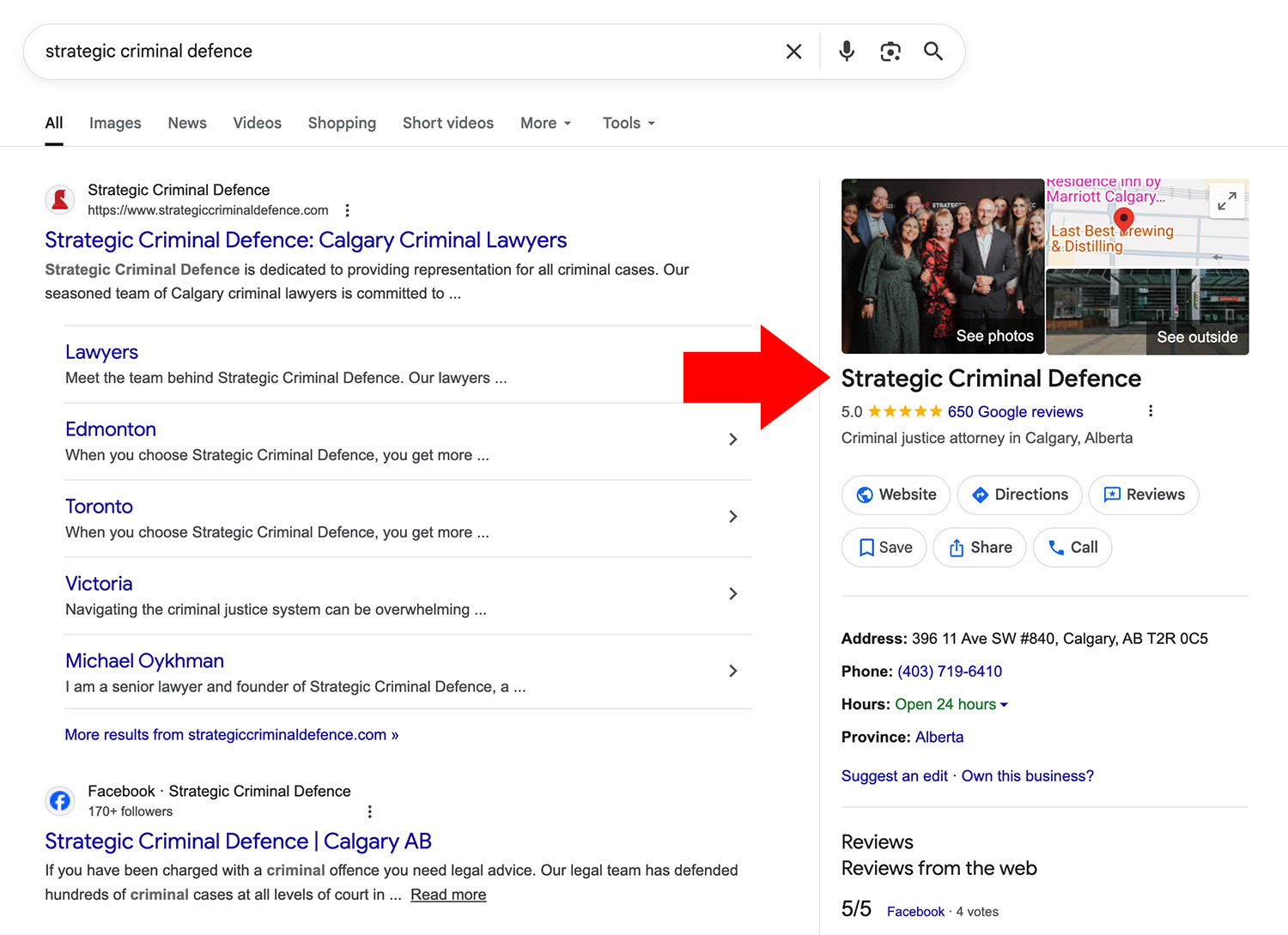
Complete profiles generate up to seven times more clicks. Yours should look something like this on the right-hand side of Google’s SERPs if you type your firm’s name in the search bar.
I’ve referenced it multiple time already in this post, but the Strategic Criminal Defence profile is an excellent example of a well-optimized profile.
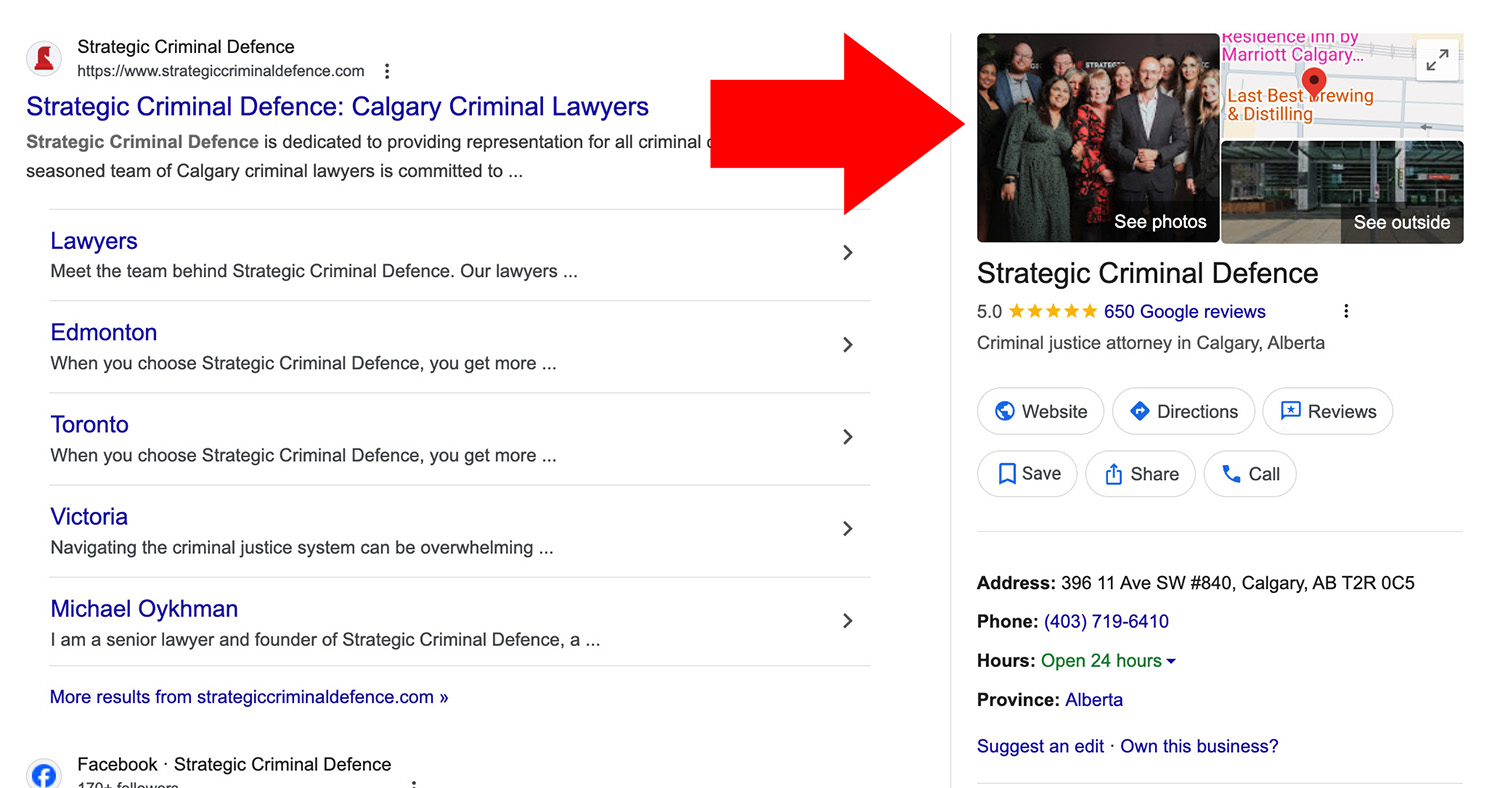
To get there, you need to optimize it with the following:
- Place your business location accurately on Google Maps.
- Link to your official, authoritative business website.
- Provide complete business details, including opening hours and other relevant information.
- Maintain strict consistency in your NAP across your website and all online listings. Google pulls data from multiple sources, so addresses and contact details must match exactly everywhere.
- Select the most relevant and specific primary category for your business to appear in the right searches (e.g., “Criminal Justice Attorney” rather than “Law Firm”).
- Upload high-quality photos of yourself, your team, and your office.
- Write a compelling business introduction that highlights key services, incorporates relevant keywords, and includes helpful links.
- Actively encourage clients to leave reviews.
- Link to blog content in regular posts.
Doing all the above will increase your firm’s visibility in the map pack, enhance your prominence, and help you rank well in local search.
Now, let’s quickly take a closer look at some of these elements.
Attract reviews
Reviews strengthen trust. Everyone reads testimonials for all types of products/services and law firms are no exception.
Reviews also improve local search performance. Google includes reviews as one of the main ranking factors in local search. You simply don’t see unreviewed or poorly reviewed law firms in the map pack, which is where you want to be.
Look at the 5-star ratings of the firms featured for a search for “divorce law firm in New-Hampshire”. All firms have well over 100 Google reviews:
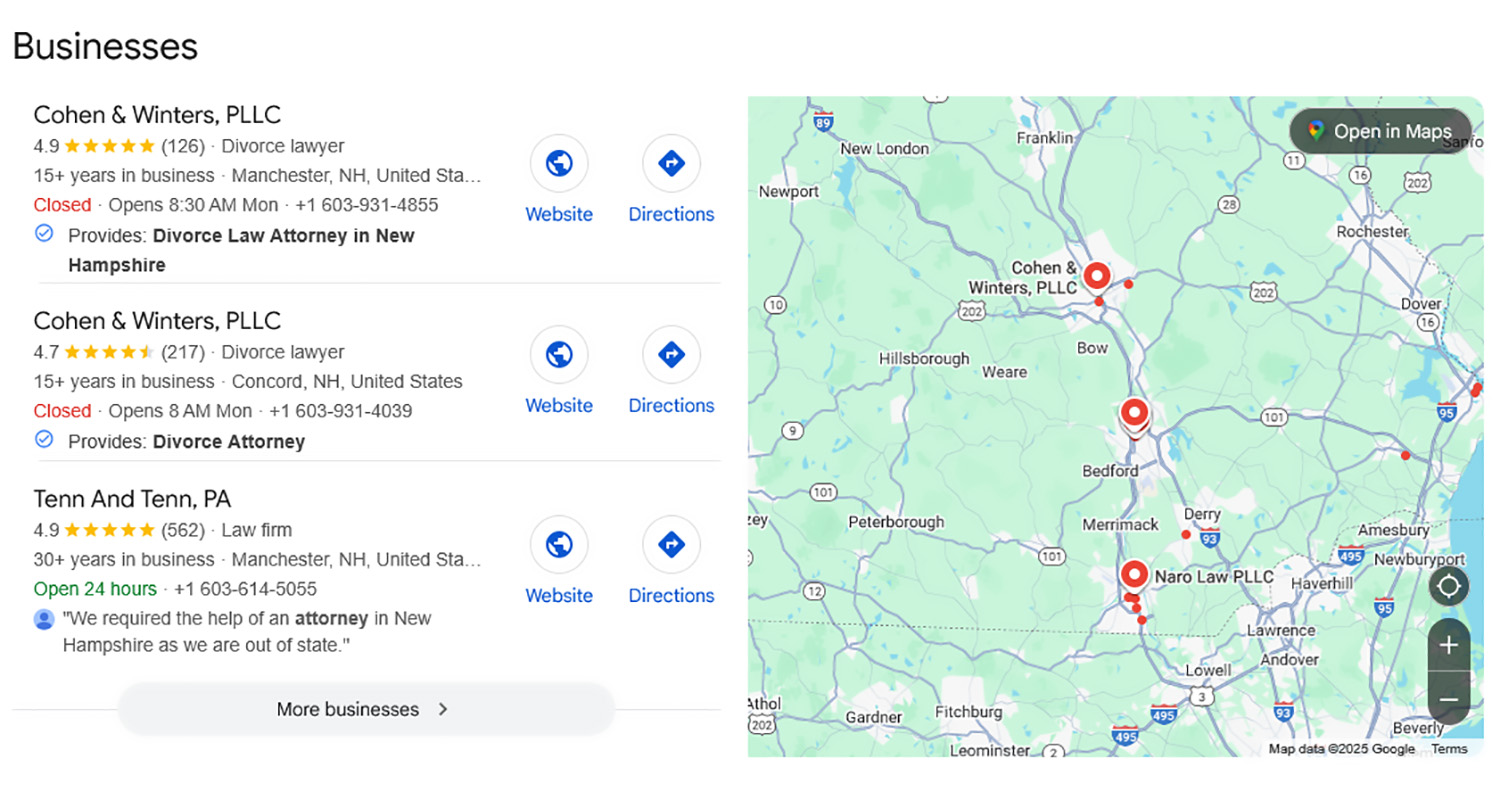
Don’t forget to reply to reviews, as this helps to keep you top-of-mind, shows Google that you are active and paying attention, and shows potential clients that you are approachable.
Create regular posts
Posting on your Google Business Profile boosts prominence because:
- It signals to Google that your firm is active and locally relevant.
- It shows Google you maintain your profile with fresh content (it’s not just static).
- It adds business legitimacy and encourages engagement (calls, clicks, etc.)
- Keywords can be used in the content (great for rankings).

For best results, use software like BrightLocal, Whitespark, or Buffer to help with scheduling posts.
Re-use blog or FAQ content rather than creating anything new.
Post 1-2 times per week, including an image, and link to the post on your website.
Upload images
Images also help increase visibility in local search and credibility for your law firm.
Try to include 10-20 images that represent what you do, where you are located, and who you are:
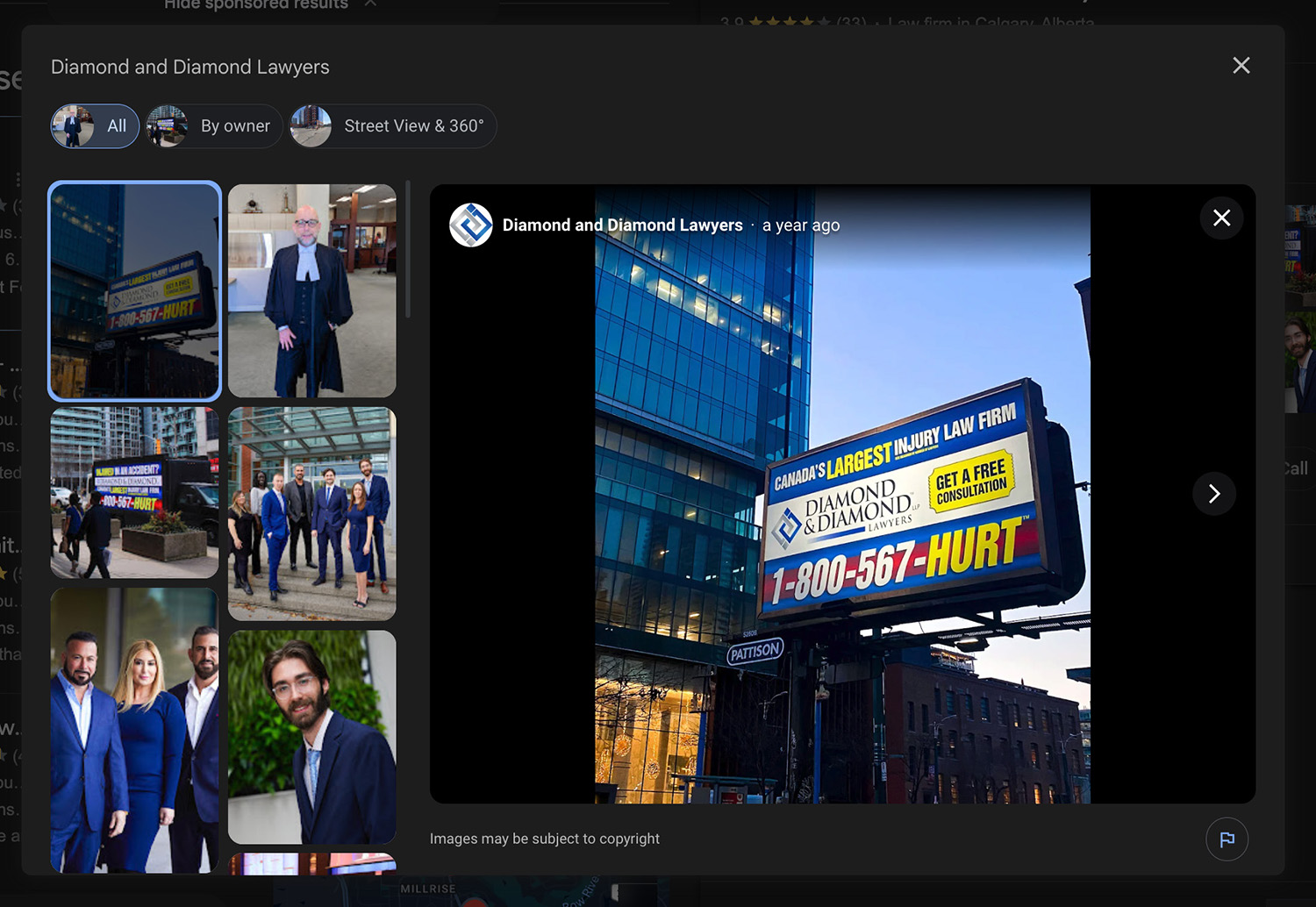
Build citations
Beyond your Google Business Profile, citation-building is another cornerstone of local SEO for lawyers.
Citations are mentions of your firm’s Name, Address and Phone Number (NAP) on other websites that may or may not include backlinks.
Providing you keep your NAP consistent, citations can add a lot of juice to your local search efforts, supplementing an optimized Google Business Profile to add credibility, relevance, and authenticity to law firms.
Top citation sources
The best citation sources to target are well-established, reliable websites with good domain authority.
Structured citations
These are citations from the prominent law firm directories like Avvo, FindLaw, Lawyers.com, and Justia, as well as Yelp, Yellow Pages, etc. (most listings are free but some are paid).
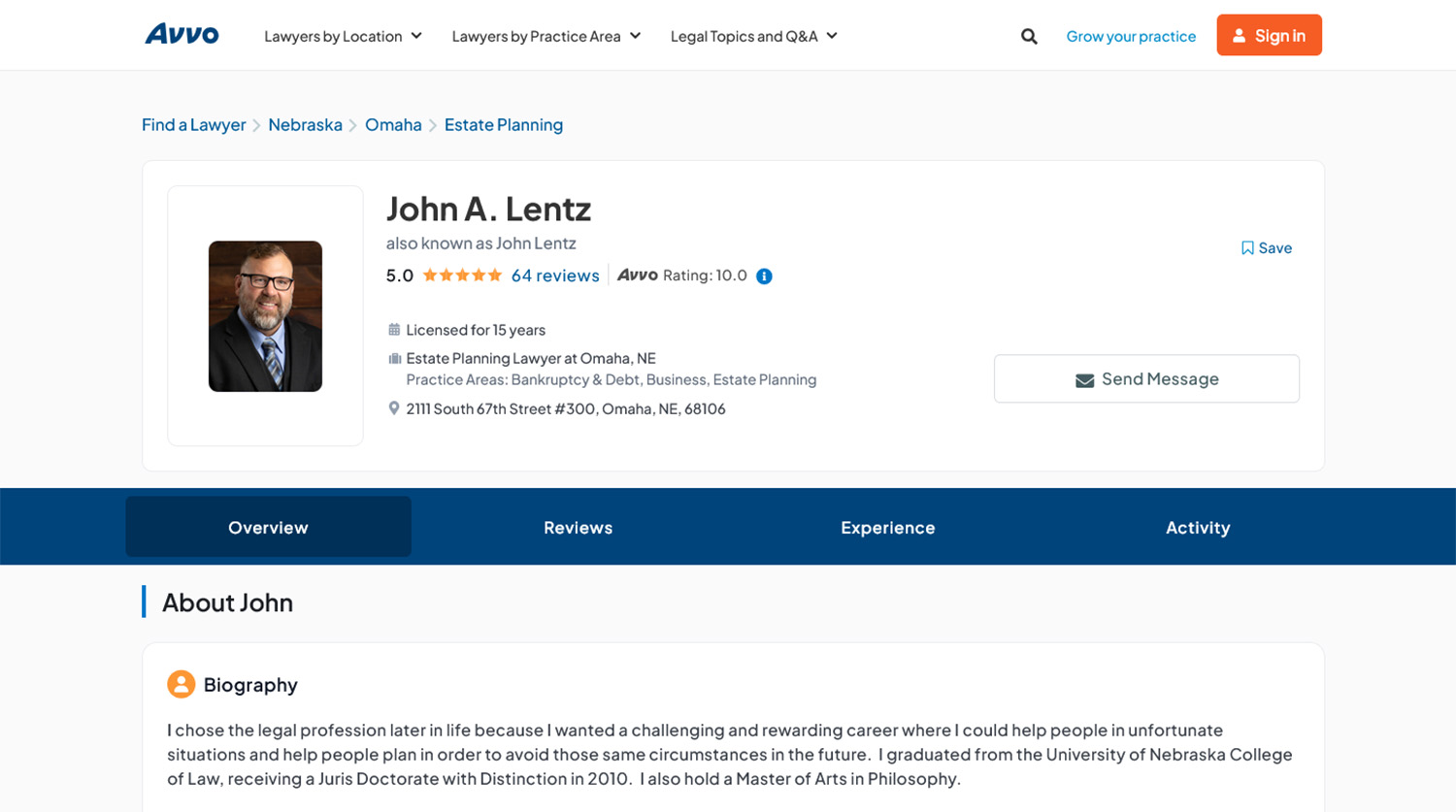
Here’s what a citation looks like on Avvo:
Unstructured Citations
These are (mentions) on legal blogs, government websites, local media websites, etc.
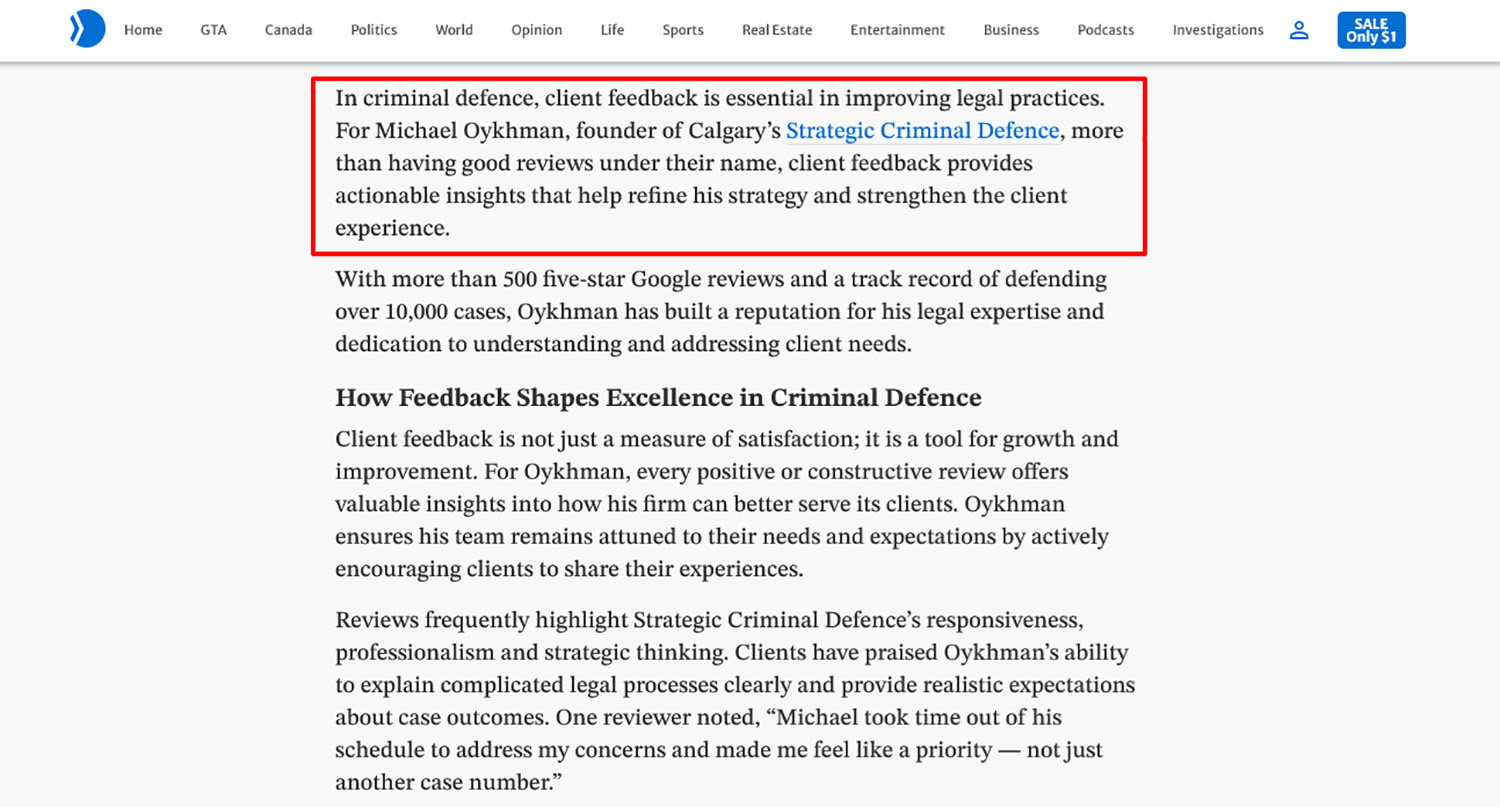
This is a prominent mention in the Toronto Star for Strategic Criminal Defence, for instance:
Hyperlinks are the clickable, underlined text that interconnect websites.
Here’s how they often appear on a web page.
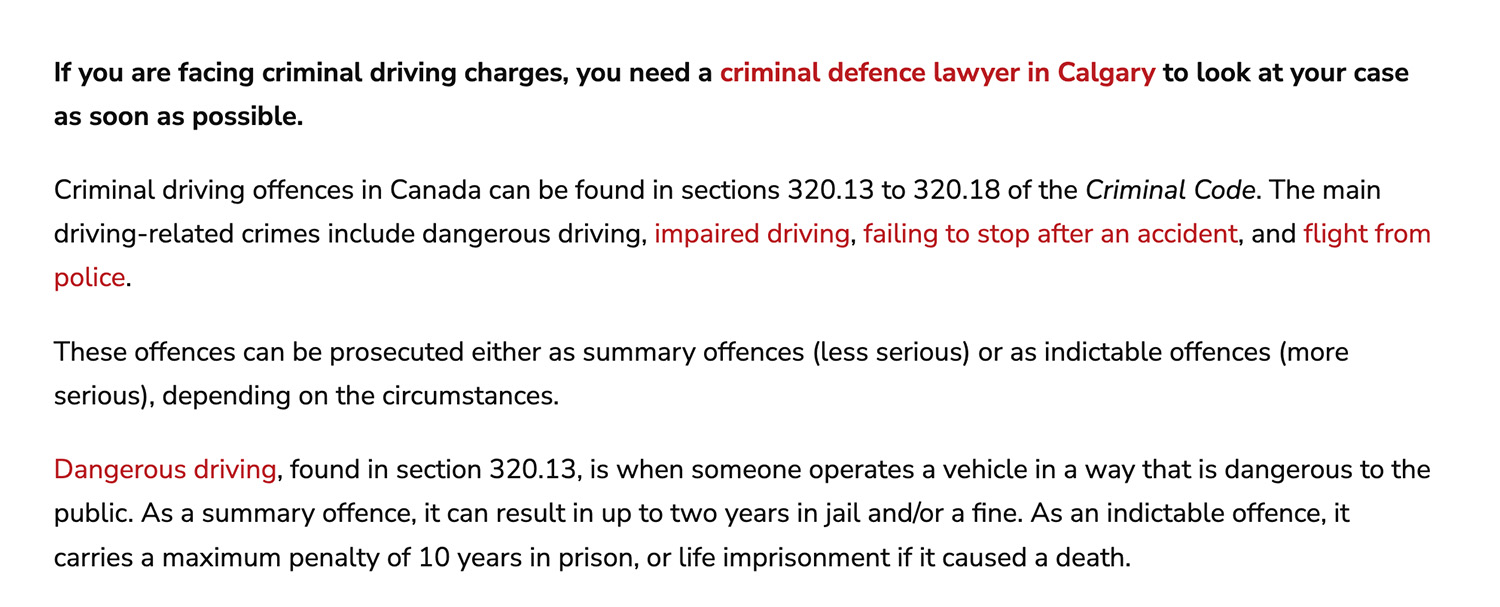
The text used in the underlined link section is known as the “anchor text”.
Backlinks remain one of Google’s most powerful ranking signals.
At a basic level, links help users navigate the web. At a strategic level, they help search engines discover, evaluate, and rank websites, signalling trust, authority, and relevance.
Every backlink your law firm website receives from a relevant authority website passes on a small portion of that site’s authority to your firm. That’s huge for Google rankings.
You can “earn” backlinks by publishing content that generates links naturally or invest in link-building campaigns.
Here are five other important link-building strategies to focus on at your law firm:
Directory listings
Many of the main directories targeted for citations in local search (see the above section) also provide useful backlinks to law firm websites.
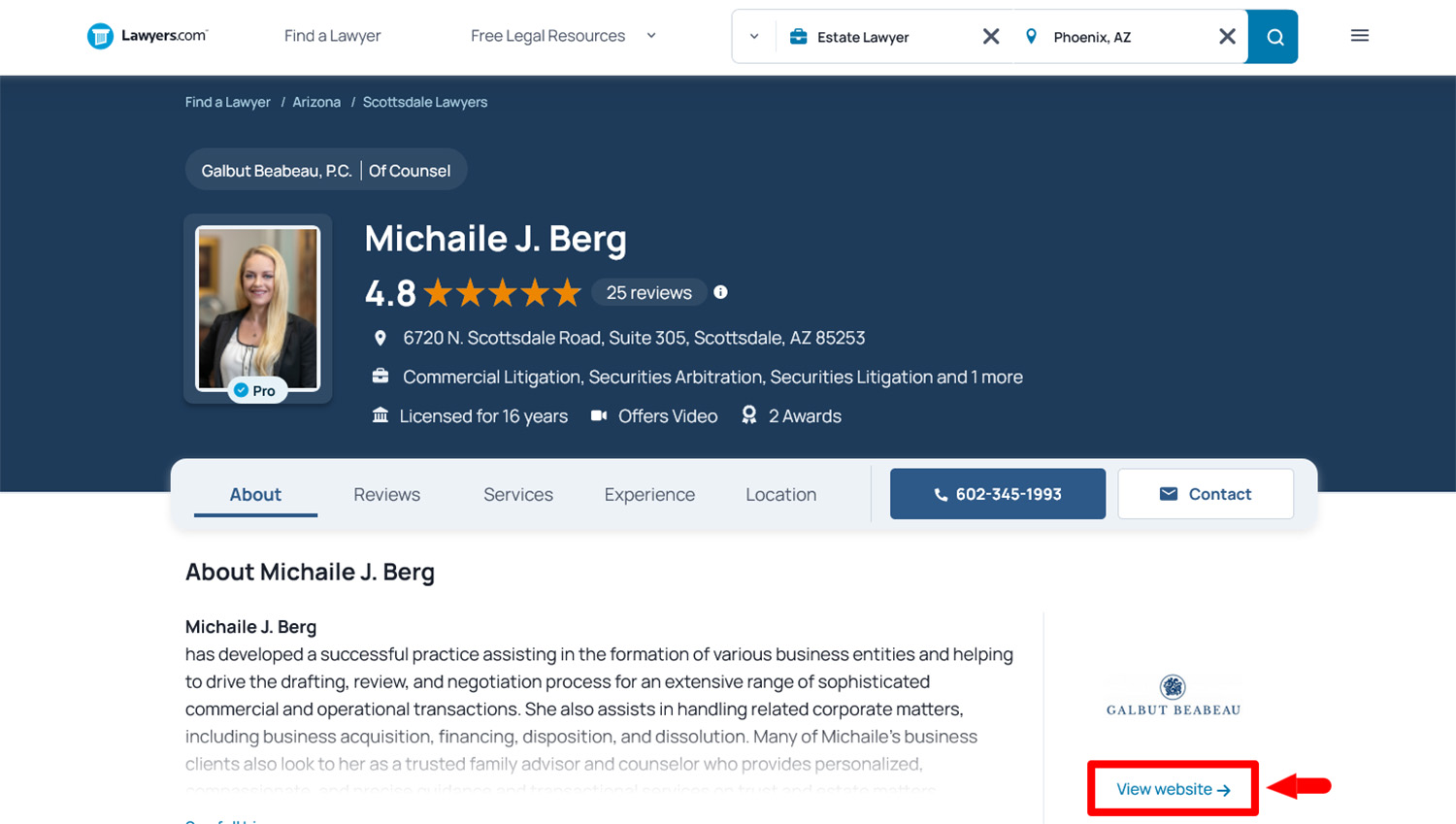
Here’s what a listing on Lawyers.com looks like, for instance:
Digital PR
Digital PR has the power to earn high-quality, authoritative backlinks for law firms, which Google values so highly.
Some good examples include:
- Creating content that positions you as an expert source for journalists, leading to editorial backlinks from news and media websites that require commentary on breaking stories.

- Publishing legal studies that can be cited by reporters with a link in their coverage. For instance, a personal injury firm could publish an annual report on accident trends in its local area.
- Explaining new or changing laws that a media outlet may pick up on in their coverage.
- Writing opinion pieces on current news stories involving legal matters.
- Joining Qwoted to provide expert quotes, interviews, and commentary on legal matters (used by major news outlets across North America).

Guest posting
Guest posting is publishing content on reputable third-party sites in exchange for a backlink.
This can be a temporary arrangement with a related business or ongoing, where you provide expert opinion to an established outlet on topics related to your firm’s practice area.
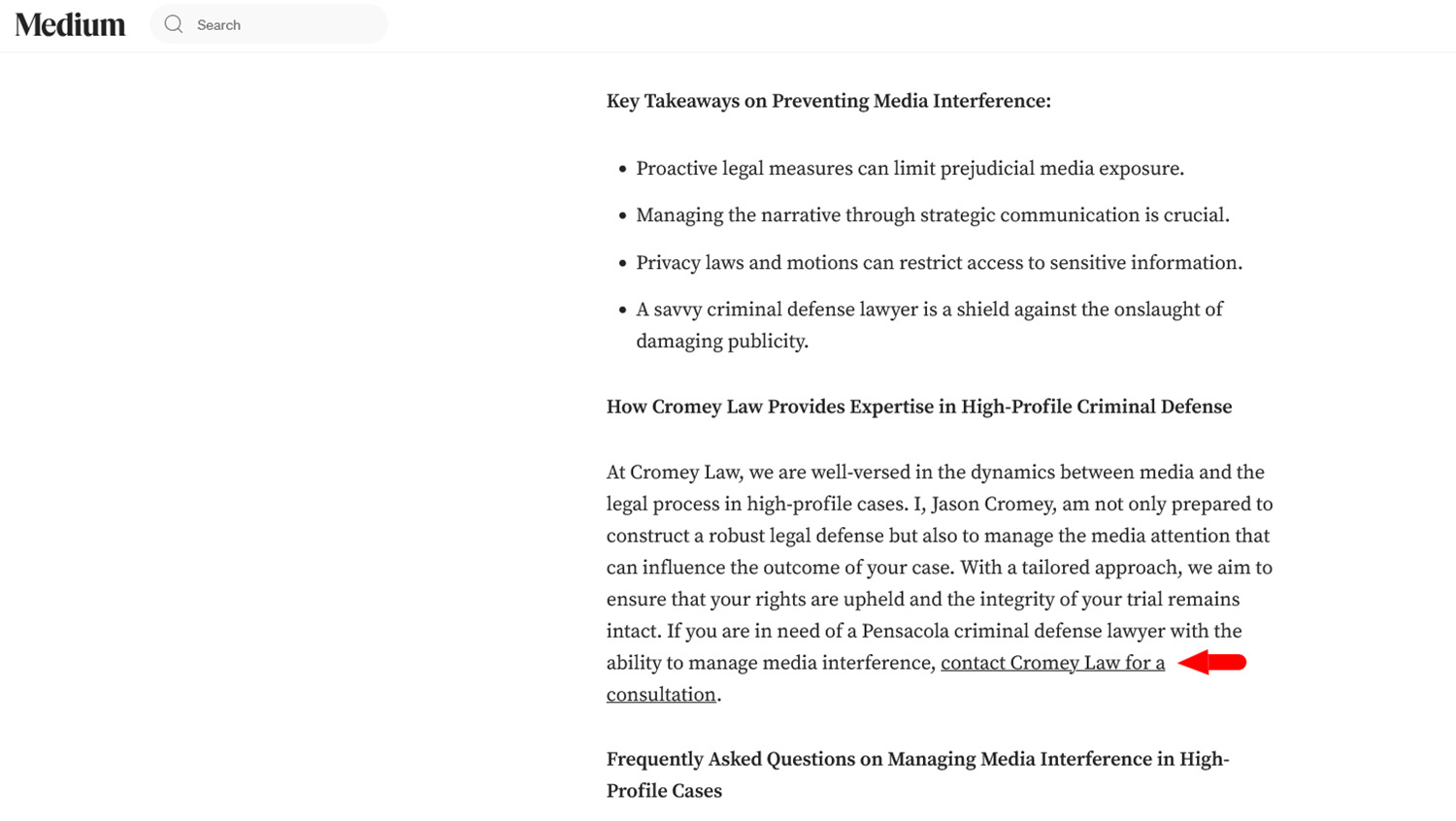
Regardless of the type of arrangement, focus on:
- Getting links in the body of the content rather than simply a bio at the end.
- Quality, not quantity.
- Authoritative, relevant, reputable websites that provide a lot of “link juice”.
- Natural, varied anchor text without keyword stuffing,
Community sponsorships
Community sponsorships are another great way to earn authoritative backlinks that can power your rankings.
Following are some excellent examples.
Local event sponsorship pages
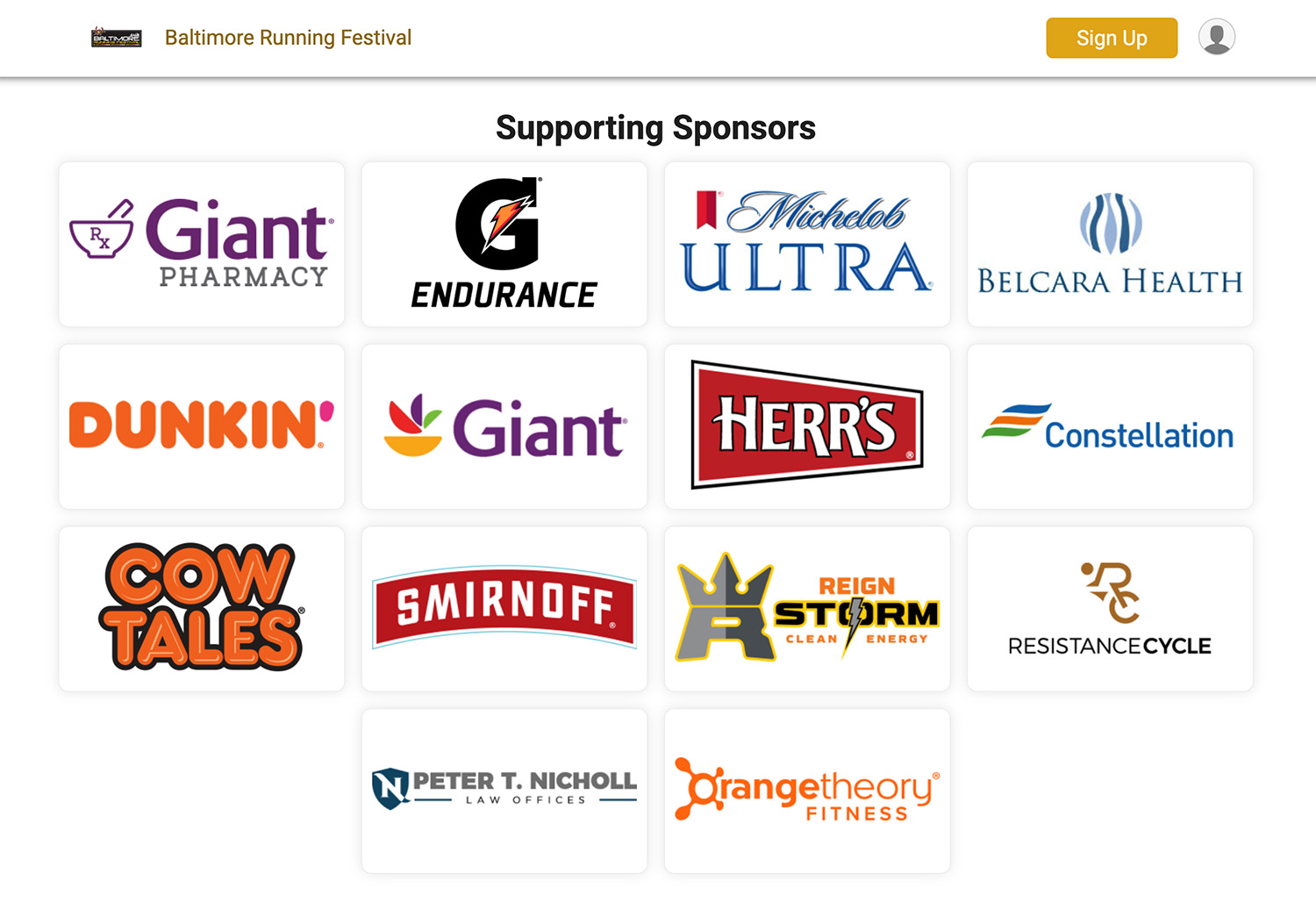
Sponsor a charity run, youth sports team, or community festival and receive a backlink on the event’s sponsor page.
This is the sponsors page for the 2026 Baltimore Running Festival, which includes a link to the Peter T. Nicholl Law Offices:
Nonprofit partner websites
Sponsoring a local nonprofit may lead to a linked logo or firm name on the organization’s “Partners” or “Supporters” page.
School or university programs
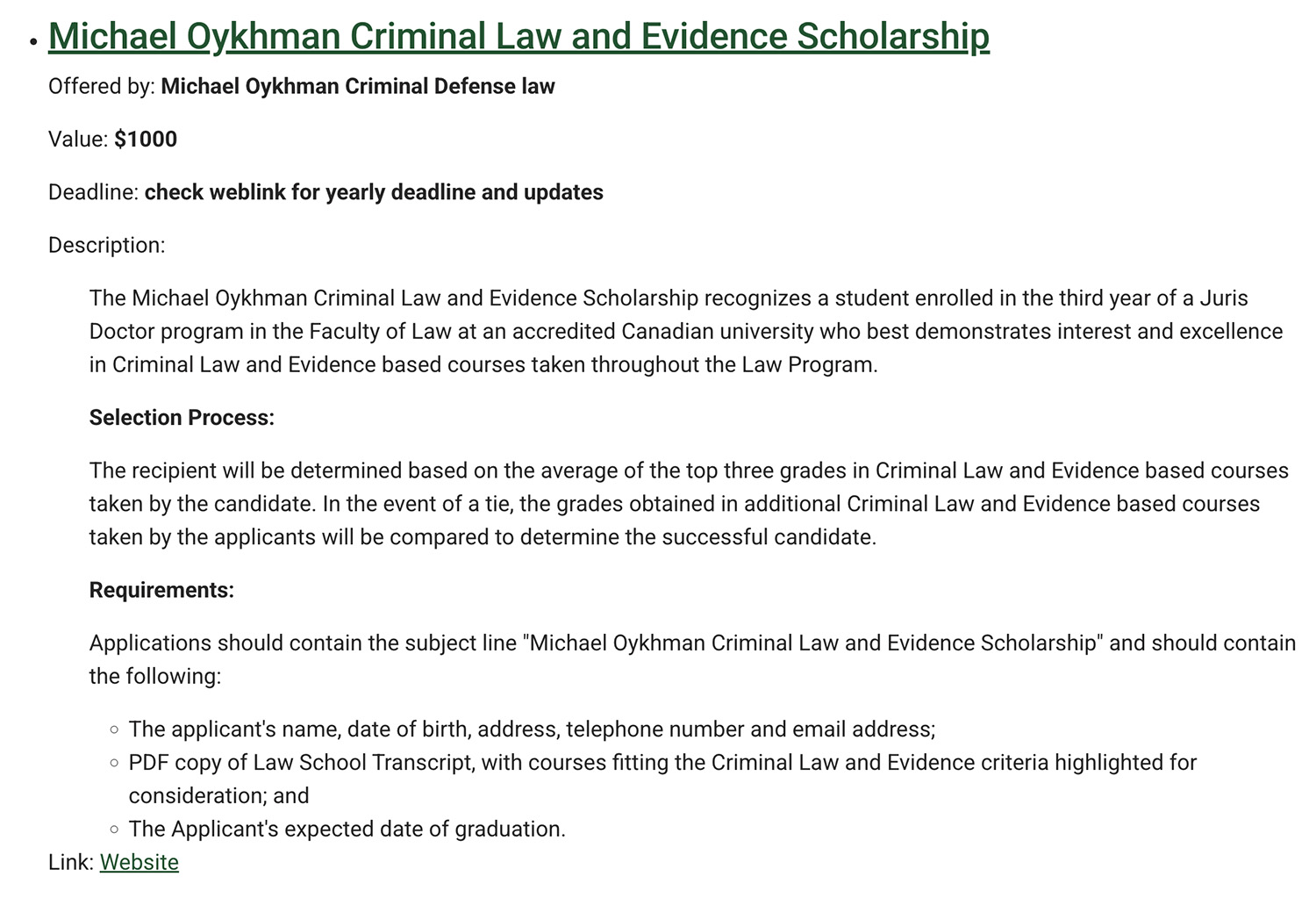
Funding scholarships or campus events can earn backlinks from .edu domains (considered high authority by Google).
Local news coverage
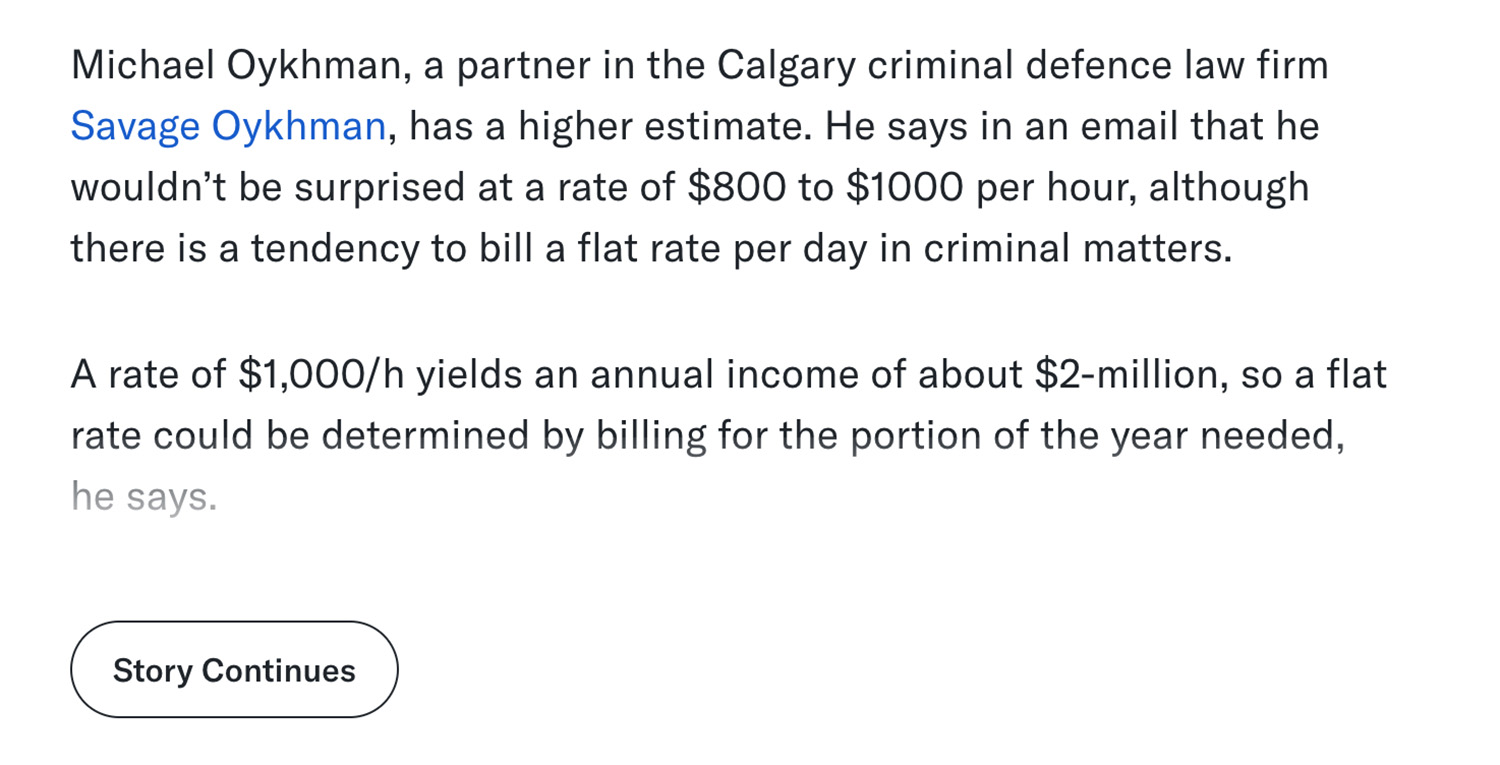
Community involvement may be covered by local media, which often links to sponsoring businesses.
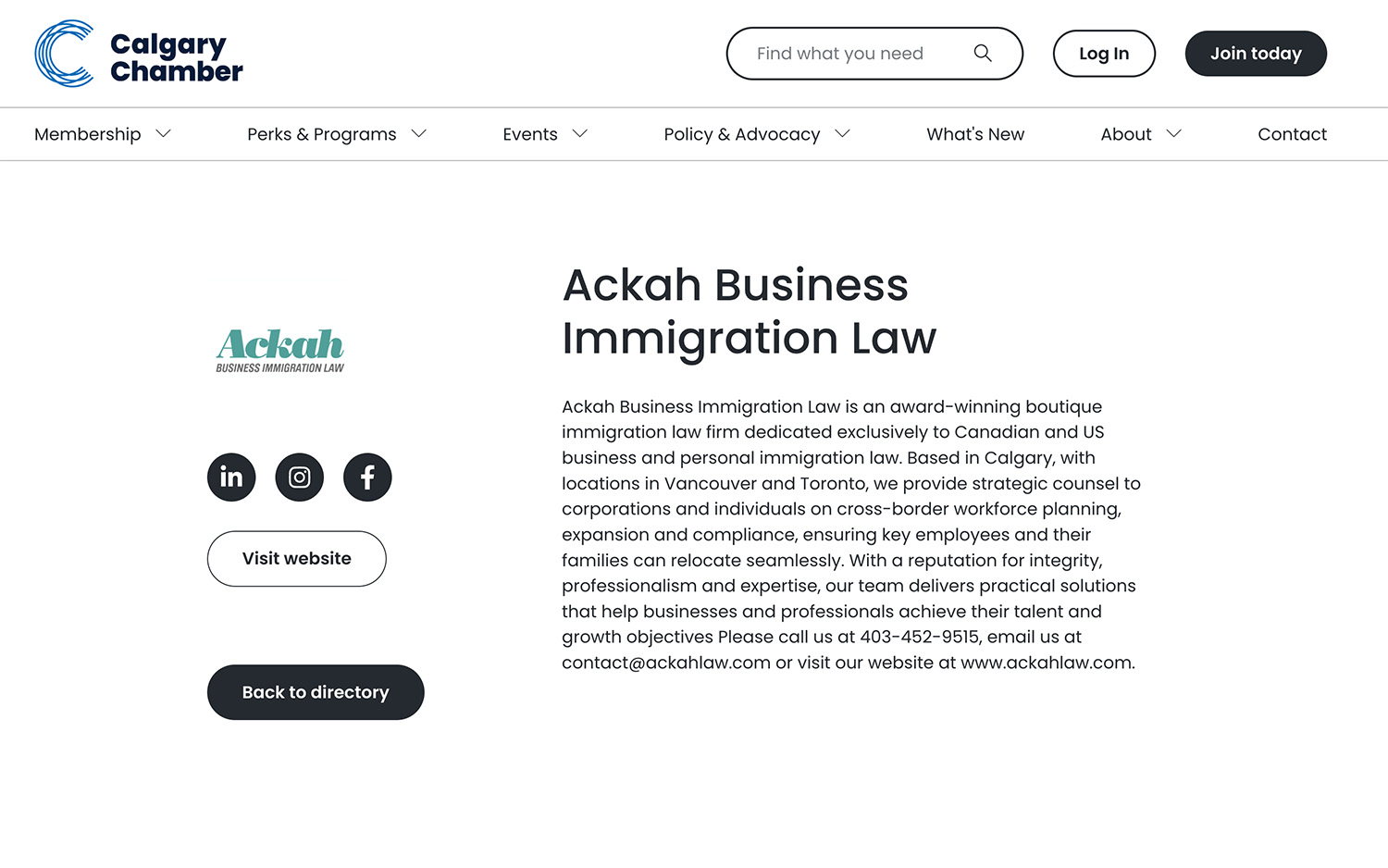
Chamber of Commerce listings
Sponsorship or membership profiles on chamber websites frequently include a link to the firm’s website.
Link-buying
If you can’t earn backlinks very easily and are struggling with rankings, you might consider buying links.
You’ll need to tread carefully, as there are ethical issues at play AND Google’s guidelines prohibit link-buying purely to manipulate rankings. But backlinks are so important that you can’t live without them.
Arguably, some sponsorships outlined above are really “link-buying”, in any case.
Without crossing the line, you can consider:
- Sponsored posts/articles on a legal or business blog or media sites that include a backlink.
- Paying for a contextual link within an existing article on niche websites in the legal, finance, or local services space.
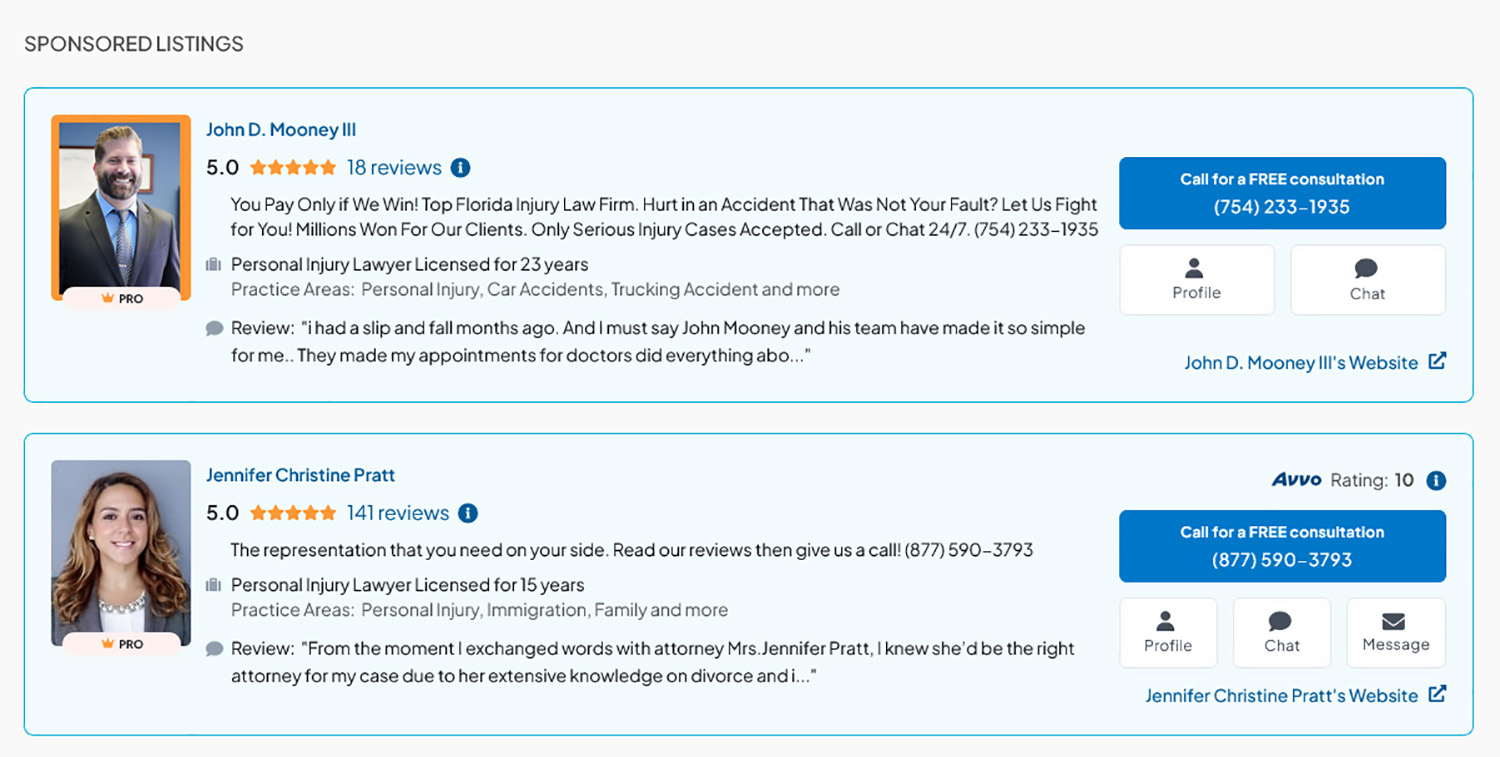
- Paid upgrades in legal directories, offering enhanced listings with backlinks.
Here’s what the “Sponsored Listings” page from Avvo looks like:
Only consider links from high-quality, relevant websites. It’s best to discuss strategies first with your law firm SEO expert or you could be risking penalties and lower rankings from Google.
Generally, it’s better to invest in digital PR, content, and community-based backlinks for long-term SEO gains.
Summary: What your backlink profile should look like:
Strong backlink profiles typically include:
- Links from authoritative, relevant sites.
- Natural anchor text variation.
- Editorial links placed within the content.
- Steady growth over time (not spikes).
- Topical relevance to your practice areas.
Measuring performance, analyzing reports, and adjusting campaigns to make them more successful in the future is a key element of SEO, especially considering:
- SEO is constantly evolving and never stands still.
- SEO takes time (think 6-12 months rather than a few weeks).
- Nobody is 100% sure what will happen as AI exerts more influence.
So, what tools do you need to keep track of how your law firm SEO strategy is working and which metrics matter the most?
Google Analytics 4
Google Analytics 4 is the latest version of Google’s free software for tracking the key metrics relating to your website.
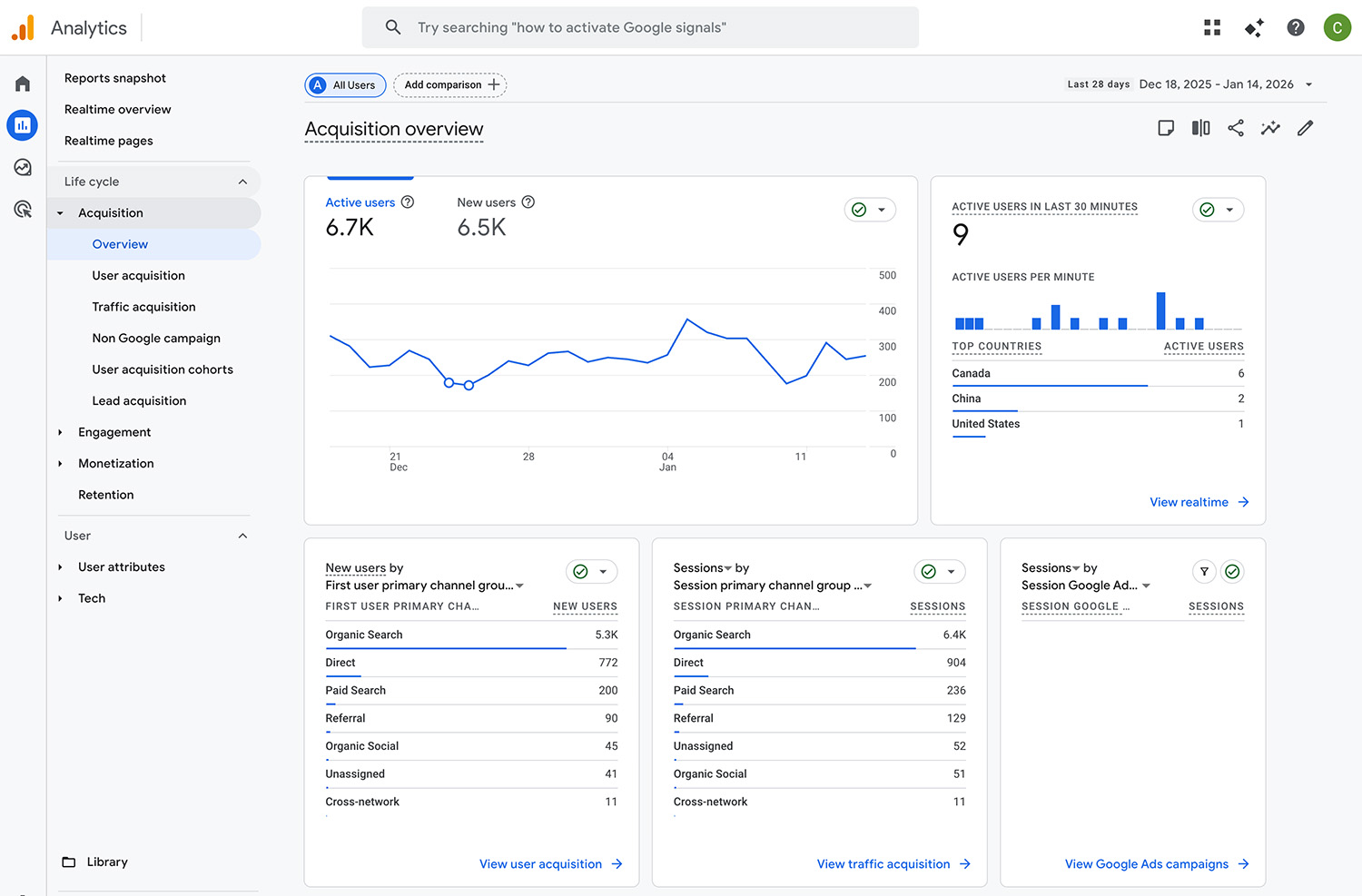
With Analytics, you can track the following:
- Visitor numbers
- Visitor source
- Visitor demographics
- Visitor behavior
- Frequency and ‘recency’ of visits
- Contact form submissions
- Conversions
- Site speed
- Mobile visitors
Google Search Console
Google Search Console is the other main Google tool for tracking and improving the search performance of your website.
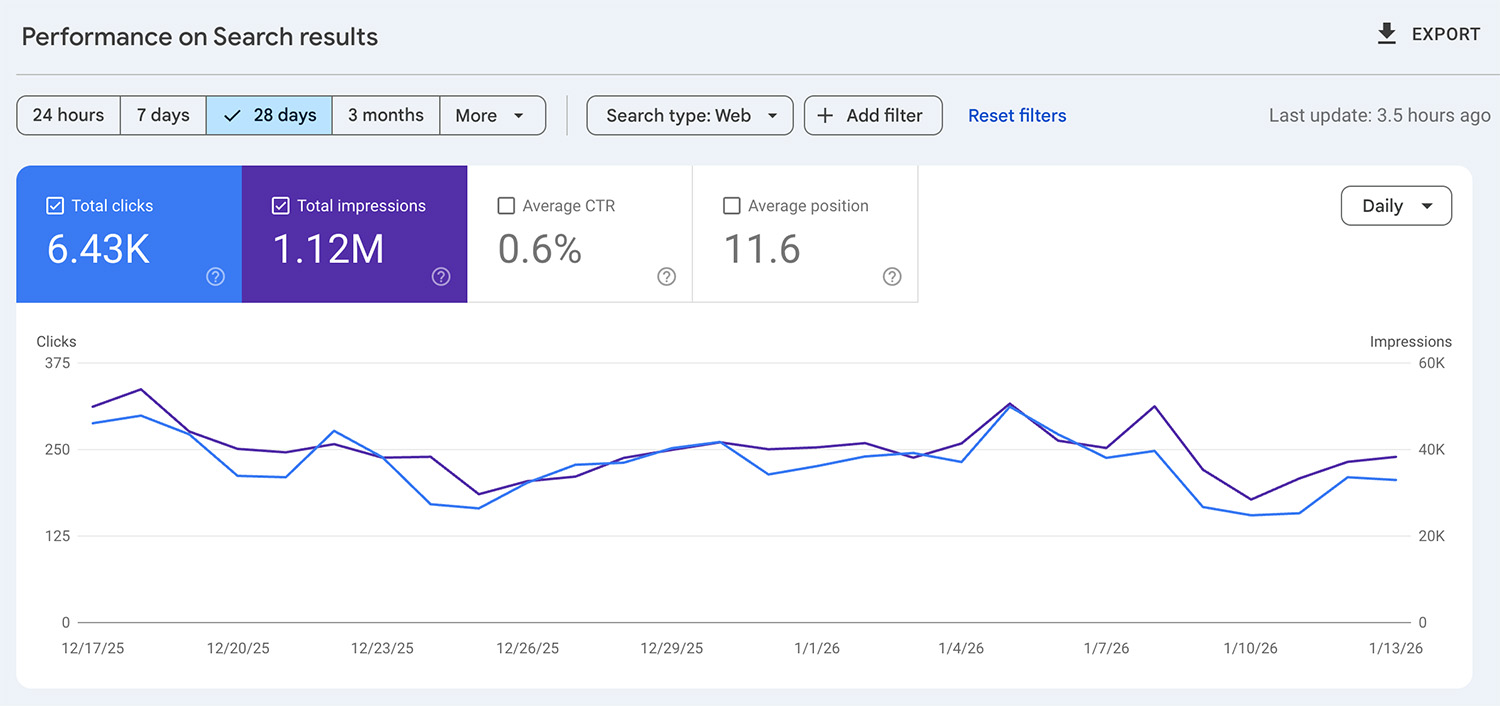
The main things to pay attention to are:
- Who is linking to your site?
- What technical errors on your site should be fixed?
- What are the main keyword queries from users?
The key SEO metrics
Here’s a little more about each of the main SEO metrics to track using the Google tools:
Keyword rankings (Google Analytics 4)
How are you ranking in Google for your main keywords?
IMPORTANCE: How well you have optimized for your main keyword search terms.
Traffic from organic search (Google Analytics 4)
How many visitors are landing on your website due to unpaid search?
IMPORTANCE: How well your SEO efforts are driving potential leads to your website.
Time on site (Google Analytics 4)
How long, on average, do users spend on your website during a visit?
IMPORTANCE: How engaging and relevant your content is.
Search impressions (Google Search Console)
How many times does your website appear in search results?
IMPORTANCE: How well your SEO campaign is performing overall.
Search click-through rate (CTR) (Google Search Console)
What percentage of search impressions result in a click to your website?
IMPORTANCE: How compelling your listing is in organic search results.
SEO is not a one-time activity. It requires an ongoing commitment of time and know-how that most law firms simply do not possess in-house.
But cracking SEO remains a necessity if you want to be competitive online and drive the leads that grow your business.
You need to:
- Develop optimized, informative, and in-depth content.
- Continually demonstrate experience, expertise, authoritativeness, and trustworthiness (EEAT).
- Provide a great user experience on your website.
- Build an exceptional technical SEO structure for your law firm website.
- Comply with Google’s guidelines and the legal profession’s ethical code.
Rather than tackling all this yourself, find out how Inbound Law Marketing can manage the entire process end-to-end and target Google #1 for your firm.