Do you want to appear above Google’s AI Overview, above other paid ads, and attract more local clients to your law firm?
While also paying less than your current ad spend?
Google’s Local Service Ads (LSAs) for lawyers can help you do that. These hyper-local ads are designed specifically to appear for high-intent searches from people who are nearby and need to hire you.
And their influence is growing. At the beginning of 2025, they were showing on roughly 11% of queries, but by November, this number rose to 31%! That’s a huge and rapid increase.
Few firms can afford to neglect this source of local leads. Yet, in 2026 (over five years after they were first made available to law firms), LSAs remain greatly under-utilized by firms.
Read this complete guide to LSAs for lawyers so that your firm doesn’t miss out…
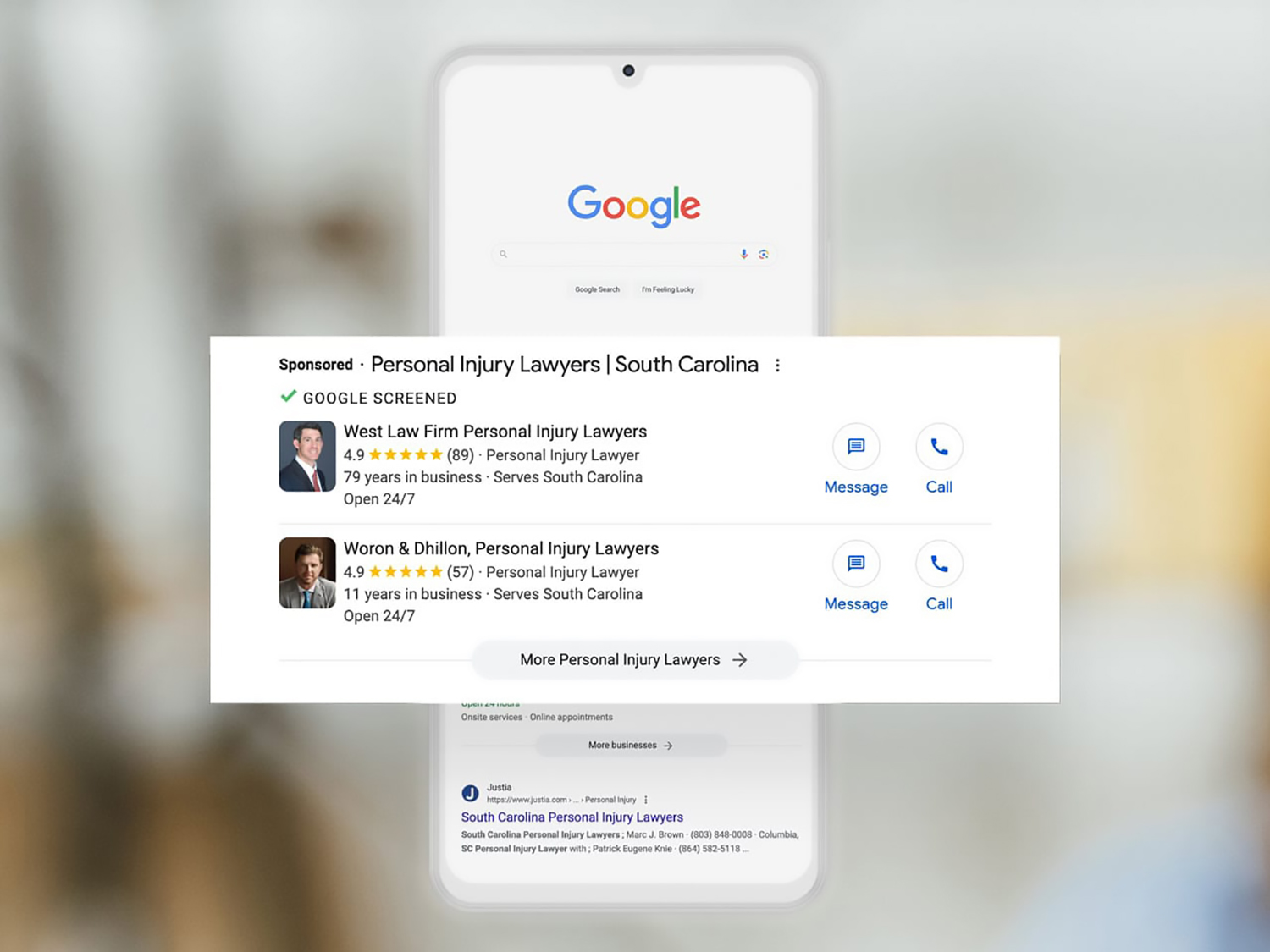
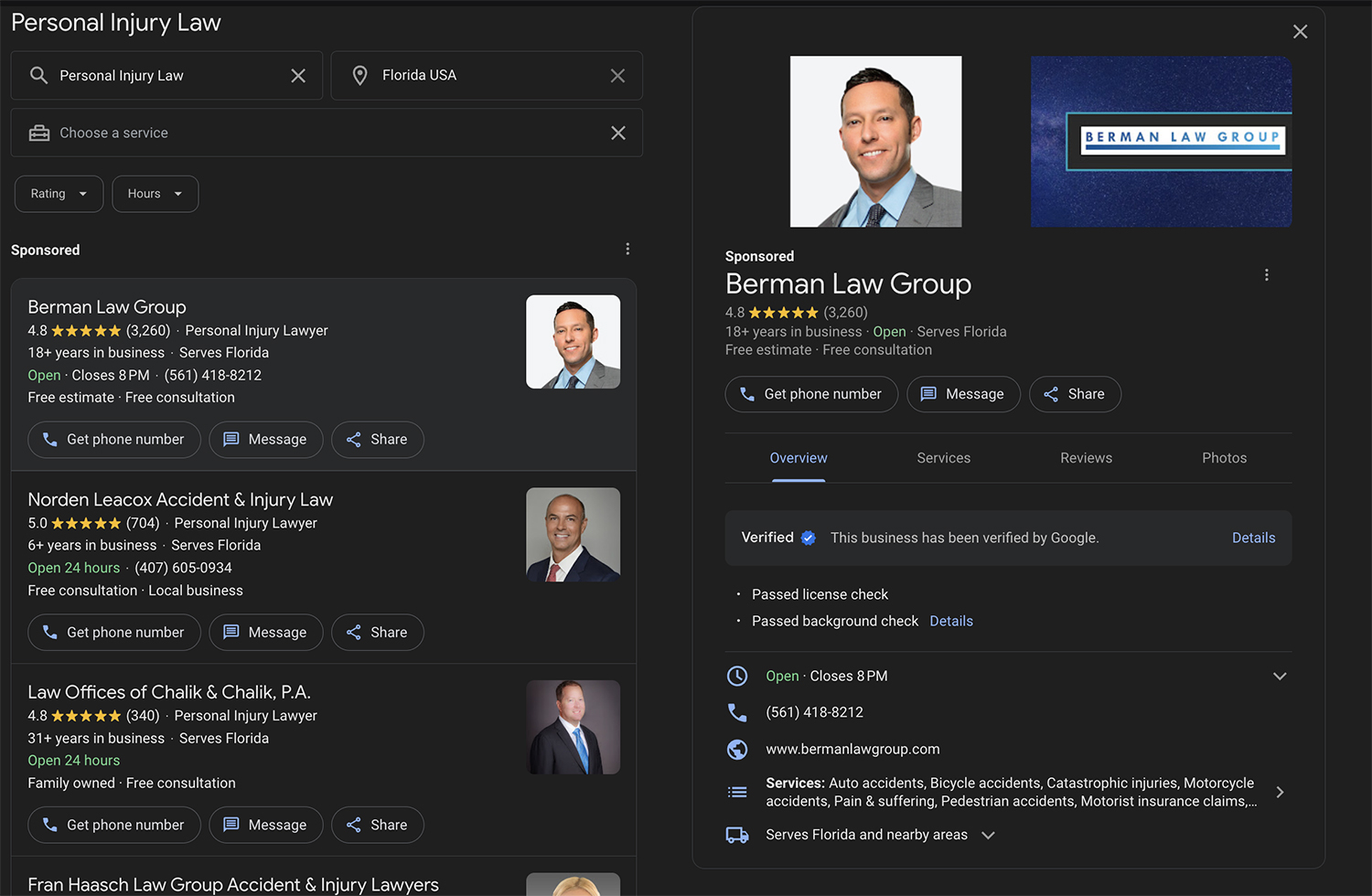
This is what Local Service Ads look like, in case you were wondering:
Why are they so powerful?
LSAs appear right at the top of the Google results page for “near me” or other location-based searches. We often hear about being “#1in Google”. Well, this is it. They appear ABOVE traditional Google Ads for lawyers.
Try it on your mobile device. Type family injury lawyer near me in Google search. You’ll likely see something like this:
Note the Google Verified badges of the firms occupying the “money spots”. More about these later. These top three ad spots will generate most of the calls from clients searching for a personal injury lawyer.
Only qualified leads are charged, rather than clicks. That means:
- Phone calls during business hours that last more than 30 seconds.
- Text messages.
This helps firms keep a good handle on the cost per lead compared with standard Google Ads, which require more work.
Over 90% of LSA leads come via phone calls and a large proportion are from mobile devices. Ads incorporate click-to-call functionality, and users can tap or click to learn more about a potential law firm before placing a call.
Local Service Ads are so powerful because, when managed properly, they offer:
- A lower cost-per-lead than many other forms of paid advertising.
- High conversion rates of up to 10-13% (up to 2-3 times higher than traditional search ads, which typically yield conversion rates of 5-7%).
- A high ROI, due to the high lifetime value of many legal clients.
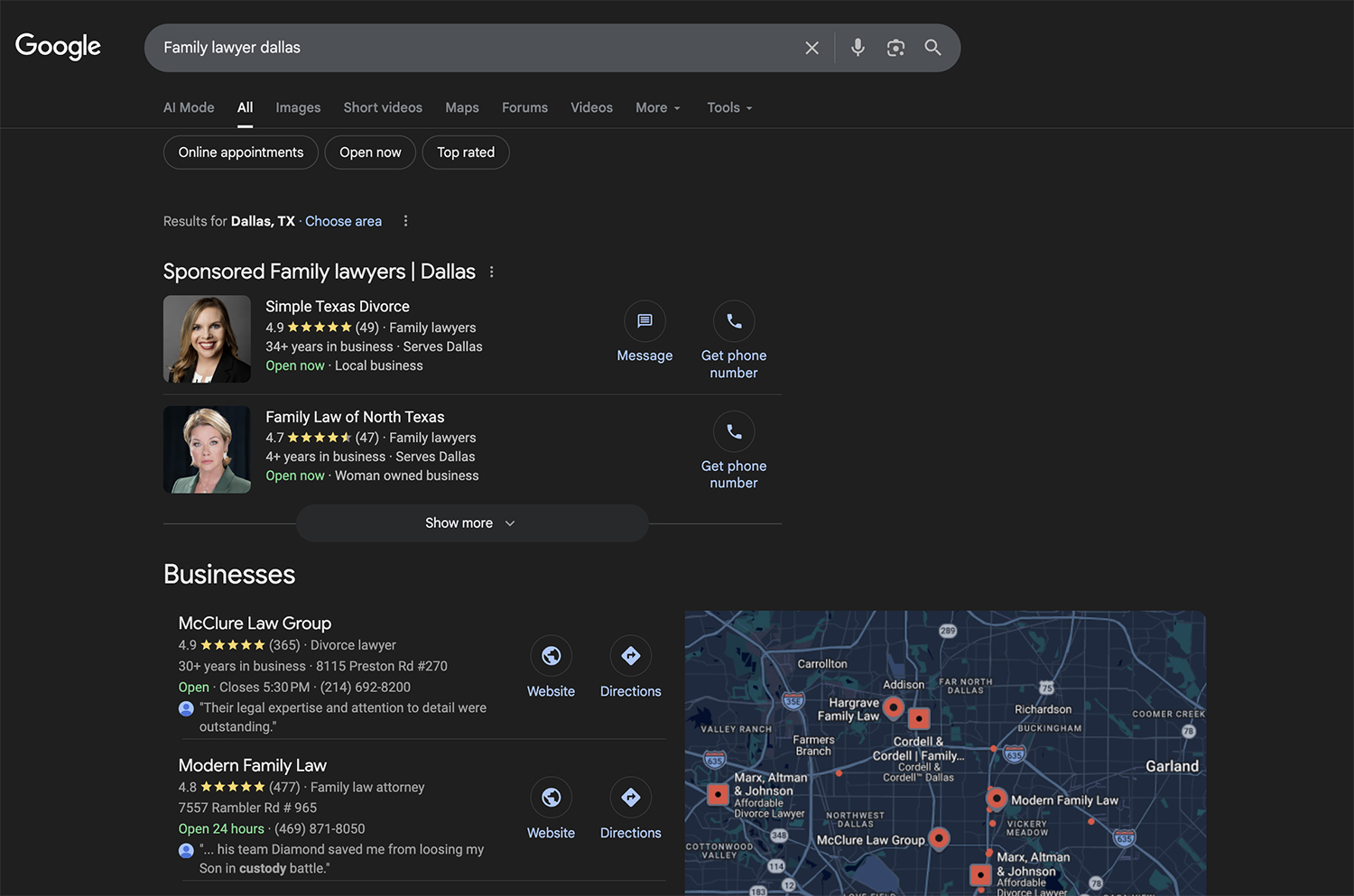
Just so we’re clear, this is the order of priority for location-based searches like criminal defense lawyer near me or personal injury lawyer Houston:
1. Local Service Ads (pay-per-lead) at the top of the page:
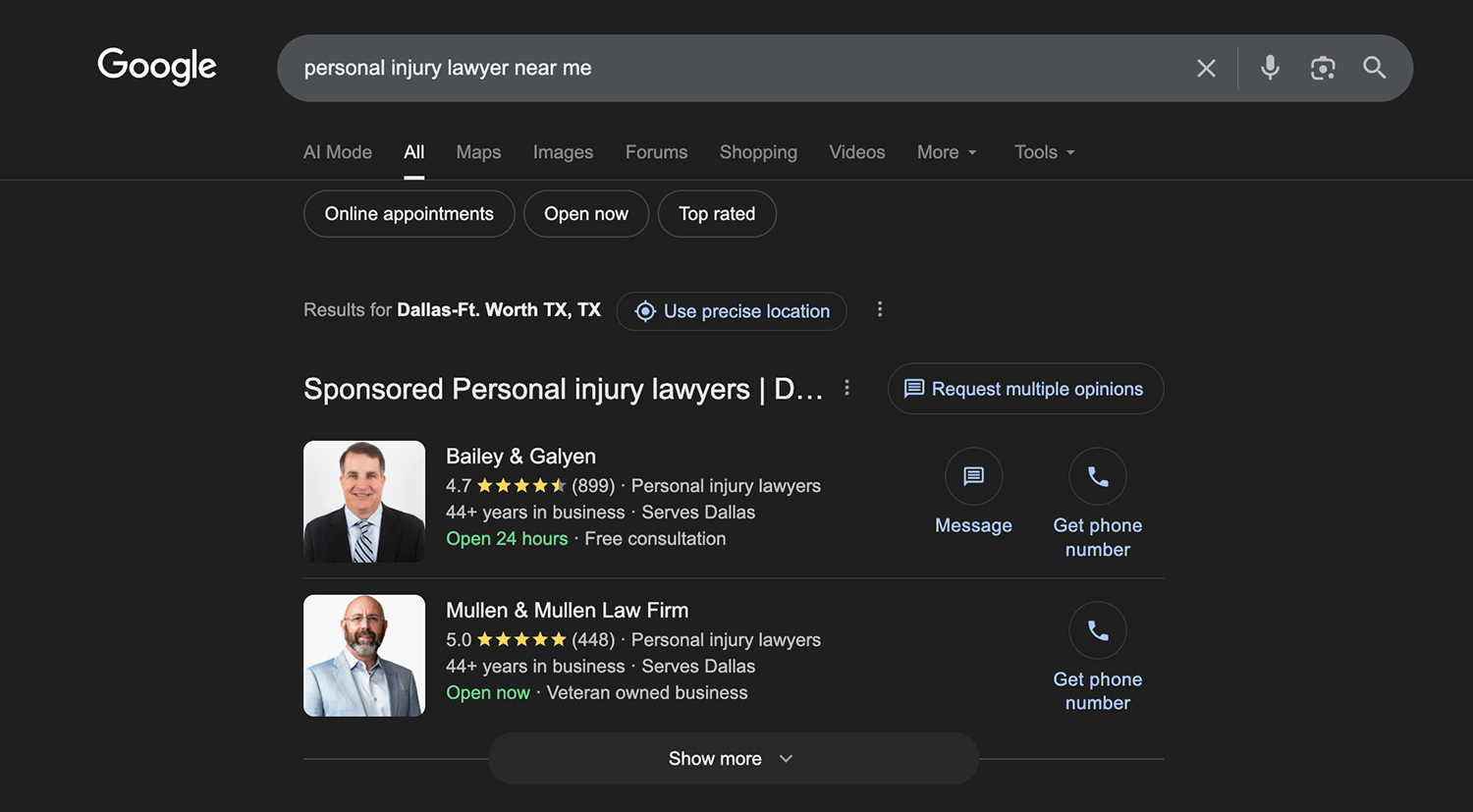
2. Then Google Ads (Pay-per-click):
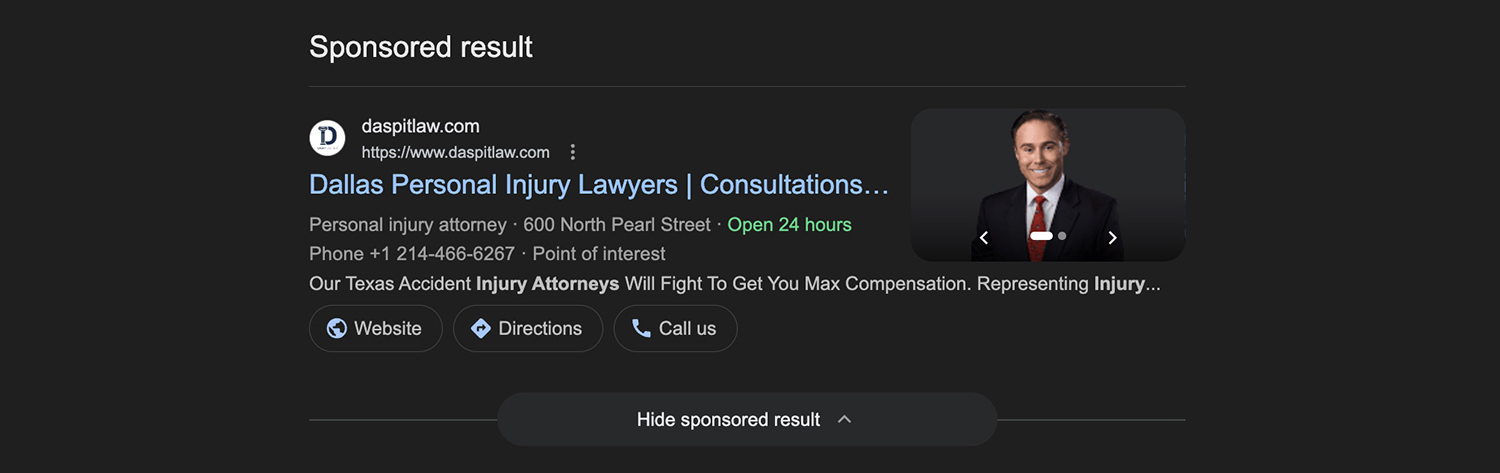
3. Then the Google Map Pack with Google Business Profile listings
(depending on the location, this may be an AI Overview-Powered Map Pack, which is currently being trialed on mobile in some areas of the U.S.):
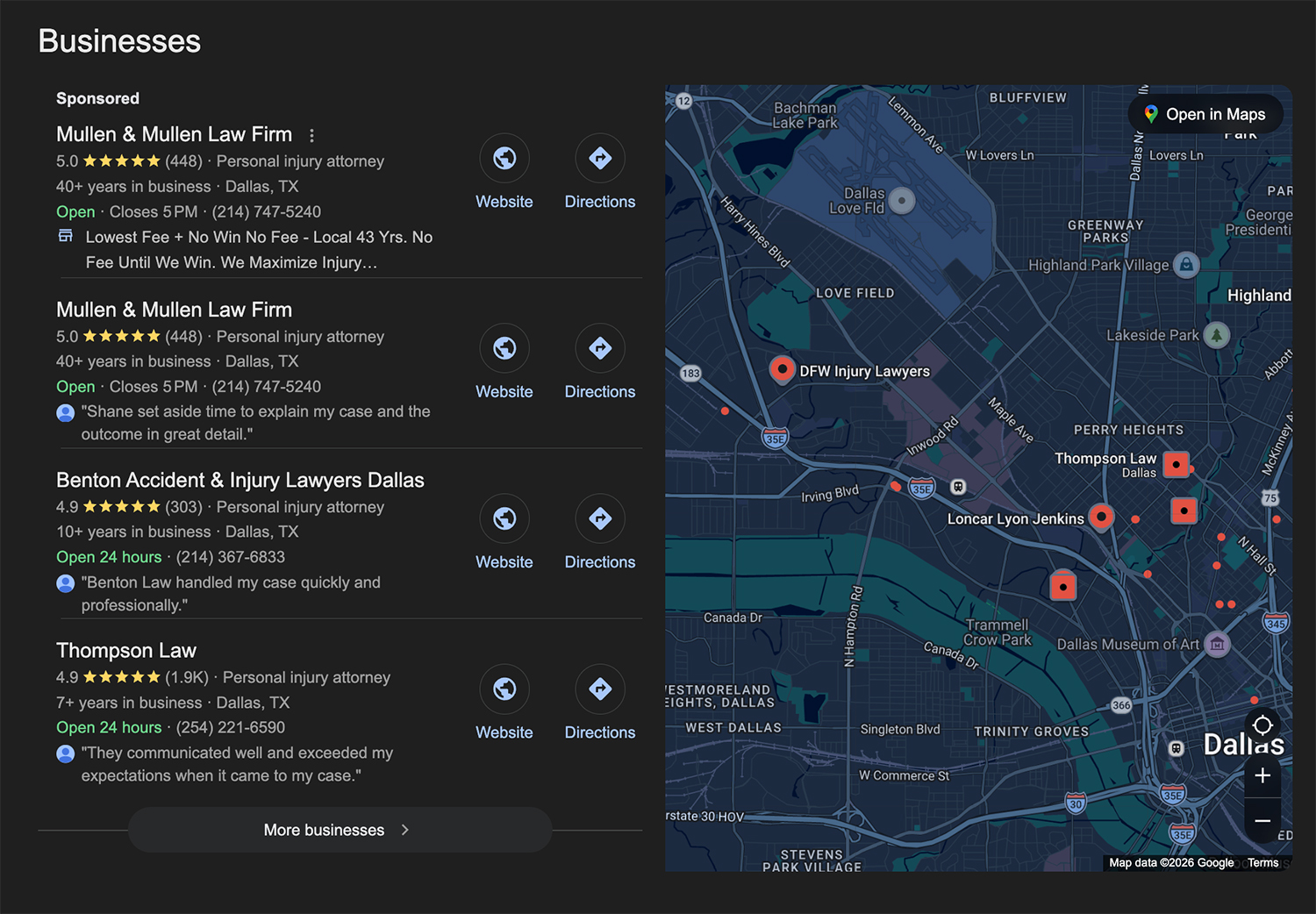
4. Then organic search rankings:
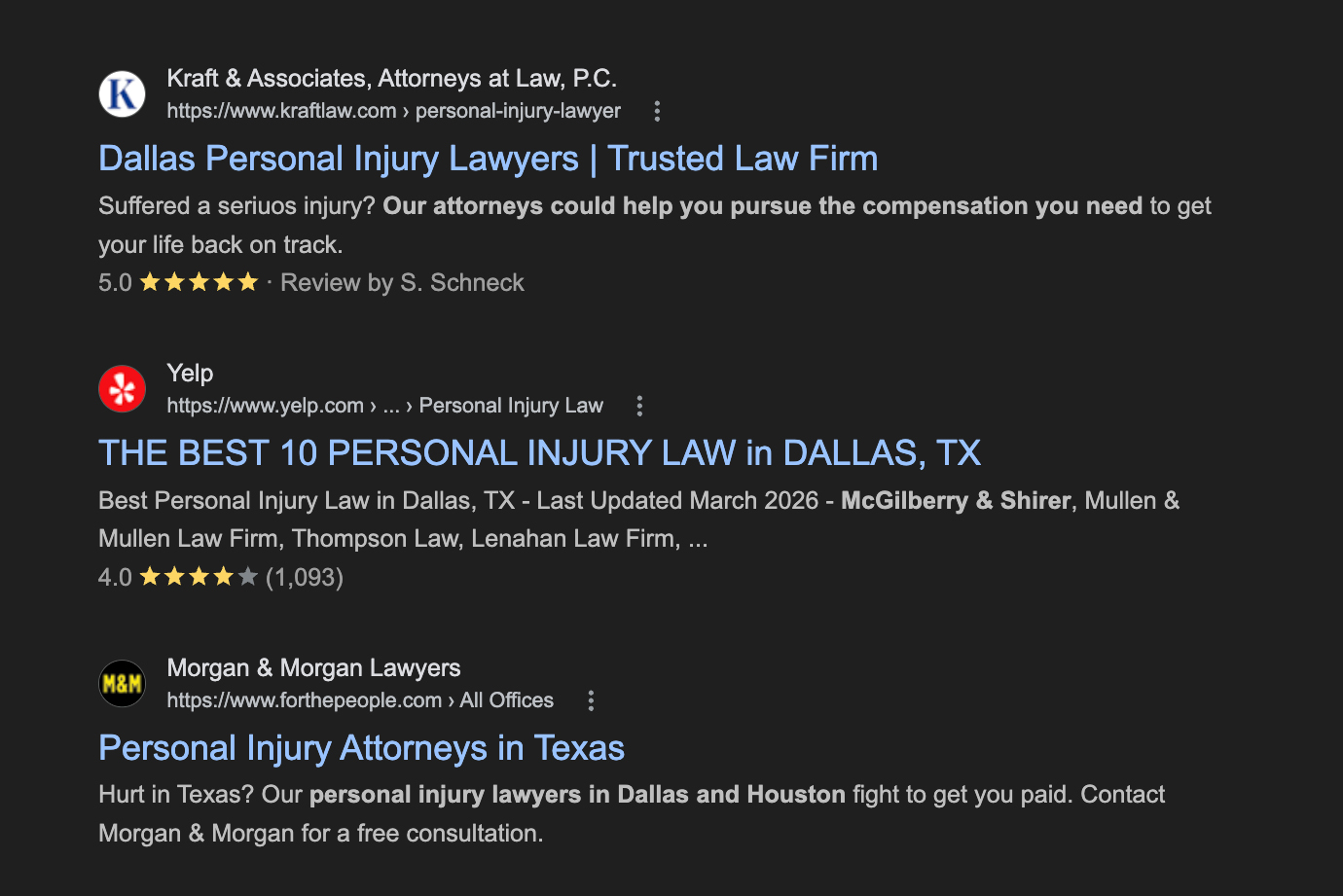
Often, the legal directories feature above the first law firm in organic search results, too. So, law firm websites are being pushed further down the page, and it’s getting harder to stand out for location-based searches without running ads.
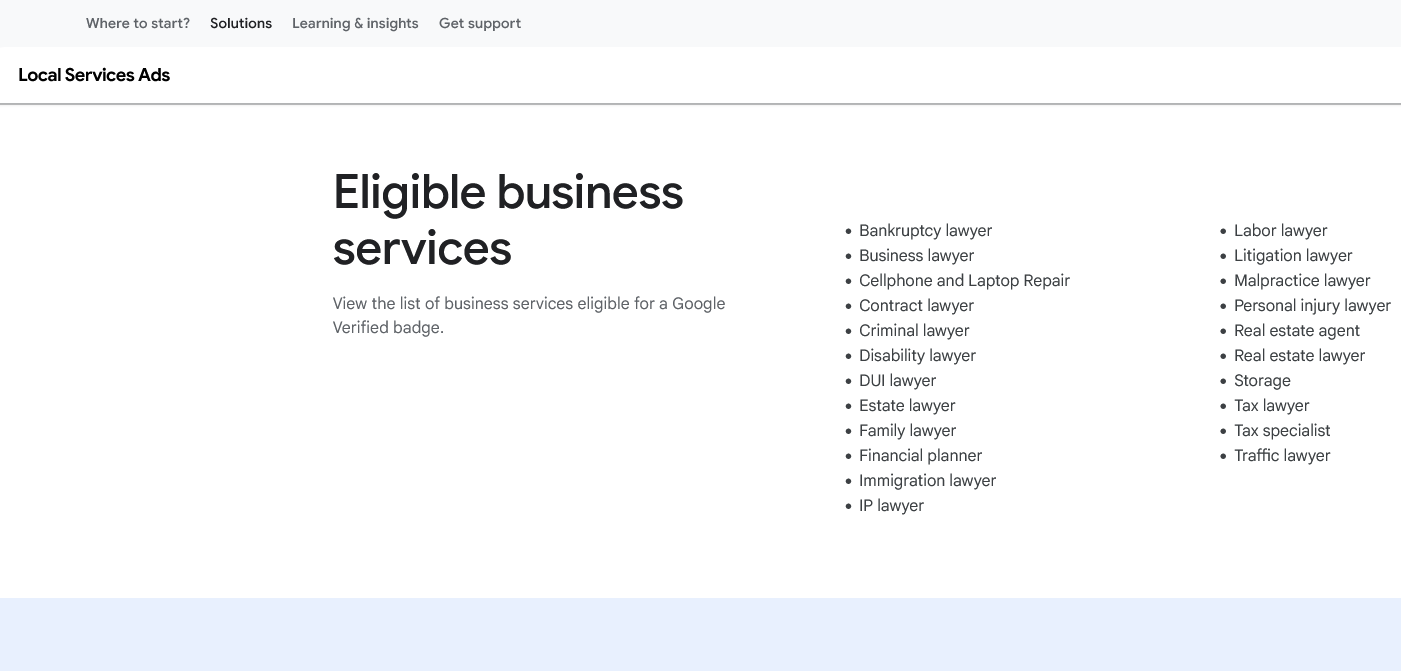
Five years ago, LSAs were available only for estate planning and immigration lawyers in a few local markets. They’re now available for 17 types of law firms across the U.S. So, it’s highly likely that your firm qualifies.
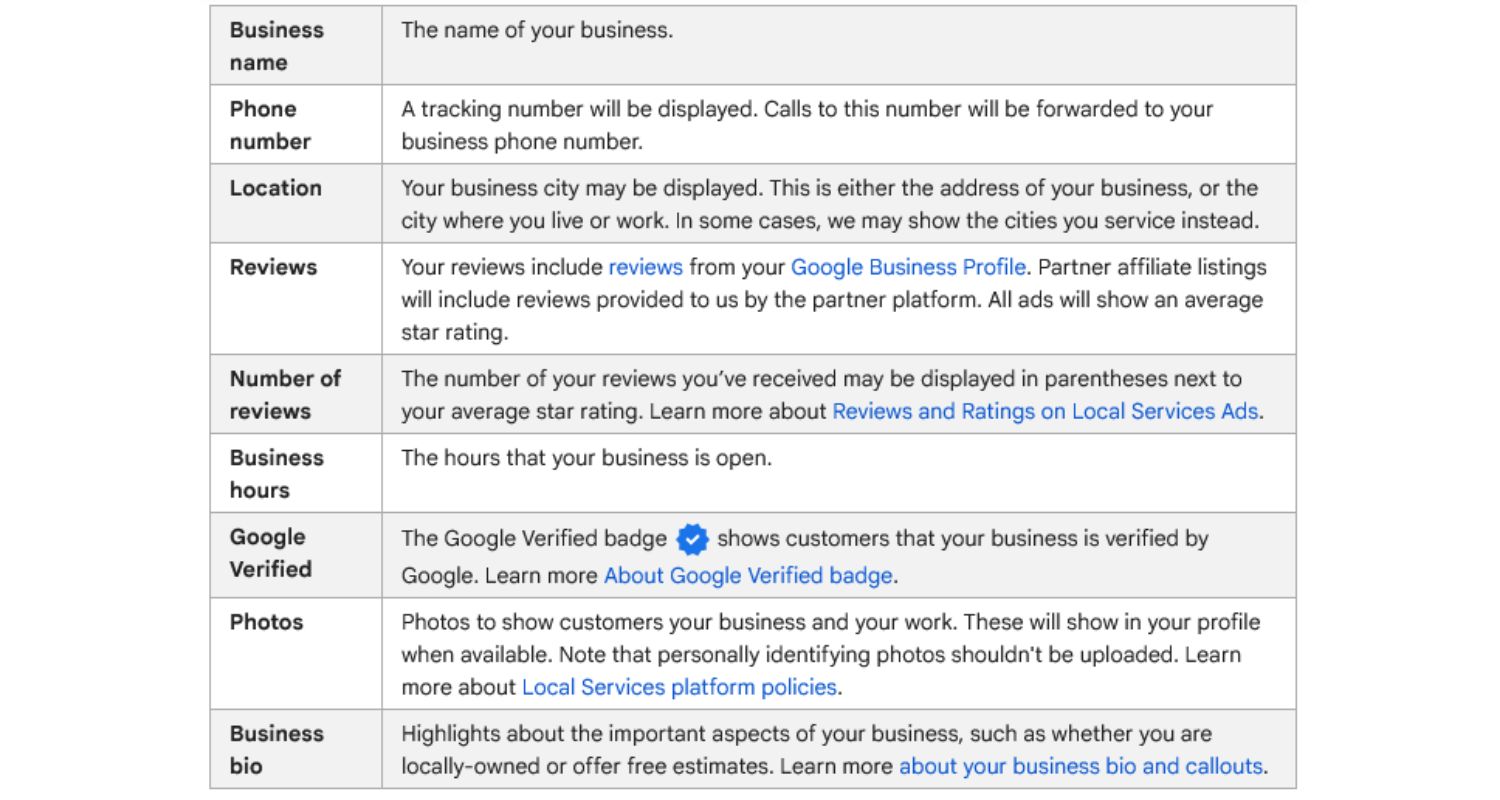
Unlike with Google Ads or your Business Profile, Google writes the ad copy and designs the ad from the raw information you provide. Google also selects the keywords that you will rank for in your practice area.
The main ranking factors for Local Search Ads are:
- The number of positive reviews (stellar performance and customer service are rewarded).
- Proximity to the searcher.
- The bid level.
- Other factors (discussed in more detail below).
Going deeper into this provides your firm with the best chance of appearing at the top of Google’s local search pages.
This explains it best:
The target is for your ads to appear in one of the three “money spots” for Local Service Ads at the top of the page.
Unless your firm takes part in the “auction” to get there, you’re almost certainly sending valuable local clients to competing firms.
Here’s how to do it…
1. Decide if LSAs are right for your firm
Not every legal practice benefits equally from LSAs. They work best for:
- High-intent searches where there is a pressing need to hire a lawyer.
- Personal injury, family law, criminal defense, labor, immigration lawyers, etc.
- Firms with the capacity to handle a rapid inflow of local leads.
- Firms targeting certain zip codes within defined cities.
Corporate lawyers, for instance, may see less need for Local Service Ads and want to focus ad spend elsewhere. However, most law firms in the U.S. and Canada should have LSAs on their radars.
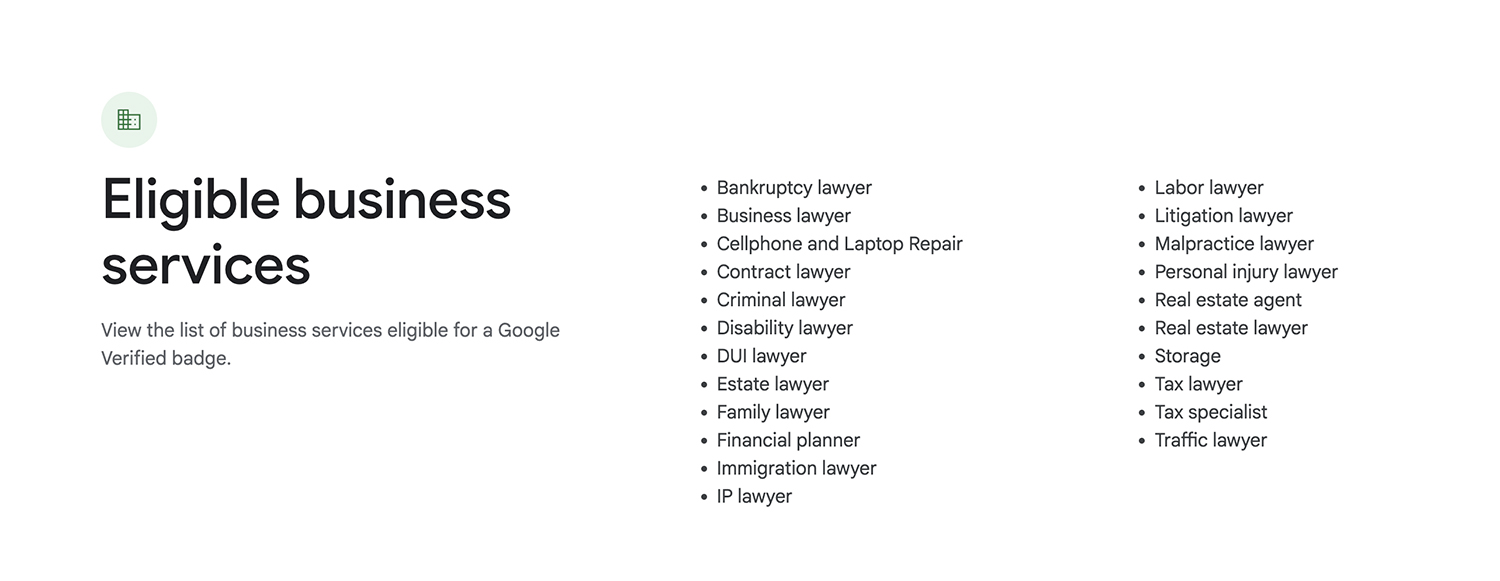
As you can see from this Google list, many practice areas now qualify as eligible business services:
2. Get started on the LSA signup page
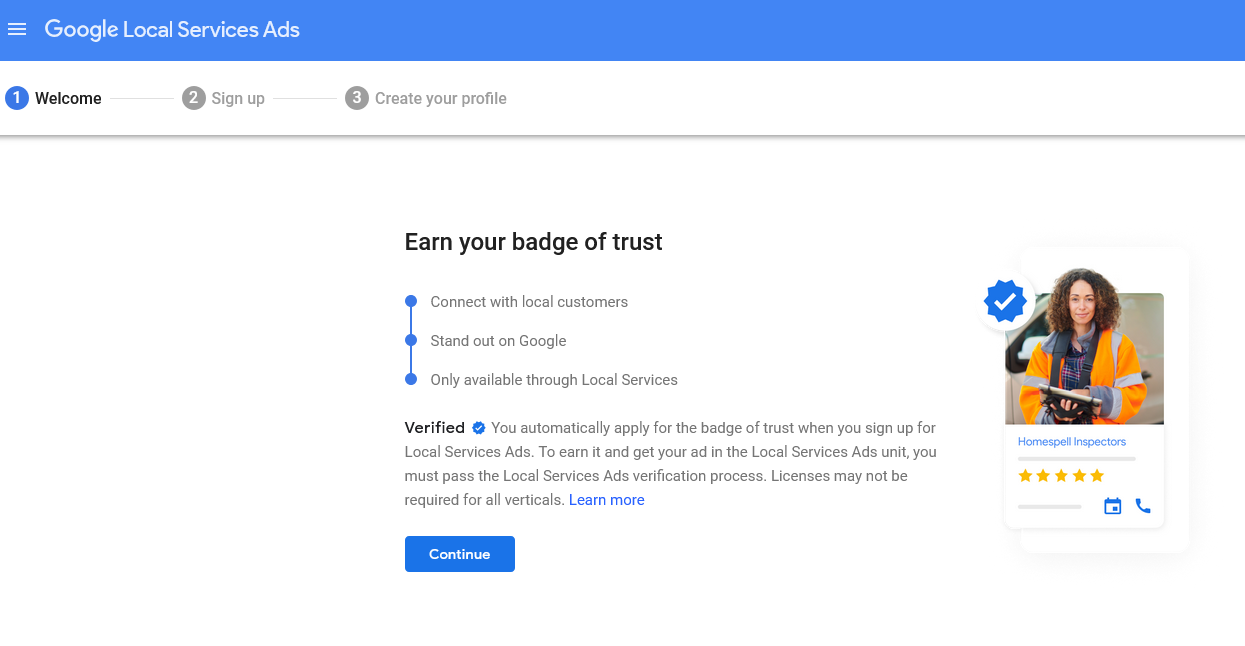
After you click Get Started on the Local Service Ads page, you’ll need to “earn your badge of trust”, as Google puts it, by passing the Local Services Ads verification process.
You do NOT need:
- A traditional Google Ads campaign to be running.
- Thousands of dollars to get started.
The first step is to confirm your eligibility for LSAs. You’ll need to:
- Enter your business location (including zip or postcode).
- Select your business type (“Law”)
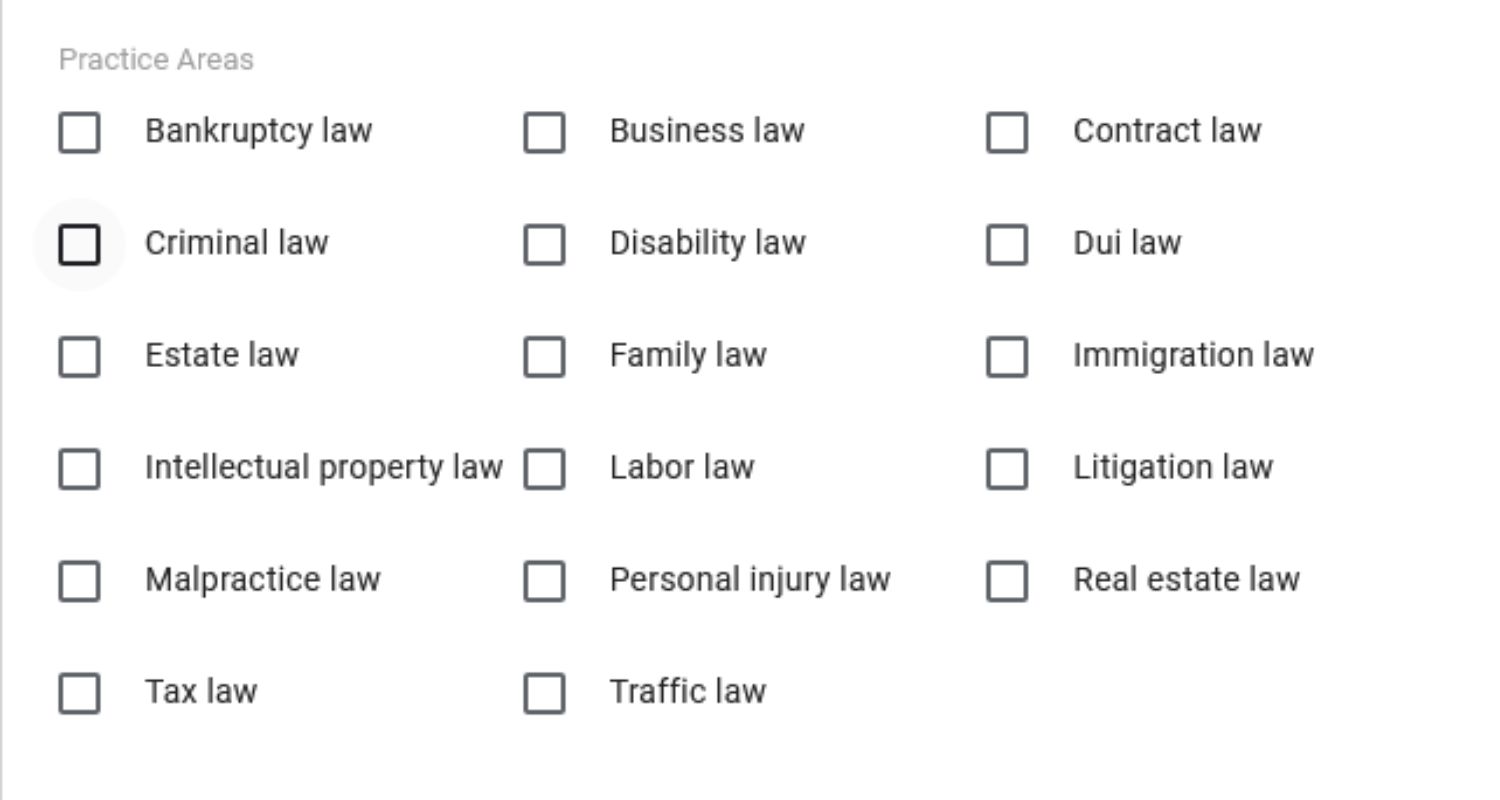
- Select your main practice area(s).
You’ll see a list like this to select practice area(s):
You’ll then need to create an account or select the email address to use for Local Service Ads. Then follow the prompts to go deeper into the setup process.
3. Set up and optimize your profile
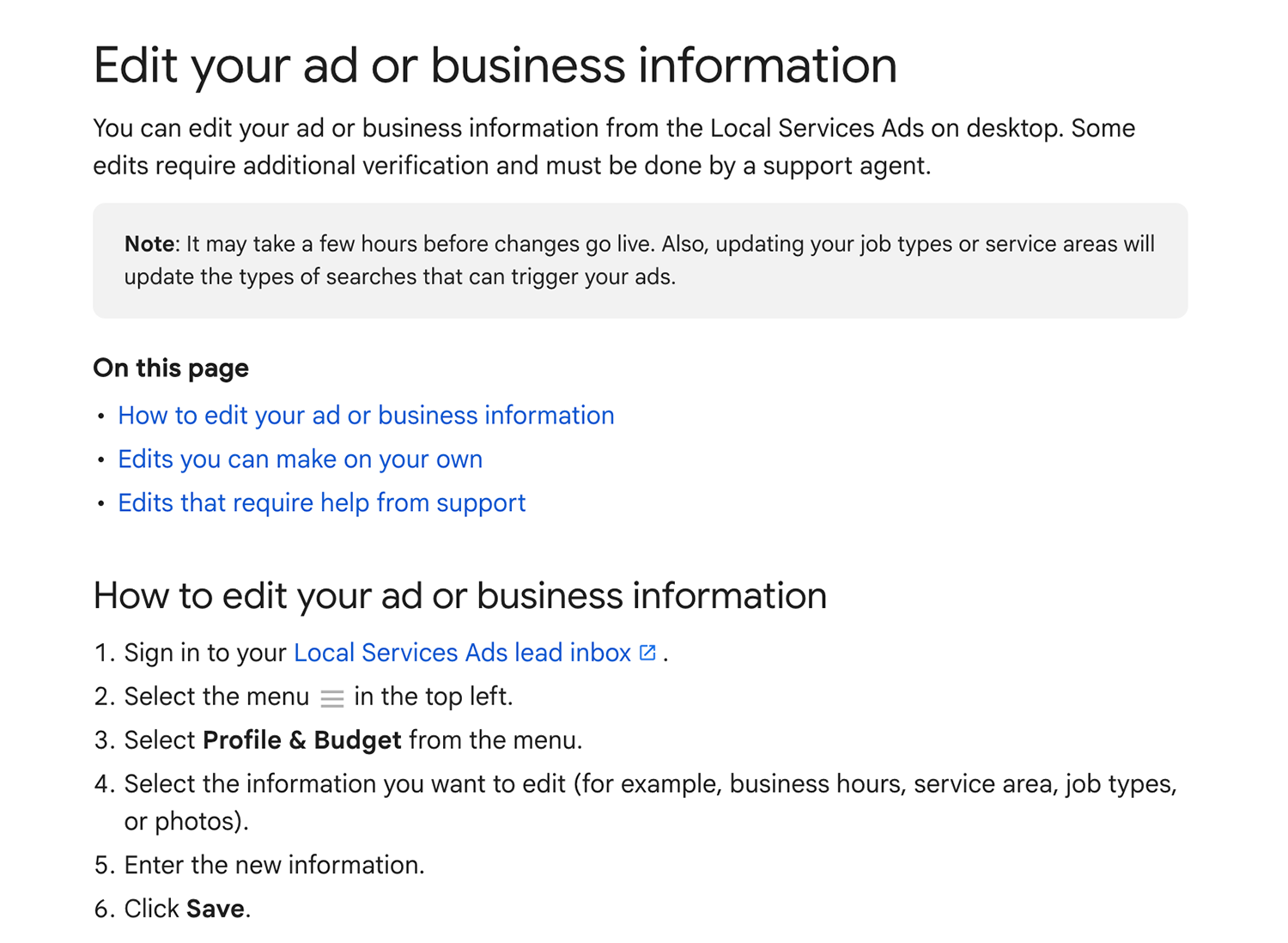
When users click on your ad, they’ll find your LSA profile. You can edit profile information at any time. This profile is different from your Google Business profile (another essential element of local search).
More detailed information is required for your LSA business profile. You’ll need to enter details about your firm and the people working in it. For instance, each legal professional working in your firm will need to be verified with their bar license information.
A complete profile includes the following information:
- Business name
- Phone number
- Website URL
- Owner’s name
- Year founded
- Languages spoken
- Business address
Established and multilingual firms can stand out from the competition by including the year they were founded and the languages spoken.
The next page is the “service area” setup page, where you provide information about the local service areas that you want to target (zip codes/cities). Multi-location firms should include details for every location.
Next, you’ll be prompted for more information about service types/practice areas:
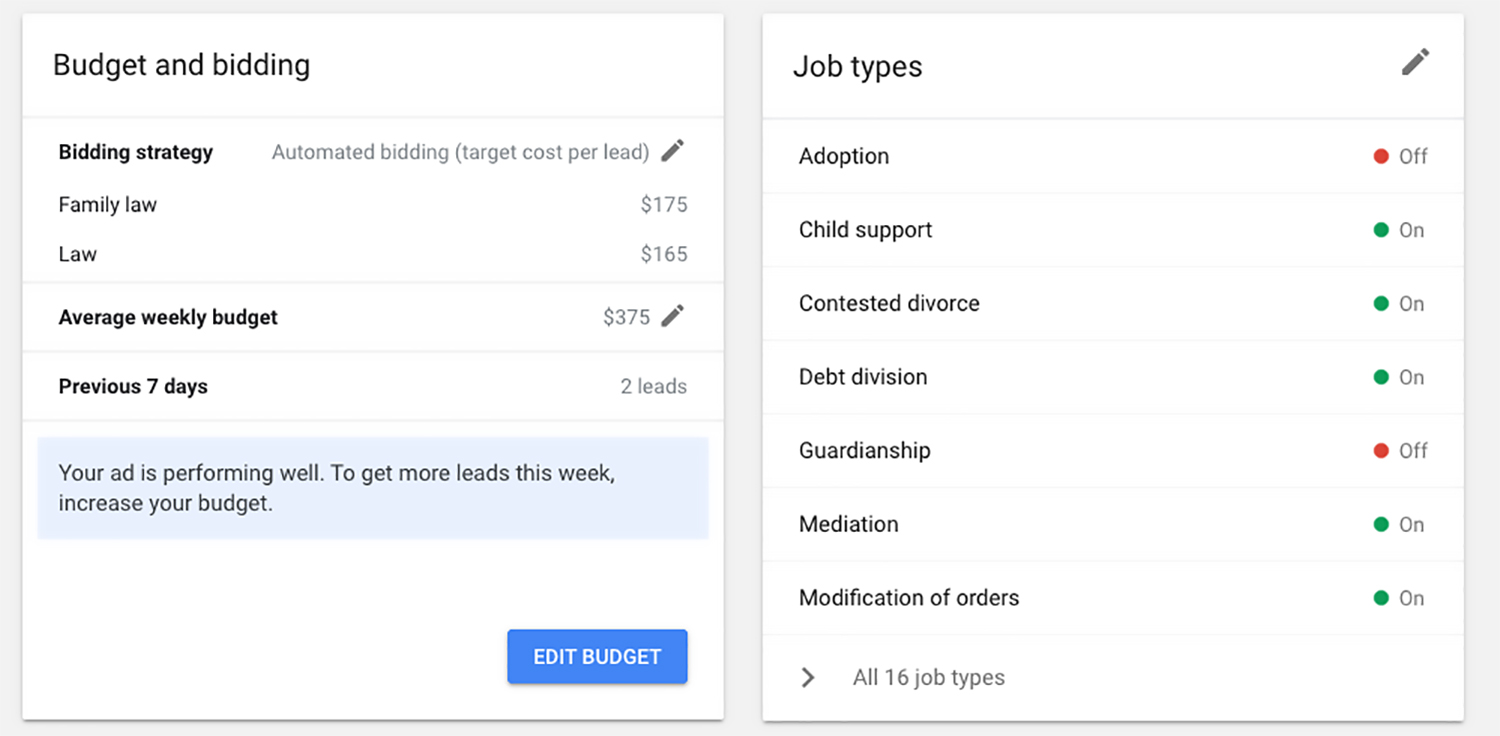
Finally, complete your business opening hours:
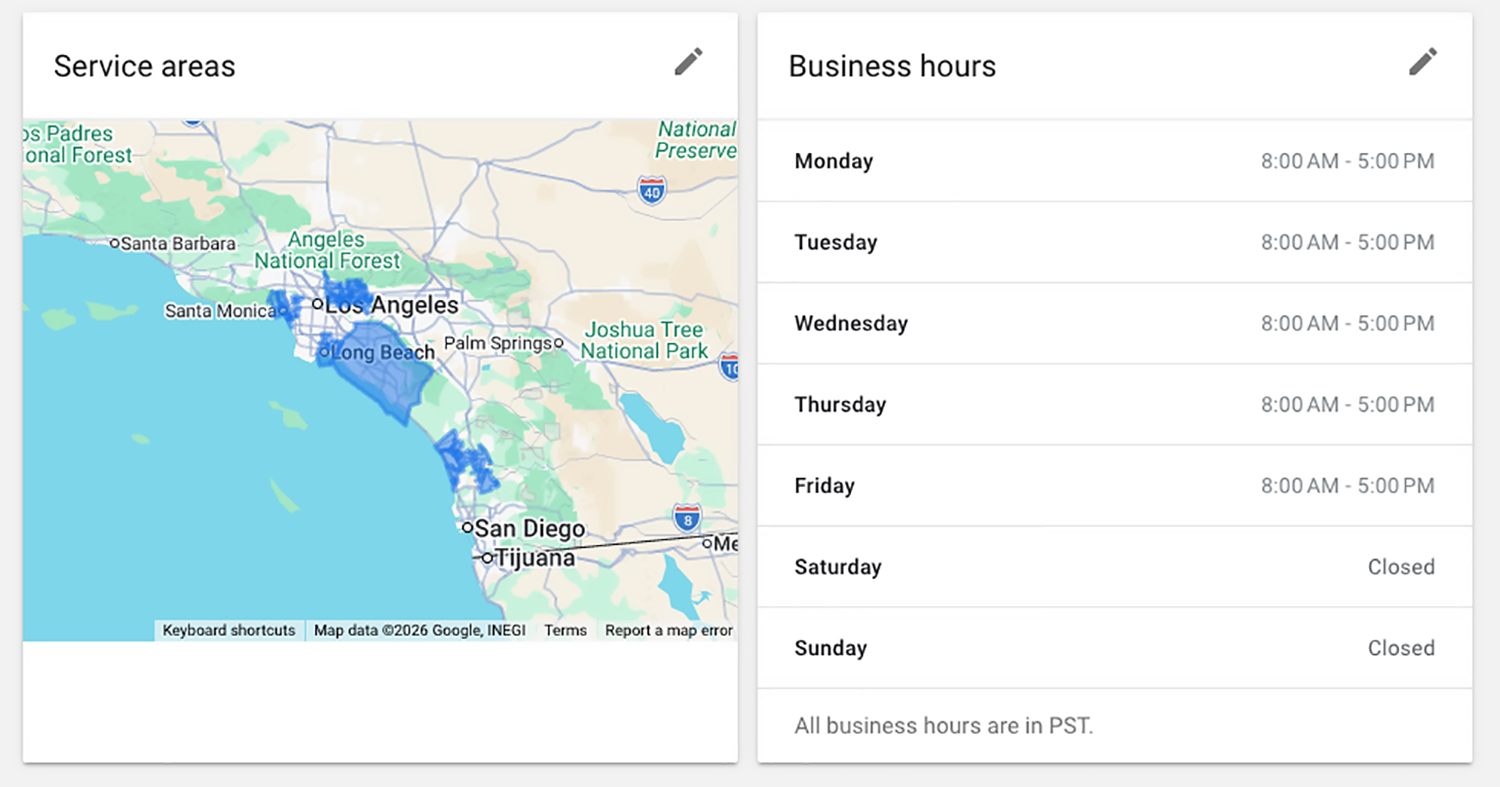
To optimize your profile, complete all sections, upload photos, and write compelling descriptions of your business. Also, maintain consistency with your NAP (Name, Address, Phone number) so that it aligns with your Google Business Profile and your other web properties.
4. Become Google Verified
Google Verified is essentially a free way to add an extra layer of credibility, authority, and trustworthiness to your firm’s online presence.
The Google Verified badge features prominently with a green tick on Local Service Ads, like this:
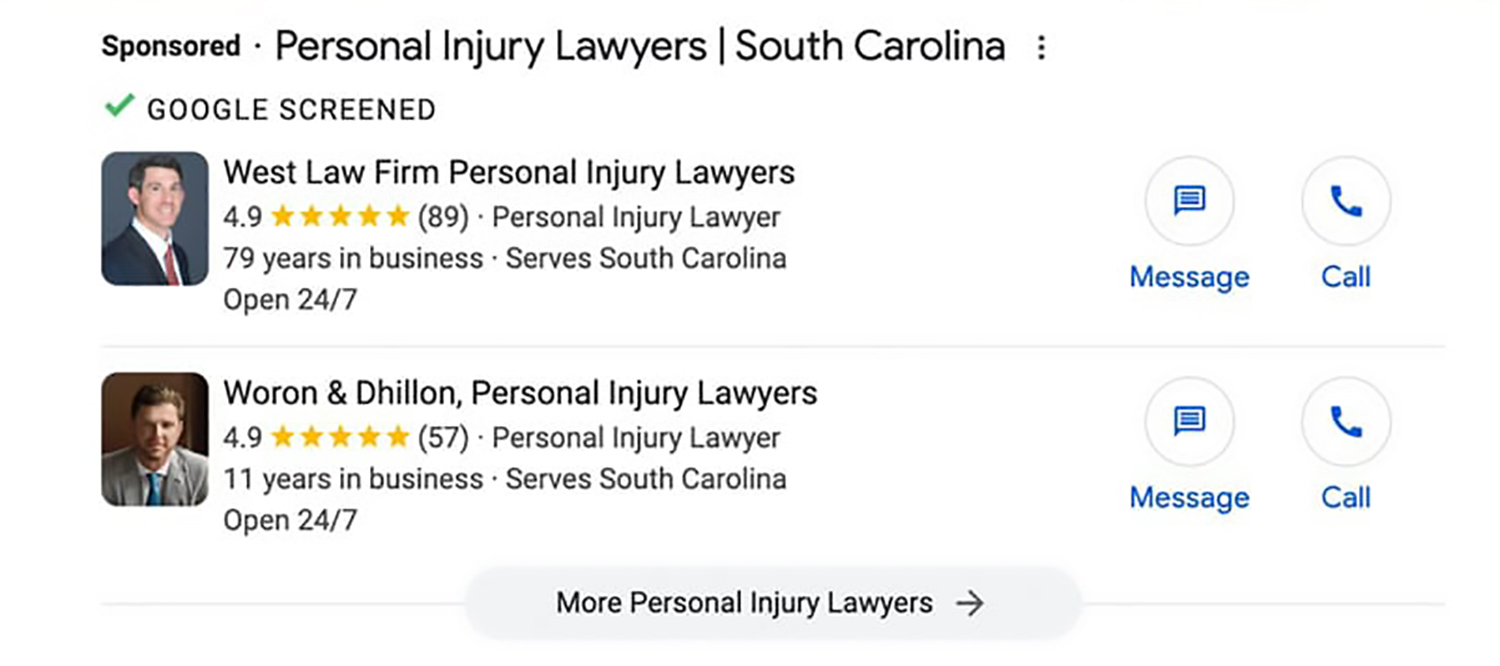
This is Google saying to local searchers that the business featured is vetted as a licensed law firm.
If you’re wondering, Google previously operated a system with multiple trust badges for LSAs, including Google Screened, Google Guaranteed, and License Verified badges, depending on business type. These were replaced with a single Google Verified badge in late 2025.
Searchers for legal services are viewed by Google as vulnerable, requiring protection from unscrupulous or unethical practices that can greatly impact lives. Expect a high bar of proof when Google verifies your business, and before you are eligible to run Local Service Ads.
How do you earn a Google Verified badge?
Existing advertisers who already met the prior requirements for Google Screened receive a Google Verified badge automatically without further action.
Law firms that intend to start using LSAs for the first time will need to earn a Google Verified badge. This is free but will take a minimum of 7-14 days to complete (larger firms with large teams of lawyers may take up to five weeks to fully verify).
Here’s how:
1. Verify licenses
Submit current bar licenses for all advertising attorneys. Manual reviews or third-party checks will match names and IDs.
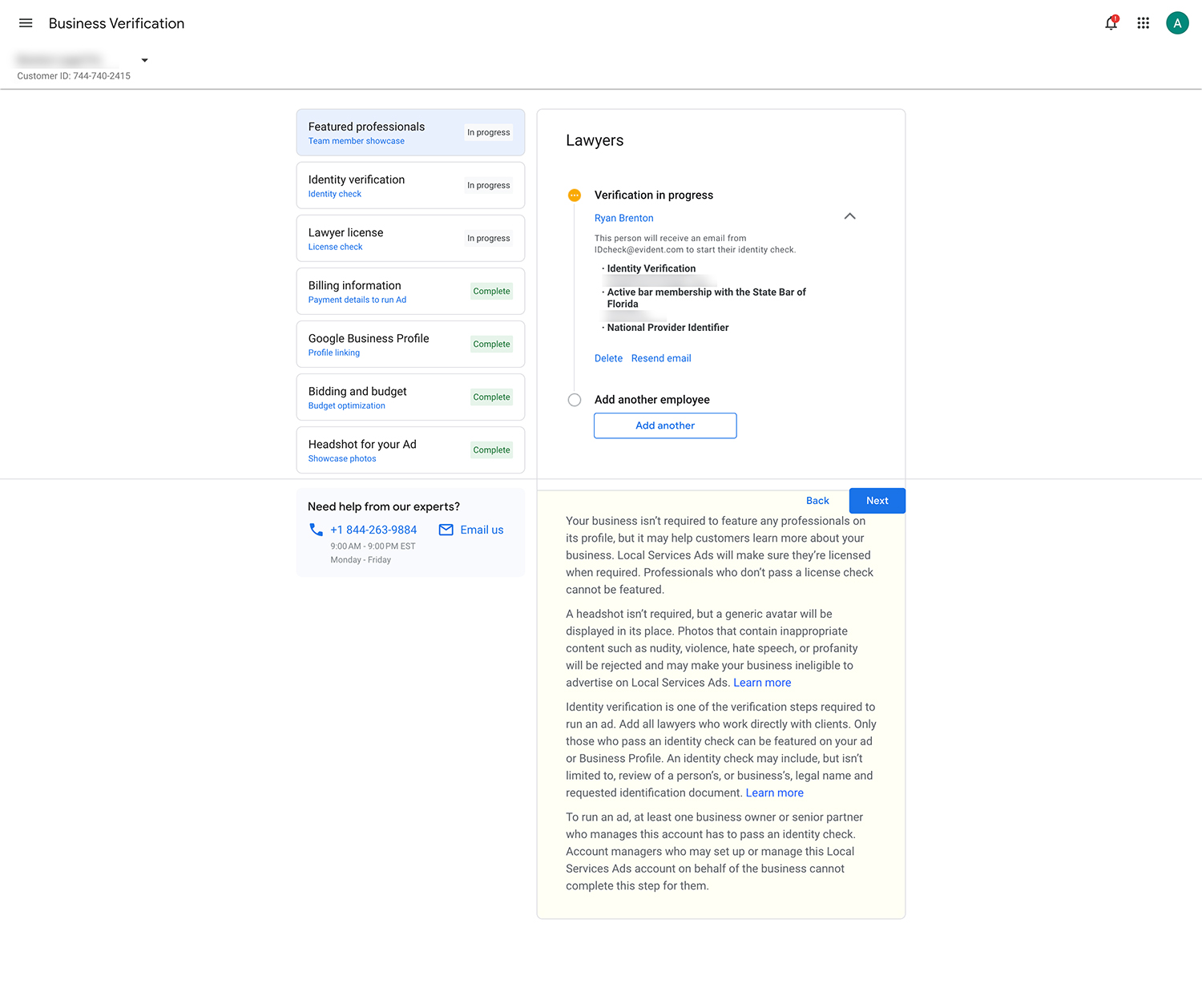
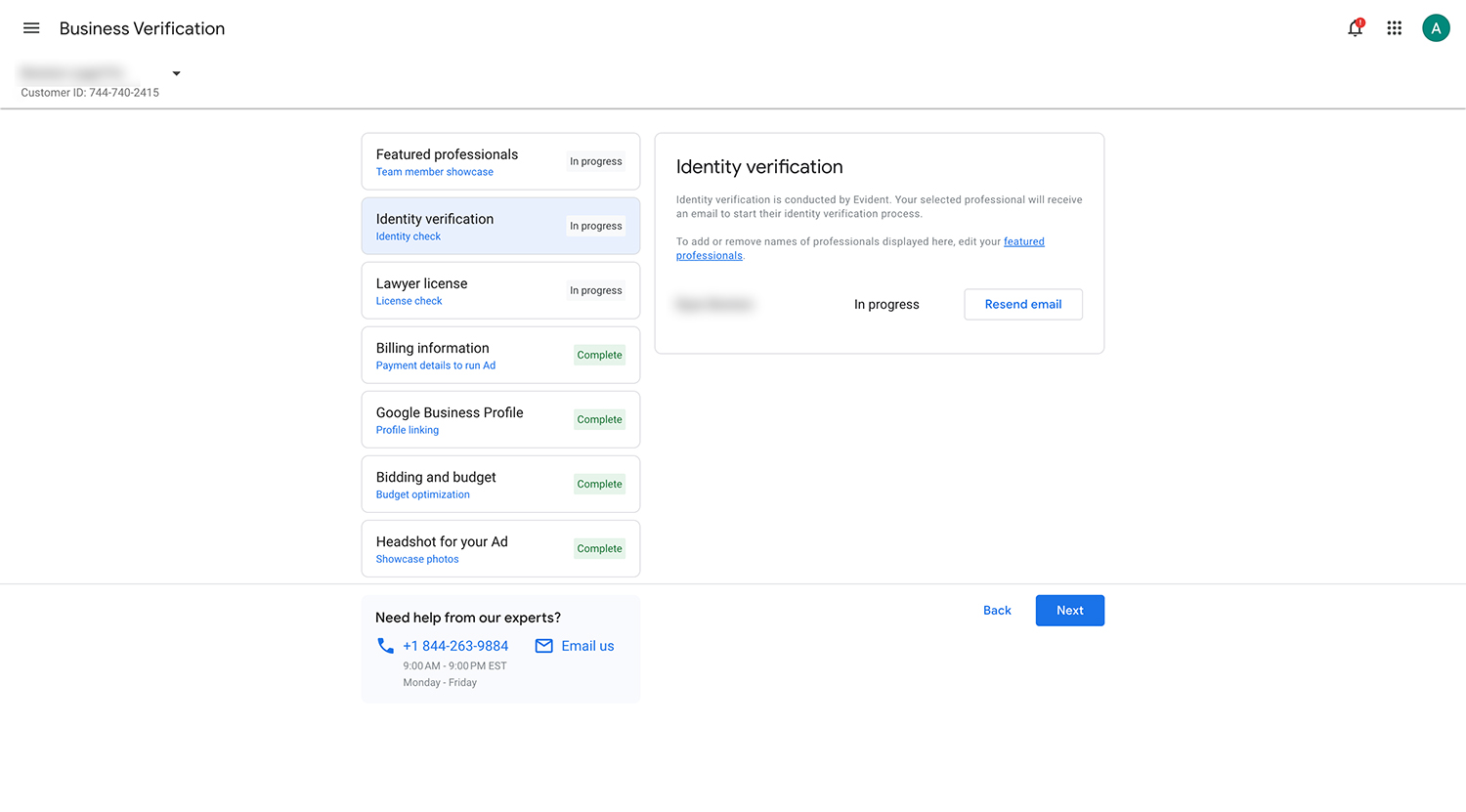
2. Confirm identity/ownership
Owners/partners must upload government ID and firms may need entity documents if not sole proprietors.
3. Provide insurance proof
Law firms require a Certificate of Liability Insurance (COI), often general liability or errors and omissions (E&O) with at least $1M coverage, valid for the next 30 days.
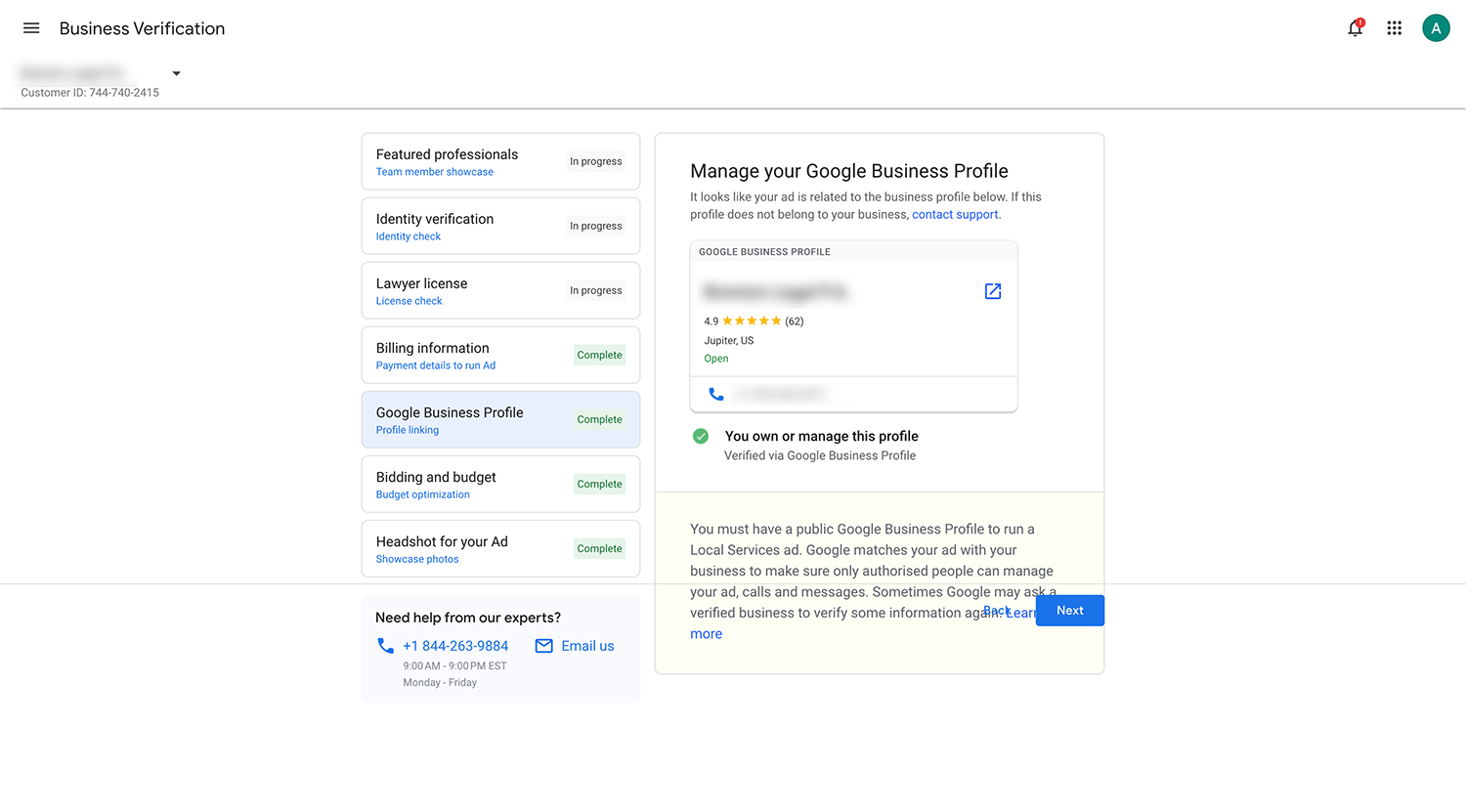
4. Include your Google Business Profile link
Law firms will need a valid Google Business Profile with verified NAP consistency.
5. Meet the review threshold.
Firms require a minimum of five positive reviews after launch before the badge will be displayed in full.
6. Set a realistic budget for leads
The profile information you enter in Step 2 will trigger a “suggested budget” from Google, weighing up the estimated cost per lead and the number of leads you’re targeting.
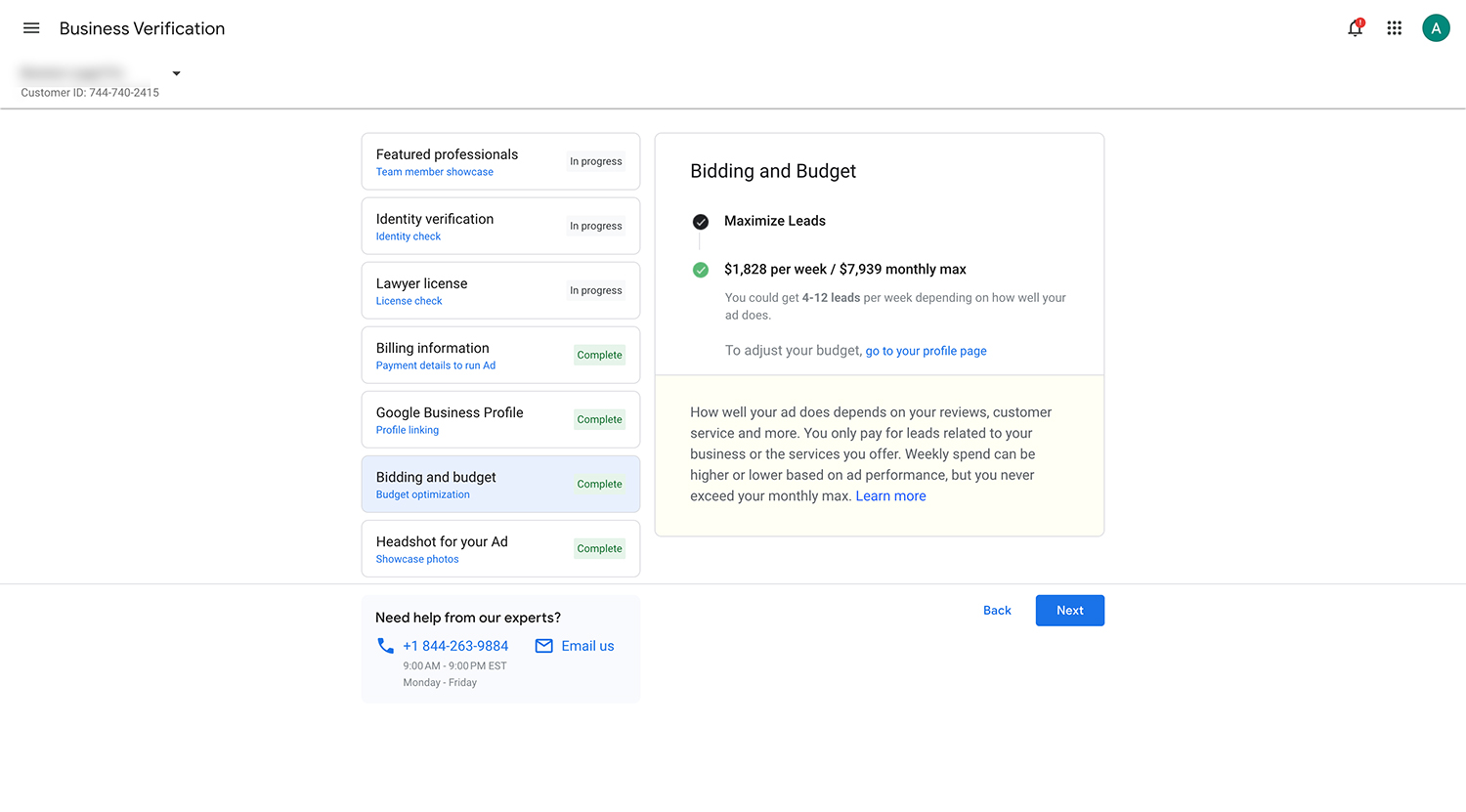
The suggested budget is just that: suggested. You can “customize” this using the sliding scale.
Law firm marketing budgets vary greatly between locations and practice areas. You can set a maximum/minimum budget and see the number of leads you can expect for your specified ad budget.
LSA budgets can vary from a few hundred dollars a month to several thousand or more.
With LSAs, you only pay for genuine leads. Billable leads are any valid customer interaction directly tied to your advertised services. This includes:
- Phone calls answered during business hours lasting over 30 seconds.
- Text messages received.
- Returned missed calls inquiring about relevant services.
- Bookings that occur within your service area and match your business profile.
Non-billable leads are:
- Leads outside your service area.
- Leads unrelated to your services.
- Leads from multi-business quote requests where all recipients are charged independently.
This is why it’s so important to set your services and service areas so precisely.
A realistic budget will depend on:
- Your location
- The level of competition
- Your firm’s capacity (“bandwidth”) to handle leads and convert them to new clients (see more about this in Step 8)
A good place to start is with a weekly cap at 5–10x your average lead cost. This way, you can test volume without overspending.
You can be quite detailed with calculations:
- Say you are targeting a monthly revenue of $10,000 from new leads, and the average job value is $5,000.
- You need 2 new clients per month.
- You convert 20% of leads into paying clients.
- You need 10 new leads from LSAs if that is your only ad spend.
So, what is a realistic budget to generate 10 new leads per month?
Will my Local Service Ad show up more if I set a higher budget?
When you set up LSAs, you set both a maximum cost per lead and a maximum weekly budget. If you set a high maximum bid per lead, you’re more likely to be visible for a certain period, while a low maximum budget makes your ad visible for a short time only.
It’s important to develop a bidding strategy that balances both settings and ensures your ad shows frequently, prominently, and consistently. Most firms leave this to LSA marketing professionals.
Remember, you can increase or decrease ad budgets at any time,
A comprehensive approach will:
- Review weekly spend data after 2–4 weeks.
- Assess ad spend and other key metrics.
- Resist a “set and forget” mindset.
- Pull back on low-quality zip codes.
- Scale up 20–50% only if conversion rates exceed 15–25% and you have the bandwidth to handle more leads.
- Scale up during “peak” legal season(s) for your practice area
6. Actively attract 5-star reviews
One of the golden rules with LSAs: Gather reviews early and often to boost ad priority and lower effective costs.
You need at least five positive reviews to be in the running to appear in the top three spots with Local Service Ads. But you should be aiming for many more than that. Your star ratings and review count visibly improve your position.
Reviews are one of the most important “EEAT signals” for Google: Your firm should be taking every opportunity to demonstrate:
- Experience
- Expertise
- Authoritativeness
- Trustworthiness.
This will help your firm remain high profile in ads, organic search results, and in AI overviews/Q&A sessions.
Here’s what you need to do to attract more positive reviews:
- Enable a formal review-gathering process in your practice, rather than an ad hoc system.
- Use the in-built triggers for LSA lead management: when you mark leads as “booked” or “job completed” in the LSA dashboard, Google will send an automated review request via email or SMS to the client.
- Respond promptly to feedback to encourage positive public reviews while showing Google a high engagement level.
- Send personalized thank-you texts or emails 1–2 days after the case is completed, with a direct link to your LSA or Google Business Profile review form.
The last word on reviews: Reviews contribute at least 25% to your ad visibility. Make them part of a natural process and follow the advertising rules for lawyers, which impose some restrictions on the review-gathering process.
7. Optimize your LSA campaign to feature in the Top 3 ads
If you’re outside the top three LSA positions for relevant local searches, you’re included in the “more *practice area* lawyers” section, which is far less prominent.
The Top 3 is usually highly competitive for law firms, with multiple firms in the local area jockeying for position. To improve your chances, you’ve already taken the first step by reading this article. But more is needed.
Google LSAs operate with an auction-based ranking system. This prioritizes three main factors:
- Bid competitiveness: Higher bids on leads directly boost ad visibility (LSAs use a pay-per-bid auction) but a higher budget doesn’t necessarily guarantee rank.
- Proximity to the searcher: Optimize your service area tightly around high-demand zones where you’re closest.
- Performance signals: Gather large numbers of positive reviews (see previous step), keep lead disputes to a minimum, and prioritize response times for a high “responsiveness score”.
Google will also factor in the following when ranking ads:
- The search context (specific terms, time of day, etc.)
- Your Google Business Profile review score.
- Your business hours.
8. Train your team on LSA lead handling
There’s little point in optimizing LSA campaigns to generate more local leads if your firm cannot handle the extra calls, text messages, and clients.
In other words, if your law firm marketing strategy has done its job, you must ensure that the intake process works effectively.
LSA leads often “behave” differently from typical website, SEO, or PPC leads. You also need to be highly responsive to calls and texts, and ensure that you pay only for verified leads.
So, your team may need guidelines, training, or direction on:
- How to identify LSA leads.
- Who should answer LSA calls (attorney versus specialized intake staff)?
- Unique scripts/responses for high-intent callers.
- Best practices for lead answer speeds (more about this in the next section).
- The consequences of missing leads.
- What counts as a billable lead?
- How to identify unqualified leads (to avoid paying for calls that aren’t actual leads).
- Tagging and tracking signed cases back to LSAs in CRM software (an indication of the real ROI, rather than just cost-per-lead).
- Handling disputes with Google over leads (more about this in the next section).
90% of LSA leads are phone calls but don’t neglect text message leads, as they may convert even better than phone calls.
Ethical & advertising compliance
Google handles the actual ad design and copy for Local Service Ads. However, state or provincial bar advertising rules must be complied with when providing the information to Google.
Staff should be aware of the potential need for:
- Legal disclaimers (if applicable).
- Call recording disclosures.
- Proper use of the terms “specialist” and “expert” in descriptions.
- Rules about handling sensitive case information
9. Improve lead response times and dispute-handling processes
Two critical areas of LSA campaign performance involve your lead responsiveness and dispute handling. Ideally, you want a high responsiveness score and a low number of lead disputes.
Response times
Law firms are not generally known for their rapid response to inquiries from potential new clients. Average law firm response times are 24-48 hours (if they respond at all).
That needs to change if you want to be successful in the competitive world of Local Service Ads.
Organizations responding to leads within one minute achieve 391% higher conversion rates compared to those waiting 30 minutes or more.
Research also shows that:
- 78% of customers choose the first responder.
- 74% of clients hire the first attorney they speak with.
- Conversion rates drop by 50% when response time increases from 5 to 10 minutes.
Remember, too, that with LSAs, your responsiveness score is a ranking factor for your ads.
First, get familiar with the Local Services Ads lead reporting dashboard, as it tells you a lot of important information about the leads you receive. It looks like this:
What should you be aiming for with your lead responsiveness?
- It’s simply good practice, regardless of Local Service Ads, to follow up promptly with a b lead.
- At a minimum, target same-day responses as standard practice for leads.
- Aim for a system that supports 1-5-minute responses.
- Follow up with leads on the LSA platform: reply to messages by email/text, call the lead back, or decline it (declined leads may still be chargeable, remember.)
Handling disputes
Disputes may occur over some leads, and it’s easy enough to dispute a lead. Try to reduce the number of manual disputes, which could count against you.
No firm wants to pay for irrelevant leads but high manual dispute rates can negatively impact your LSA account health. It signals poor lead qualification or service mismatches. Google views this as problematic.and may reduce ad visibility or issue warnings.
Here’s what Google says about disputing leads.
Valid reasons for disputing a lead:
- Job not served (not on your profile)
- Location not served (zip code or city)
- Wrong number or sales call (not a customer)
- Spam or bot (not a human)
- Duplicate lead (customer contacted you twice)
- Incorrect business (lead does not belong to you)
If you dispute a lead, a message will appear at the top of the lead in the dashboard to let you know if your dispute was approved or not.
To prevent too many lead disputes, law firms should optimize service areas and job types upfront.
The good news is that Google now uses automated crediting for invalid leads, placing some in an In Review status before final determination.
Google provides regular reports that break down the charges:
Your team should review these reports, as well as call recordings, regularly to:
- Identify bad leads vs. bad intake.
- Reduce the number of disputes.
- Improve dispute success.
- Spot conversion issues.
- Improve responsiveness metrics.
This can help optimize campaigns and prevent unnecessary charges.
The most common mistakes that lawyers make with Local Service Ads are:
- Turning ads off too quickly or too often.
- Never disputing leads.
- Over-disputing leads.
- Ignoring review recency.
- Not having efficient lead response and intake processes (which damages responsiveness scores).
- Not keeping a good handle on the key metrics: new lead numbers, converted leads, inactive leads, lead locations, contact method, cost per lead, cost per conversion, etc.
There’s a good chance your competitors aren’t using Local Service Ads, as only an estimated 30 to 40% of law firms in eligible markets currently use LSAs in North America.
Mastering LSAs takes some know-how, experience, and management but the results are worth it. Small firms can compete with larger firms and save up to two-thirds of their ad spend when compared with traditional Google Ad campaigns.
Most law firms don’t have the necessary resources in-house to manage ad campaigns. That’s where we come in, providing full management for Local Service Ads/PPC campaigns and combining these strategies with law firm SEO to make firms highly visible.
Get in touch with Inbound Legal to start getting more from your ad spend.